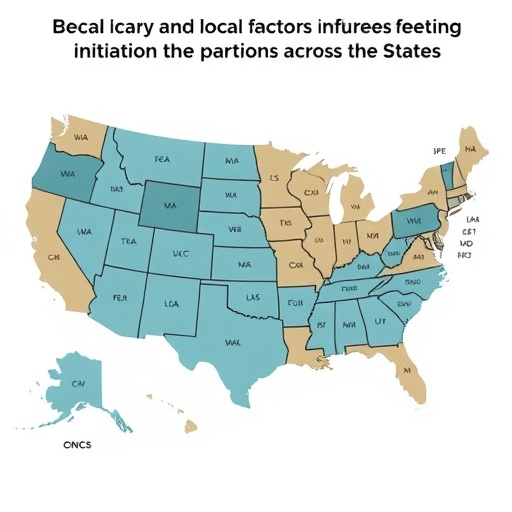
New county-level analysis is adding urgency to efforts aimed at boosting breastfeeding initiation in the United States. In a paper published July 15, 2026 in the open-access journal PLOS Global Public Health, Tony Grubesic of the University of California Riverside and colleagues combine large-scale surveillance data with advanced spatial statistics to map where breastfeeding initiation rises—or stalls.
Breastfeeding is promoted for both infants and mothers, and national targets such as Healthy People 2030 are designed to raise initiation and persistence. Yet county estimates from 2018–2019 show striking variation: initiation ranged from roughly 22% to well above 90%. Such uneven geography suggests that a single national narrative can hide the local realities that shape maternal choices and access.
Using county-level initiation data for infants born in 2018 and 2019 (covering about 95.8% of U.S. counties), the researchers apply a multiscale geographically weighted regression (MGWR) framework. Unlike conventional linear models, MGWR allows different factors to operate at different spatial scales, improving sensitivity to neighborhood-level heterogeneity.
The results reveal both broad, consistent regional trends and highly localized patterns. Rates were generally higher in the Northeast and along the West Coast, while lower initiation clustered in parts of the Gulf Coast and regions of Appalachia. These gradients align with earlier findings but are refined through the model’s ability to capture local departures from the national mean.
Some influences proved “sticky” across geography, meaning they mattered regardless of where counties were located. Education and race-related patterns showed relatively stable associations, reinforcing their role as structural drivers. However, other determinants varied substantially by place rather than acting uniformly.
One example is the relationship between the share of female-headed households with children and breastfeeding initiation. The association is spatially heterogeneous: in some regions it is stronger, more negative, and localized. Statistically significant negative patterns emerged in areas including parts of the Upper Midwest, the Mississippi Delta, Appalachia, and eastern North Carolina.
The study also highlights context-dependent demographic links. While breastfeeding initiation showed a positive association with Hispanic populations overall, the pattern was primarily concentrated in the eastern U.S., not the West or Southwest where Hispanic populations are larger—underscoring that population size alone does not predict outcomes.
The authors interpret these findings as a call for targeted, locally designed interventions rather than one-size-fits-all policies. They point to three cost-effective, evidence-backed strategies: increasing access to lactation consultants in hospitals, expanding peer-to-peer support groups such as La Leche League, and widening WIC eligibility by removing income restrictions for mothers seeking breastfeeding support.
Finally, the work argues that advanced spatial modeling can outperform traditional methods when public health decisions depend on where disparities concentrate. By pinpointing localized structural barriers, the analysis aims to give officials a more precise, data-driven roadmap for improving initiation.
Subject of Research: People
Article Title: Spatial inequalities in breastfeeding initiation in the United States: A multiscale analysis of county-level determinants
News Publication Date: 15-Jul-2026
Web References: https://doi.org/10.1371/journal.pgph.0005659
References: Grubesic TH, Kang W, Durbin KM, Helderop E (2026) Spatial inequalities in breastfeeding initiation in the United States: A multiscale analysis of county-level determinants. PLOS Glob Public Health 6(7): e0005659.
Image Credits: Grubesic et al., 2026, PLOS Global Public Health, CC-BY 4.0
Keywords: breastfeeding initiation, spatial inequalities, multiscale geographically weighted regression, county-level determinants, public health interventions, structural barriers, WIC, lactation support, peer counseling, maternal health disparities
Tags: Breastfeeding initiation disparities in the United Statescounty-level spatial analysis of breastfeeding ratesgeographic determinants of infant feeding decisionsimpact of local socioeconomic factors on breastfeedinginfluence of geographical and local factors on maternal health behaviorsmapping breastfeeding initiation across US countiesmultiscale geographically weighted regression in public healthregional public health strategies for breastfeeding promotionregional variations in breastfeeding practicesspatial heterogeneity in breastfeeding initiationspatial statistics in maternal health research