

• HOME
  • NEWS
  • EXPLORE
    • CAREER
      • Companies
      • Jobs
    • EVENTS
    • iGEM
      • News
      • Team
    • PHOTOS
    • VIDEO
    • WIKI
  • BLOG
  • COMMUNITY
    • FACEBOOK
    • INSTAGRAM
    • TWITTER
Sunday, August 30, 2026
BIOENGINEER.ORG
No Result
View All Result
  • Login
  • HOME
  • NEWS
  • EXPLORE
    • CAREER
      • Companies
      • Jobs
        • Lecturer
        • PhD Studentship
        • Postdoc
        • Research Assistant
    • EVENTS
    • iGEM
      • News
      • Team
    • PHOTOS
    • VIDEO
    • WIKI
  • BLOG
  • COMMUNITY
    • FACEBOOK
    • INSTAGRAM
    • TWITTER
  • HOME
  • NEWS
  • EXPLORE
    • CAREER
      • Companies
      • Jobs
        • Lecturer
        • PhD Studentship
        • Postdoc
        • Research Assistant
    • EVENTS
    • iGEM
      • News
      • Team
    • PHOTOS
    • VIDEO
    • WIKI
  • BLOG
  • COMMUNITY
    • FACEBOOK
    • INSTAGRAM
    • TWITTER
No Result
View All Result
Bioengineer.org
No Result
View All Result
Home NEWS Science News Biology

Saitama researchers find metal ions toggle peptide aptamer between two proteins

Bioengineer by Bioengineer
July 16, 2026
in Biology
Reading Time: 2 mins read
0
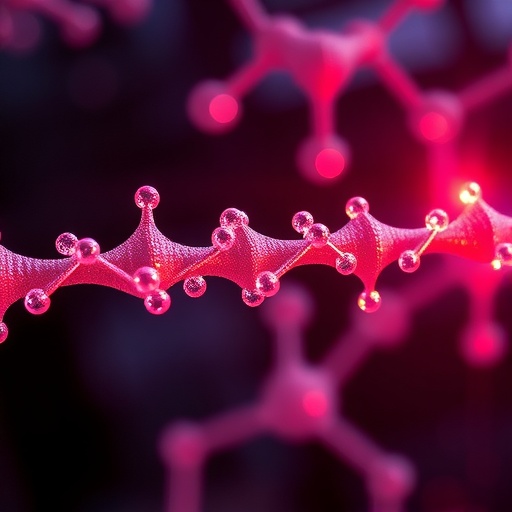
Saitama researchers find metal ions toggle peptide aptamer between two proteins
Share on FacebookShare on TwitterShare on LinkedinShare on RedditShare on Telegram

In biological systems, proteins communicate by locking onto specific molecular partners with high precision. For decades, scientists have tried to replicate this selectivity using short peptides, which can act as compact recognition elements for diagnostics and drug discovery. Yet an unanswered question has been how small peptides can recognize different targets when the chemical environment changes.

A new study from Saitama University investigates a calmodulin-binding peptide (CBP) derived from skeletal muscle myosin light chain kinase. CBP is already known for attaching to calmodulin when calcium ions are present, linking it to processes such as muscle contraction, neurotransmission, and cell-cycle control. The surprise is that the same peptide can behave differently toward another protein—human midkine.

Midkine is expressed at low levels in healthy adult tissues but is elevated in many cancers, making it a promising biomarker and therapeutic target. To test whether CBP might recognize midkine, researchers compared the binding behavior of wild-type CBP with a single–amino acid mutant across multiple proteins, including bovine serum albumin, GFP, and immunoglobulin G.

Using surface plasmon resonance, the team measured real-time interactions and found that CBP binds human midkine specifically in the presence of sodium ions. Under those conditions, the peptide’s affinity shifts away from calmodulin-like recognition and toward midkine, despite the two proteins being structurally unrelated.

To understand how ions reshape molecular recognition, the researchers employed AlphaFold 3 for structural prediction. Their modeling suggests that metal ions can alter the binding interface and the preferred interaction mode between the peptide and its target, effectively rewiring contact geometry at the molecular level.

Taken together, the results support a broader concept: naturally derived peptides can function as “peptide aptamers” that switch targets depending on the surrounding ion composition. This adaptability could offer an engineered route to environment-responsive biosensors and therapeutic targeting tools.

The work was published online in Biochemical and Biophysical Research Communications on July 8, 2026. In a key takeaway, the authors emphasize that a single short peptide can recognize structurally distinct proteins through ion-dependent molecular switching.

Subject of Research: Not applicable
Article Title: Calmodulin-binding peptide is a natural peptide aptamer that binds to human midkine in a metal ion–dependent manner
News Publication Date: 8-Jul-2026
Web References: https://doi.org/10.1016/j.bbrc.2026.154256
References: 10.1016/j.bbrc.2026.154256
Image Credits: Koji Matsuoka from Saitama University
Keywords: calmodulin-binding peptide; metal-ion dependent binding; sodium ions; calmodulin; midkine; surface plasmon resonance; AlphaFold 3; peptide aptamer; biosensor; cancer biomarker

Tags: calcium ion role in protein interactionscalmodulin-binding peptidesmetal ion influence on protein bindingmolecular mechanisms of protein target switchingmolecular recognition in biological systemspeptide aptamerspeptide engineering for drug discoverypeptide recognition of midkine in cancer biomarkerspeptide specificity and selectivityprotein conformational changes induced by metal ionsProtein-peptide interactionssurface plasmon resonance in biomolecular studies

Share12Tweet7Share2ShareShareShare1

Related Posts

How captivity experiences shape Picasso triggerfish behavior and cognition

How captivity experiences shape Picasso triggerfish behavior and cognition

August 30, 2026
Fertility benefits may explain why harmful disease genes persist in humans

Fertility benefits may explain why harmful disease genes persist in humans

August 30, 2026

New atlas reveals mesenchymal diversity in human gut and organoids

August 30, 2026

New spatial transcriptomics method maps RNA isoforms across primate brain cells

August 30, 2026

POPULAR NEWS

  • How captivity experiences shape Picasso triggerfish behavior and cognition

    29 shares
    Share 12 Tweet 7
  • Untangling chromosomal and hormonal effects to make sex-specific endothelial OCT4 clinically actionable

    29 shares
    Share 12 Tweet 7
  • Waldenström’s macroglobulinemia in siblings: 25 years of institutional cases reviewed

    29 shares
    Share 12 Tweet 7
  • Disrupting CDK4/6–RARα–NF-κB axis eases senescence inflammation, improving aging and chemotherapy recovery

    29 shares
    Share 12 Tweet 7

About

We bring you the latest biotechnology news from best research centers and universities around the world. Check our website.

Follow us

Recent News

How captivity experiences shape Picasso triggerfish behavior and cognition

Untangling chromosomal and hormonal effects to make sex-specific endothelial OCT4 clinically actionable

Waldenström’s macroglobulinemia in siblings: 25 years of institutional cases reviewed

Subscribe to Blog via Email

Enter your email address to subscribe to this blog and receive notifications of new posts by email.

Join 85 other subscribers
  • Contact Us

Bioengineer.org © Copyright 2023 All Rights Reserved.

Welcome Back!

Login to your account below

Forgotten Password?

Retrieve your password

Please enter your username or email address to reset your password.

Log In
No Result
View All Result
  • Homepages
    • Home Page 1
    • Home Page 2
  • News
  • National
  • Business
  • Health
  • Lifestyle
  • Science

Bioengineer.org © Copyright 2023 All Rights Reserved.