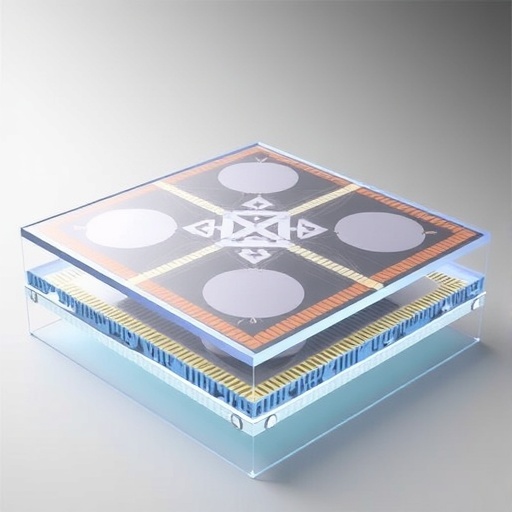
In a groundbreaking advancement for wearable technology and flexible electronics, researchers have unveiled a novel graded-modulus tri-layer substrate designed to dramatically improve the fabrication of integrated stretchable systems. This innovation addresses one of the most persistent challenges in flexible electronics: managing mechanical stress during manufacturing while maintaining device performance.
Traditional substrates used for stretchable electronics often suffer from mechanical fatigue and failure due to the abrupt changes in stiffness between different materials. These mismatched mechanical properties induce stress concentrations, ultimately compromising the durability and reliability of the devices. The new tri-layer substrate offers a graded modulus design, where the elastic properties gradually transition across layers, effectively mitigating these stress points.
The research team achieved this by engineering a three-layered structure with progressively tuned stiffness—from a soft, compliant outer layer, through an intermediate gradient, to a stiffer base layer. This precise modulation in mechanical properties allows the substrate to absorb and distribute strain more evenly, reducing the risk of cracking or delamination during stretching cycles.
What distinguishes this work is the direct fabrication technique enabled by the graded-modulus substrate. Unlike conventional methods requiring complex transfer printing or additional protective layers, this substrate allows integrated circuits and components to be directly printed or deposited onto the stretchable platform. This simplification not only accelerates manufacturing but also enhances scalability for commercial applications.
Moreover, the graded substrate’s design is compatible with a broad spectrum of electronic materials, including conductive inks, semiconductors, and insulating polymers. This versatility paves the way for creating multifunctional integrated systems that can be robustly stretched, twisted, or bent without performance degradation—a critical advancement for next-generation flexible displays, bioelectronics, and soft robotics.
The tri-layer approach also shows promise in improving the longevity of wearable sensors, which must endure repeated mechanical deformation while maintaining consistent signal quality. By minimizing interfacial stress, the substrate prolongs device lifespan and reliability in real-world conditions, where durability is paramount.
From a materials science perspective, this work exemplifies how finely tuned mechanical gradients can unlock new design paradigms in flexible electronics. It highlights the importance of interdisciplinary approaches combining polymer chemistry, mechanical engineering, and microfabrication techniques to solve longstanding challenges.
As the wearable tech market continues its explosive growth, innovations like this graded-modulus substrate could be pivotal in bringing sophisticated, stretchable systems from the lab to everyday consumer use. This development not only elevates manufacturing efficiency but also enhances device robustness, potentially transforming how electronics interact with the human body and environment.
The study underscores a significant leap towards fully integrated, mechanically resilient flexible electronics, marking a major milestone in the future of human-machine interfaces and soft, implantable devices.
Subject of Research: Development of graded-modulus tri-layer substrates for integrated stretchable electronic systems fabrication.
Article Title: Graded-modulus tri-layer substrates for stress-relieved direct fabrication of integrated stretchable systems.
Article References:
Yamakoshi, S., Nakamura, F., Sato, S. et al. Graded-modulus tri-layer substrates for stress-relieved direct fabrication of integrated stretchable systems. npj Flex Electron (2026). https://doi.org/10.1038/s41528-026-00617-6
Image Credits: AI Generated
Tags: advanced manufacturing of flexible electronicscrack and delamination prevention in stretchable devicesdirect fabrication techniques for flexible electronicsdurable stretchable integrated systemsgraded modulus tri-layer materialsgradient stiffness design in flexible electronicsinnovation in wearable technology substrateslayered composite substrates for stretchabilitymechanical stress management in wearable devicesstrain distribution in multi-layer substratesstress-free fabrication of flexible electronicsstretchable electronic substrates