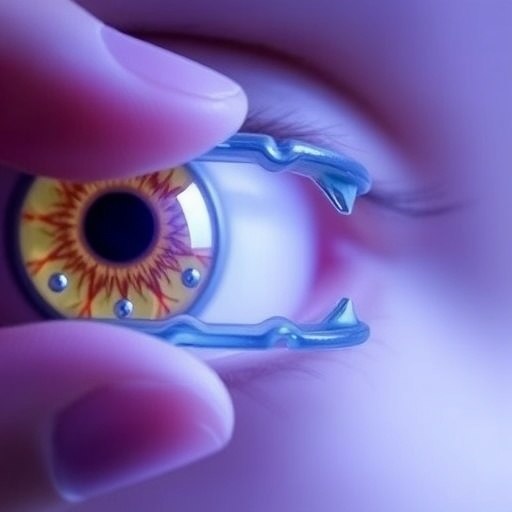
Researchers at the University of Waterloo have pioneered a revolutionary advancement in contact lens technology by combining cutting-edge 3D printing with innovative silicone chemistry. This breakthrough allows for the rapid production of patient-specific hard contact lenses, tailored to fit each individual’s unique ocular topography in under 20 minutes. The innovation promises to redefine the process of fitting lenses, making personalized vision correction achievable within a single optometrist visit.
Traditional contact lenses come in a limited array of standard sizes and curvatures, often requiring multiple fittings over weeks or months, especially for patients with irregular corneal shapes who depend on rigid lenses for clear vision. Addressing this challenge, the Waterloo research team developed a digital fabrication platform that integrates custom lens design software with a newly formulated silicone material optimized for vat photopolymerization 3D printing.
Silicone’s biocompatibility and superior oxygen permeability make it an ideal material for contact lenses. However, conventional silicones present significant challenges for additive manufacturing processes, which usually require materials with specific photopolymerizable properties. The team’s novel hydrophilic silicone formulation overcomes these limitations, maintaining essential lens properties such as transparency, mechanical robustness, and comfort while being compatible with high-resolution 3D printing.
One of the key technological hurdles was mitigating the “stair-step” effect—minute surface irregularities inherent in layer-by-layer printing—that could degrade visual clarity and wearer comfort. To solve this, researchers implemented an ultra-thin non-contact fluidization coating technique that smoothes the lens surface without altering its customized shape or optical performance, ensuring a flawless finish crucial for vision quality.
The digital platform’s software precisely maps the patient’s corneal geometry, designing an inner lens surface that conforms perfectly, while the outer surface is engineered to provide the desired vision correction. This customization translates to lenses that fit comfortably and correct vision effectively from the first try, a significant leap forward compared to traditional fitting methods.
Preliminary laboratory testing established the biocompatibility of these lenses, with plans underway for in vivo studies to further validate safety and efficacy. The team has secured a provisional patent for the innovative hydrophilic silicone material and is preparing a full patent application, signaling strong commercial potential.
Collaborations with the Centre for Vision and Eye Research, a joint initiative between the University of Waterloo and Hong Kong Polytechnic University, are propelling this technology closer to clinical application. The project recently earned a Gold Medal at the 2026 Shanghai International Exhibition of Inventions, underscoring its global impact and innovation.
This development exemplifies how advanced materials science and precision 3D printing are converging to revolutionize healthcare devices. By enabling rapid production of highly customized, comfortable, and effective hard contact lenses, this breakthrough could transform vision care, substantially improving patient experiences and outcomes.
Subject of Research: Customized hard contact lenses, 3D printing, silicone materials, additive manufacturing
Article Title: Patient-specific hard contact lenses fabricated by vat photopolymerization printing and non-contact fluidization coating
News Publication Date: June 2026
Web References: https://www.sciencedirect.com/science/article/pii/S0264127526010567
Image Credits: Jay Mielke/University of Waterloo
Keywords
Optometry, Additive manufacturing, Chemistry, Contact lenses, 3D printing, Silicone materials, Vision correction
Tags: 3D-printed contact lensesadvancements in optical device customizationbiocompatible silicone materials for ocular usedigital fabrication of custom contact lensesfast fitting process for irregular corneashigh-resolution 3D printing of contact lensesinnovative silicone chemistry in ophthalmologypatient-specific rigid contact lensesrapid personalized lens fabricationsilicone-based 3D printing for vision correctionsustainable and efficient contact lens productionvat photopolymerization in lens manufacturing