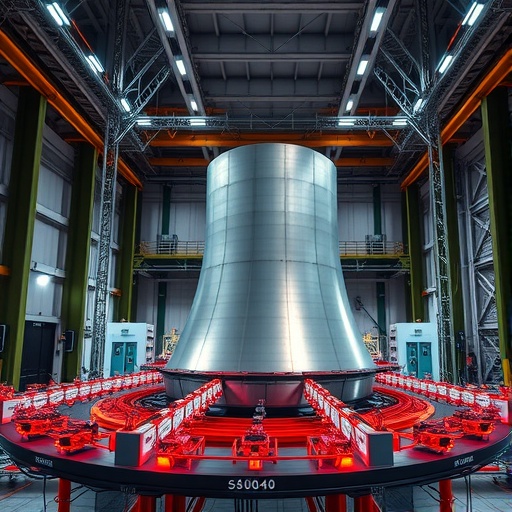
For the first time, a team of researchers from Idaho National Laboratory (INL), Purdue University, and the University of Illinois Urbana-Champaign has successfully demonstrated the remote, real-time autonomous control of a nuclear research reactor. Utilizing a geographically distributed system, the group adjusted the power of Purdue’s PUR1 reactor remotely, all while maintaining the reactor’s inherent safety protocols. This milestone represents a pivotal step toward integrating advanced computational models and artificial intelligence into nuclear reactor operation.
The experiment hinged on a digital control loop that automatically fine-tuned the power output of the PUR1 reactor. Researchers enhanced this loop by implementing a reinforcement learning algorithm that interacts with a sophisticated software model simulating the physical forces inside the reactor core. This setup integrated three distinct locations: high-performance computing resources at INL in Idaho, the PUR1 reactor in Indiana, and a Microsoft Azure cloud environment in Virginia, communicating seamlessly in real time.
“This advancement not only proves the feasibility of AI-assisted control in nuclear reactors but also ensures that intrinsic safety measures remain uncompromised,” explained Chris Ritter, director of INL’s Scientific Computing and AI division. The system computes and issues commands to move an auxiliary control rod, utilizing INL’s DeepLynx data and control platform linked with a digital twin of the PUR1 reactor. Notably, the entire process involved no manual rod manipulation onsite, highlighting the system’s robustness and reliability.
Stylianos Chatzidakis, assistant professor and associate reactor director at Purdue, emphasized how this new capability expands experimental possibilities and control system research at PUR1. Such collaborations between national labs and universities not only accelerate technology development but also prepare the next generation of nuclear engineers for emerging challenges.
Building on previous demonstrations of digital twins and secure communications, this achievement is supported by INL’s Laboratory Directed Research and Development program. The autonomous control system actively monitors conditions, predicts reactor behavior, and adjusts power output, all without overriding essential safety controls. This arrangement aligns with Nuclear Regulatory Commission guidelines, as it operates alongside the reactor’s safety systems, ensuring that safety remains paramount.
Industry leaders see this technology as transformative. Timothy Grunloh from the Illinois Nuclear Power Institute highlighted its potential to optimize how novel reactor designs integrate with broader energy infrastructure. Meanwhile, Microsoft’s commitment to harnessing AI for practical, sustainable energy solutions was underscored by Nelli Babayan, emphasizing the fusion of advanced computation and real-world applications.
This demonstration marks a significant stride toward the Department of Energy’s Genesis Mission, which aims to accelerate nuclear energy innovation through AI-driven design, licensing, manufacturing, and operation. By proving the viability of remote, autonomous nuclear reactor control, the team has set the stage for safer, more efficient energy generation that could reshape the future of nuclear power.
Subject of Research:
Article Title:
News Publication Date:
Web References: https://inlsoftware.inl.gov/product/deeplynx-nexus, https://www.purdue.edu/newsroom/2025/Q2/at-indianas-only-nuclear-reactor-engineers-conduct-the-first-experiments-of-their-kind-in-the-u-s/, https://inl.gov/feature-story/going-digital-idaho-students-engineers-demonstrate-first-nuclear-reactor-digital-twin/, https://inl.gov/ldrd/, https://www.energy.gov/undersecretaryforscience/genesis-mission/genesis-mission
References:
Image Credits: Idaho National Laboratory
Keywords
remote nuclear reactor control, autonomous reactor operation, digital twin, reinforcement learning, high-performance computing, nuclear safety, AI in nuclear energy, Idaho National Laboratory, PUR1 reactor, Department of Energy Genesis Mission