A groundbreaking study from the University of California, Davis, published in Nature Communications, revolutionizes our understanding of climate dynamics by identifying the North Pacific as a crucial driver of changes in the Atlantic Meridional Overturning Circulation (AMOC). The AMOC, an immense ocean current system responsible for transporting warm, salty water from the tropics to the North Atlantic, plays a vital role in regulating global climate by redistributing heat across the planet.
Traditionally, scientists believed that iceberg melting in the North Atlantic Ocean was the primary factor weakening the AMOC during Heinrich stadials—periods linked to abrupt climate changes over the last ice age. However, recent findings challenge this view, indicating that these North Atlantic iceberg events actually followed AMOC weakening rather than caused it. The puzzle thus remained as to what triggers these massive shifts in ocean circulation.
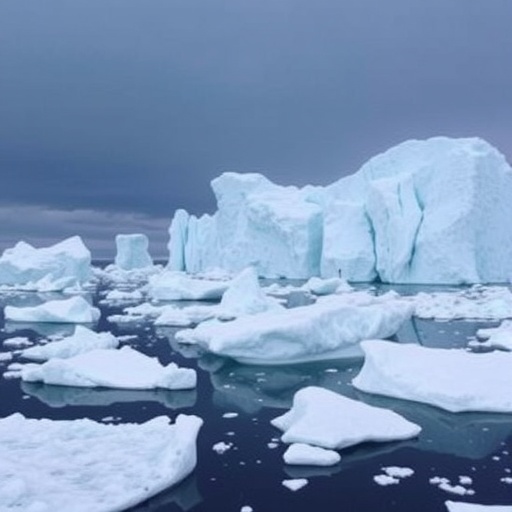
Utilizing sophisticated paleoclimate data and supercomputer simulations, the research team led by Assistant Professor Chijun Sun recreated the conditions of Heinrich stadial 1, approximately 19,000 years ago, during which extensive ice sheets and much lower sea levels prevailed. Their simulations revealed that freshwater discharge from iceberg melting in the northeastern Pacific Ocean can travel across the globe and disrupt water formation in the North Atlantic. This influx of less dense freshwater dilutes the salty ocean waters, causing subsurface warming that ultimately weakens the AMOC.
This phenomenon, driven by Pacific meltwater rather than Atlantic sources, introduces a novel paradigm for understanding how ancient climate shifts were triggered. The subsurface warming induced by this freshwater flux not only weakened the AMOC but also instigated further iceberg calving in the North Atlantic, establishing a feedback loop. Notably, this subsurface warming mechanism is known to affect the West Antarctic Ice Sheet, contributing to ice retreat during glacial periods and relevant to current ice loss concerns.
The implications extend beyond historical climate reconstructions. There is a growing scientific consensus that the AMOC is poised to weaken considerably by the end of the 21st century, with some models predicting a potential collapse. Earlier research by Sun’s group highlighted that such weakening could drastically reduce rainfall in some of the Earth’s wettest regions, including the Amazon and West Africa, altering global weather patterns and ecosystems.
This study underscores the AMOC’s sensitivity to freshwater inputs from distant parts of the world, expanding the scope of influential factors beyond the North Atlantic basin. The discovery that North Pacific meltwater has a powerful, previously underappreciated influence on AMOC stability opens new avenues for climate research, emphasizing the interconnectedness of global ocean systems.
As climate change accelerates glacier melt worldwide, understanding these cross-basin interactions is critical for predicting future climate scenarios. This research, supported by the U.S. National Science Foundation, sheds light on complex ocean-atmosphere feedbacks and the far-reaching impacts of polar ice dynamics on planetary climate.
Subject of Research: Climate science, ocean circulation, paleoclimate modeling
Article Title: North Pacific meltwater weakens the Atlantic Meridional Overturning Circulation and preconditions Heinrich Stadial 1
News Publication Date: 4-Jul-2026
Web References: https://www.nature.com/articles/s41467-026-75199-y
Image Credits: Andrewman327/Wikipedia
Keywords
Atlantic Meridional Overturning Circulation, AMOC, Heinrich stadials, North Pacific meltwater, iceberg discharge, paleoclimate simulations, global climate change, ocean currents, West Antarctic Ice Sheet, climate modeling
Tags: climate change impact on ocean circulationconsequences of melting icebergs on global climate stabilityfreshwater discharge effects on ocean currentsglobal heat redistribution by ocean currentsHeinrich stadials and abrupt climate changeiceberg melting and global climateinterconnectedness of Pacific and Atlantic oceansnew insights into climate dynamics and ocean systemsNorth Pacific influence on Atlantic Meridional Overturning Circulationpaleoclimate data and supercomputer simulationsrole of ice sheets during last ice agestability of deep ocean circulation systems