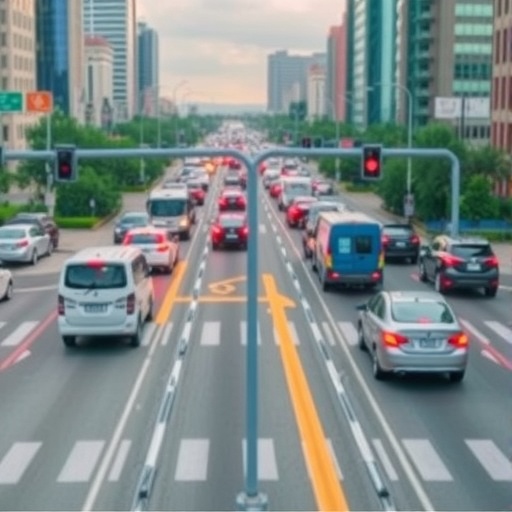
Urban navigation apps have revolutionized how city dwellers find their way through complex traffic networks. Yet, an emerging body of research is shedding light on unintended consequences these digital copilots may be imposing on urban traffic patterns. A groundbreaking new study by Cornacchia, Nanni, Pedreschi, and colleagues, soon to be published in Nature Communications, reveals that popular navigation services could be exacerbating traffic congestion by concentrating vehicle flows along a limited set of routes.
The study leverages extensive traffic data and advanced modeling techniques to analyze urban traffic distribution in cities using algorithm-driven navigation advice. The researchers deployed network analysis tools paired with real-time vehicle location data from navigation app users, uncovering how specific routing algorithms lead many drivers to converge on identical main arteries, creating “traffic choke points.” This phenomenon, referred to as traffic concentration, undermines classical traffic dispersion principles and may negate expected congestion relief from smarter routing.
By simulating different navigation strategies, the authors compared the spreading effect of decentralized routing versus the narrowing effect of algorithmically similar route recommendations. Their models show that when many users receive the same optimal path, traffic density amplifies disproportionately along that route. This results in localized gridlocks that reduce overall traffic efficiency and increase travel times, emissions, and road wear. Crucially, the study isolates the role of real-time navigation instructions rather than static maps or habitual driver choices.
The implications are significant for urban planners and policymakers aiming to leverage technology for smarter cities. While app-based navigation can help mitigate individual travel frustrations, its collective impact may paradoxically worsen congestion hotspots. The research advocates for integrating traffic-aware, diversity-enhancing features into routing software to distribute traffic more equitably across the road network. Such measures could involve algorithmic randomness or coordinated route allocation to prevent oversaturation of key corridors.
Beyond technical adjustments, the findings prompt a broader debate about the societal effects of digital mediators in urban systems. As navigation apps increasingly influence daily commuting patterns and logistics operations, understanding their systemic consequences is essential. The authors suggest dialogues between technology developers, city authorities, and academic experts to co-design navigation solutions that align with public interest.
This pioneering work bridges the domains of computational social science, transportation engineering, and urban informatics. By highlighting the paradox that smarter individual decisions can lead to collectively suboptimal outcomes, it opens pathways for more holistic approaches to managing urban mobility in the digital age.
Looking forward, the team plans to extend their research to incorporate multimodal traffic, including pedestrians and cyclists, to evaluate navigation impacts across all stakeholders. They also aim to test adaptive algorithms in live pilot projects to assess the real-world benefits of congestion-reducing routing diversity.
As cities continue to embrace intelligent transportation systems, this study serves as a timely reminder: technology solutions must be carefully crafted to harmonize individual convenience with collective urban welfare.
Subject of Research: The effects of urban navigation services on traffic concentration and congestion patterns.
Article Title: The traffic concentration effects of urban navigation services.
Article References: Cornacchia, G., Nanni, M., Pedreschi, D. et al. The traffic concentration effects of urban navigation services. Nat Commun (2026). https://doi.org/10.1038/s41467-026-75254-8
Image Credits: AI Generated
Tags: algorithm-driven routing and traffic choke pointsdigital navigation impact on city trafficeffects of navigation apps on traffic flowimpact of smart routing algorithms on city trafficmodeling urban traffic congestionreal-time vehicle location data analysistraffic dispersion versus concentrationtraffic distribution patterns in urban areastraffic modeling with network analysis toolsunintended consequences of navigation servicesurban navigation app traffic congestionurban traffic management challenges