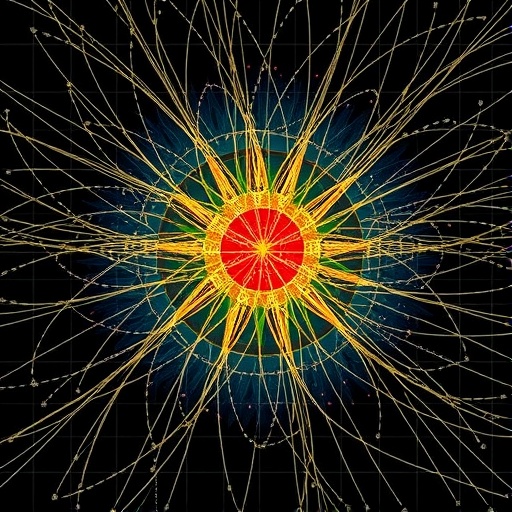
Physicists at the University of California, Irvine have developed a novel artificial intelligence system capable of autonomously designing theoretical models in particle physics, specifically targeting the enigmatic behavior of neutrinos. This breakthrough leverages reinforcement learning (RL), a machine learning paradigm where the AI iteratively improves its performance through trial and error, setting it apart from conventional predictive or pattern-recognition models.
Named Autonomous Model Builder (AMBer), this AI tool was created by doctoral candidates Victoria Knapp-Pérez and Jake Rudolph alongside their team in UC Irvine’s Department of Physics and Astronomy. The system explores vast theoretical spaces by constructing particle physics models via selection of mathematical symmetry groups, deciding which particles to include, and assigning particle properties relative to these symmetries. It evaluates each model for how well it fits existing experimental data while striving to minimize parameter complexity—key for a theory’s predictive reliability.
Testing AMBer on established neutrino theories demonstrated its ability to reproduce known scientific results, validating the system’s efficacy. More impressively, AMBer ventured into uncharted mathematical frameworks to propose new candidate models for neutrino behavior, marking a significant advancement in theoretical exploration. Neutrinos, nearly massless subatomic particles, have long challenged physicists due to their properties eluding explanation within the Standard Model of particle physics.
Jake Rudolph emphasized that unlike traditional machine learning models, AMBer creates its own training data dynamically as it searches, enhancing its understanding of theoretical model spaces. The AI acts as an intelligent filter, offering physicists a refined set of promising models, thereby accelerating the conventional theoretical approach rather than replacing the expertise of human researchers.
Victoria Knapp-Pérez highlighted AMBer’s role as an assistive tool that provides a more informed starting point for deeper analysis of neutrino models and their complex behaviors. The development represents a marriage of computational simulation with theoretical physics, opening avenues for AI-assisted scientific discovery in areas where human intuition alone struggles with vast complexity.
Additional contributors to the project include former and current researchers affiliated with UC Irvine and Fermilab, highlighting the collaborative nature of this multi-institutional effort. The computational resources from the National Energy Research Scientific Computing Center enabled the high-powered simulations, while funding came from the National Science Foundation, UC-MEXUS-CONACyT, and the Department of Energy’s Office of High Energy Physics.
Published in Communications Physics in May 2026, this research signals a pioneering step toward integrating advanced AI into theoretical physics, especially for tackling one of particle physics’ most persistent puzzles: the origin of neutrino mass.
Subject of Research:
Not applicable
Article Title:
Towards AI-assisted neutrino flavor theory design
News Publication Date:
July 9, 2026
Web References:
https://www.nature.com/articles/s42005-026-02627-2
References:
Knapp-Pérez, V., Rudolph, J., et al. (2026). Towards AI-assisted neutrino flavor theory design. Communications Physics. DOI: 10.1038/s42005-026-02627-2
Keywords
Particle physics, Artificial intelligence, Neutrino mass, Reinforcement learning, Theoretical physics, Computational modeling
Tags: AI in particle physicsAI-assisted neutrino researchAI-driven scientific discoveryautonomous theoretical model designmachine learning in fundamental physicsneutrino behavior predictionNeutrino mass mysterynovel models for neutrino propertiesparticle physics symmetry groupsreinforcement learning in scientific modelingtheoretical exploration of neutrino theoriesUC Irvine physics innovations