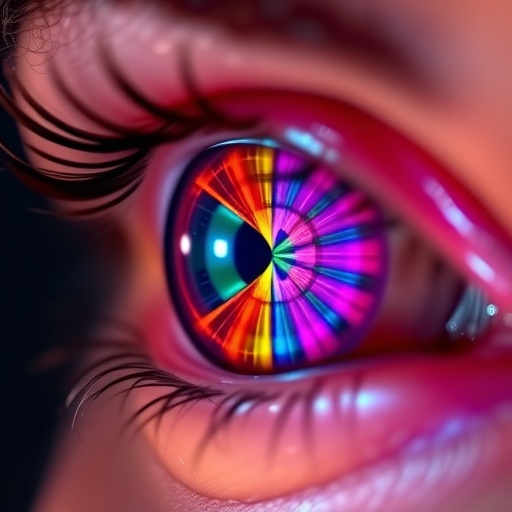
A groundbreaking study led by the University at Buffalo is harnessing quantum optics to revolutionize how retinal health is assessed. The research focuses on enhancing the visibility of Boehm’s brushes, subtle two-lobed, bowtie-shaped light patterns that appear in the peripheral vision when polarized light scatters off retinal structures. These faint patterns have long intrigued scientists for their potential use as biomarkers to detect retinal diseases, although their elusive nature has hindered clinical application—until now.
Using a sophisticated form of polarized light known as structured light, the researchers amplified the normally imperceptible Boehm’s brushes, transforming them into vivid, multi-lobed patterns. Structured light is engineered with a carefully arranged polarization pattern, tailored to the symmetry of retinal features. This quantum optics tool allows the light to interact more effectively with the retina, making Boehm’s brushes appear brighter and more complex to the observer.
The research team conducted experiments with healthy volunteers at the University of Waterloo’s School of Optometry, employing an optical system akin to traditional eye exams. Participants observed the structured light and reported their perceptions, including the number of lobes they detected and the contrast threshold required for detection. This method provided a quantitative measurement of the visual phenomenon rather than a simple yes-or-no response, enhancing the precision of retinal function assessments.
Results revealed that healthy subjects detected Boehm’s brushes more easily at locations farther from the central vision, establishing a normative baseline for visual perception of these patterns. This finding holds promise for future investigations into how retinal diseases, such as macular degeneration, may alter the perception of Boehm’s brushes, potentially unveiling new diagnostic targets.
This innovative approach could transcend traditional diagnostic methods by leveraging the intrinsic optical responses of the retina. If retinal damage diminishes the visibility or complexity of these patterns, clinicians might one day use structured light to identify early retinal dysfunction non-invasively.
The interdisciplinary collaboration involved University at Buffalo, University of Waterloo, and the Centre for Eye and Vision Research in Hong Kong, combining expertise in quantum physics and vision science. This fusion of fields exemplifies how advances in fundamental physics can impact medical technology.
Supported by Canadian research foundations, the study paves the way for novel eye health diagnostics by exploiting the quantum properties of light. The next phase will rigorously test individuals with retinal conditions to determine if Boehm’s brushes can serve as reliable clinical indicators.
This research not only highlights the practical applications of structured light in biomedicine but also emphasizes the growing synergy between quantum optics and vision science. The enhanced visualization of Boehm’s brushes offers a new lens into retinal health, promising earlier detection and improved patient outcomes.
Subject of Research: People
Article Title: Topological expansion of Boehm’s brushes via structured light
News Publication Date: 9-Jul-2026
Web References: http://dx.doi.org/10.1073/pnas.2532243123
Image Credits: Dusan Sarenac/University at Buffalo
Keywords
Quantum optics, Structured light, Retina, Boehm’s brushes, Eye health, Retinal diagnostics, Vision science
Tags: advanced visualization of subtle eye structuresapplication of quantum optics in eye examsdetection of Boehm’s brushes as indicators of retinal healthinnovative eye exam methods utilizing structured lightleveraging quantum optics to improve diagnostic sensitivitynon-invasive retinal disease diagnosis techniquesnovel approaches in ophthalmperipheral vision light scattering analysis for retinal analysispolarized structured light for enhanced retinal imagingquantitative measurement of retinal biomarkers using quantum opticsrole of polarization patterns in eye health assessmenttransformation of faint visual cues into clinical biomarkers