


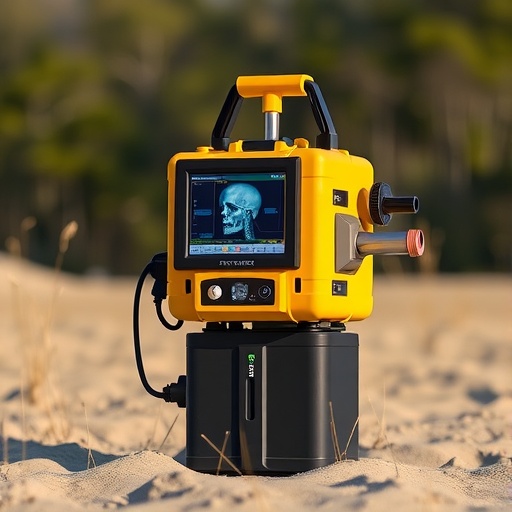
A groundbreaking advancement in environmental health monitoring has emerged with the development of a portable K-shell X-ray fluorescence (KXRF) system designed specifically for in vivo bone lead measurement. This innovative technology, detailed in a recent study by Grier et al., promises to revolutionize how cumulative lead exposure is assessed in field settings, enabling more accessible and rapid evaluations of long-term lead burden in human populations.
Lead’s toxic legacy continues to pose a significant health threat worldwide, particularly in regions with industrial pollution and aging infrastructure. Traditional methods for assessing lead exposure rely heavily on blood lead levels which primarily indicate recent exposure. However, lead sequestered in bone serves as a more reliable biomarker for cumulative exposure, offering crucial insights into chronic health risks. Until now, the cumbersome and immobile nature of conventional KXRF machines limited their use in routine environmental health surveillance.
The new system integrates a cadmium-109 (Cd-109) radioactive source with cadmium zinc telluride (CZT) detectors, creating a compact and highly sensitive device. Cd-109 stimulates the emission of K-shell X-rays from lead atoms within bone tissue, while CZT detectors capture these fluorescent signals with remarkable resolution. This dual-component setup facilitates non-invasive, precise quantification of bone lead concentrations in real time, allowing assessments outside of specialized laboratory environments.
One of the breakthrough features of this portable KXRF system is its deployability in diverse field conditions. Traditional KXRF units typically require substantial shielding, steady electrical power, and controlled laboratory conditions. In contrast, the Cd-109/CZT arrangement requires minimal infrastructure, making it ideally suited for on-site measurement campaigns, even in resource-limited or remote locations. This field readiness significantly enhances public health research capabilities by broadening access to vital exposure data.
Moreover, the analytical performance of this novel device matches or surpasses prior bulky instrumentation. By leveraging the superior energy resolution of CZT detectors, researchers can distinguish the lead signal from background noise with heightened sensitivity and specificity. The system also demonstrates rapid acquisition times, reducing participant burden during scans and facilitating larger-scale epidemiological studies.
This technology carries profound implications for environmental scientists, clinicians, and policymakers. With easier access to precise bone lead measurements, health professionals can better identify populations at risk of lead-related ailments such as cognitive impairments, cardiovascular diseases, and renal dysfunction. Concurrently, regulatory agencies gain a powerful tool for monitoring the effectiveness of lead abatement initiatives and contamination control programs.
The publication of this research marks a pivotal milestone in environmental exposure assessment. Future iterations of the device may incorporate wireless data transmission and integrated software for immediate data processing, further streamlining field operations. Such enhancements promise to accelerate our understanding of lead toxicity and aid in the global effort to mitigate this persistent public health menace.
In sum, the portable Cd-109/CZT-based KXRF system developed by Grier and colleagues introduces a new era of accessible, precise, and field-ready bone lead measurement. Its ability to measure cumulative lead burden non-invasively and rapidly stands poised to transform environmental health studies and enhance population-wide lead exposure surveillance worldwide.
Subject of Research: Cumulative lead exposure assessment using portable K-shell X-ray fluorescence technology.
Article Title: Portable Cd-109/CZT KXRF system for in vivo bone lead measurement: a field-deployable method for assessing cumulative lead exposure.
Article References:
Grier, T.R., Goodman, D.I., Taylor, K.M. et al. Portable Cd-109/CZT KXRF system for in vivo bone lead measurement: a field-deployable method for assessing cumulative lead exposure. J Expo Sci Environ Epidemiol (2026). https://doi.org/10.1038/s41370-026-00942-y
Image Credits: AI Generated
DOI: 09 July 2026
Tags: advancements in KXRF technologyassessment of lead exposure in industrial regionscadmium zinc telluride detectors for X-ray fluorescencecadmium-109 radioactive source in lead detectionchronic lead toxicity evaluationfield KXRF system for environmental healthin vivo lead exposure assessmentlong-term lead exposure biomarkernon-invasive bone lead quantificationportable bone lead measurementportable environmental health monitoring technologyreal-time bone lead measurement device


