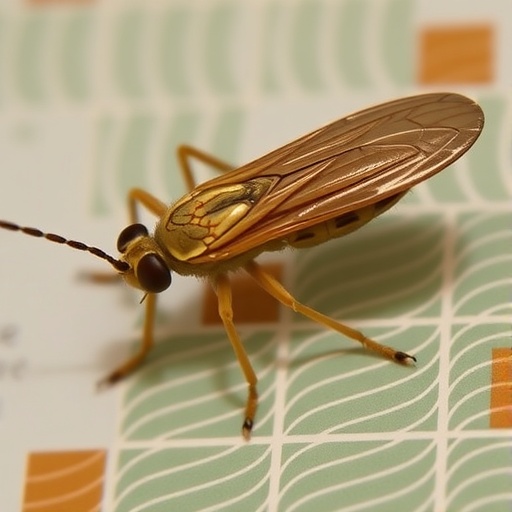
Caddisflies, freshwater insects renowned for their remarkable underwater construction skills, produce silk that serves as a critical bioadhesive. This silk, spun from a protein encoded by the H-fibroin gene, enables them to build protective cases and intricate capture nets in flowing streams. University of Utah’s Russell Stewart and biologists at Brigham Young University have now unveiled new genetic insights illuminating the evolution and extraordinary variability of this silk protein within a single caddisfly species, Arctopsyche grandis.
The team sampled 18 individuals from two separate populations situated about 40 miles apart in Utah’s Wasatch Mountains. Sequencing and analyzing 34 gene copies, they discovered a surprisingly high level of genetic diversity, with 24 distinct variants of the H-fibroin gene identified. These variants translated into silk fibers varying in length up to 25%, showcasing an unexpected degree of polymer variation within a natural population. Remarkably, despite this diversity, certain features remain tightly conserved, indicating evolutionary constraints that preserve the silk’s functional integrity.
This paradox of ultra-diverse yet constrained genetic variation offers a rare glimpse into how nature fine-tunes polymer chemistry to balance adaptability with performance. Understanding these genetic dynamics is pivotal for scientists attempting to engineer synthetic underwater adhesives—a challenge that has stymied researchers due to the complex interplay between protein structure and adhesive functionality in wet environments.
The evolutionary story extends beyond caddisflies to marine sandcastle worms, another group independently evolved to produce underwater glues, demonstrating convergent evolution. While sandcastle worms deploy a fluid adhesive dabbed onto surfaces, caddisflies extrude sticky fibers from their silk, emphasizing diverse biochemical strategies shaped by environmental demands.
These findings hold profound implications for the future of bio-inspired materials. With the rapid evolution of gene-editing technologies, deciphering the structure-function relationship in caddisfly silk proteins lays a blueprint for creating synthetic adhesives suitable for medical devices, underwater repairs, and engineering applications where conventional adhesives fail.
Russell Stewart, whose pioneering work on marine worm adhesives led to a startup developing FDA-pending embolic agents, emphasizes how these evolutionary insights deepen fundamental understanding of natural polymers. Co-author Paul Frandsen underscores the study’s contribution to bridging genetics, molecular evolution, and applied bioengineering by parsing gene function within ecological contexts.
Published in Molecular Biology and Evolution, this research uniquely profiles silk gene variation within a single species’ natural populations, marking a milestone in evolutionary biology and materials science. It shines a spotlight on the genetic “flexibility” that nature exploits to craft high-performance biopolymers and charts a course towards synthetic alternatives that mimic these resilient yet adaptable natural materials.
Subject of Research: Not applicable
Article Title: On the dynamic caddisfly silk H-fibroin gene: a population study in a net-spinning species
News Publication Date: 3-Jun-2026
Web References:
https://doi.org/10.1093/molbev/msag132
University of Utah: https://www.bme.utah.edu/profile/?unid=u0030696
BYU Department of Plant & Wildlife Sciences: https://pws.byu.edu/paul-frandsen-lab
Image Credits: Brian Maffly, University of Utah
Keywords: Bioengineering, Molecular evolution, Adhesives, Evolutionary biology
Tags: Caddisfly silk gene evolutionconservation of silk functional features despite genetic variationgenetic analysis of caddisfly populations in Utahgenetic diversity of H-fibroin gene in caddisfliesimplications for bio-inspired underwater adhesive designnatural mechanismsrapid evolution of caddisfly silk genesrole of H-fibroin gene in silk fiber polymerizationunderwater bioadhesive production in freshwater insectsvariability of silk protein length in Arctopsyche grandis