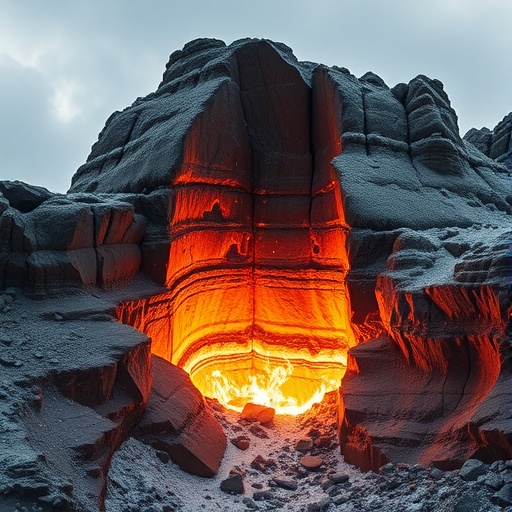
A new rock-breaking technique that harnesses the devastating power of underground rockbursts could revolutionize mining, tunneling, and construction by shattering the hardest rock without explosives. An international research team has demonstrated that firing a stream of tiny particles at ultra-high frequencies into a rock surface can trigger a controlled, self-sustaining fragmentation process, mimicking the spontaneous and violent failure of rock deep within the Earth. The method, published in Communications Engineering, turns a feared geological hazard into a precise engineering tool.
The phenomenon of a rockburst is one of the most dangerous events in deep mining. Under immense pressure, the rock stores elastic strain energy. When a small disturbance tips the balance, that energy is released in an explosive chain reaction, sending shards of rock flying at lethal speeds. The team, led by Y. Zhou and colleagues, asked a deceptively simple question: could this violent instability be tamed and directed, so that the rock breaks itself on command? Their answer is a system that uses a high-speed stream of steel or ceramic micro-particles, each no larger than a grain of sand, accelerated to hundreds of meters per second and slammed into the target surface at repetition rates in the kilohertz to megahertz range.
At the heart of the phenomenon is a feedback loop between impact-induced damage and the rock’s intrinsic stress state. Each particle strike generates a small crater and a network of micro-cracks that radiate into the interior. Because the impacts arrive at such high frequencies, the stress waves from successive hits overlap and interfere, building a complex, transient stress field. In hard, brittle rocks like granite or basalt, this overlapping wavefield triggers a cascade of crack nucleation and propagation. Crucially, if the rock is under even a modest pre-existing compression—common in underground excavations—the damage zone begins to shed load onto adjacent intact material, which then becomes critically stressed. This load transfer is the very mechanism that drives a natural rockburst, but here it is carefully orchestrated.
The researchers discovered a threshold impact frequency above which the process becomes self-organized. Below this threshold, each particle simply chips away at the surface in a conventional erosion mode. But when the impact rate crosses into what they term the “burst-dominated regime,” the fragmentation accelerates spontaneously. The rock literally tears itself apart from the inside, with the energy required dropping dramatically. In laboratory experiments on granite blocks under biaxial confinement, the team measured a nearly zero external energy input required to sustain fragmentation once initiated; the rock’s own stored strain energy did the bulk of the work. High-speed videography captured slabs detaching violently from the free face, mirroring the spalling seen in real rockbursts.
The underlying physics involves the nonlinear superposition of waves. At ultra-high impact frequencies, the particle impacts cease to act as discrete events and instead create a continuous, high-intensity phonon flux. This acoustic irradiation dynamically reduces the rock’s fracture toughness through a process akin to high-cycle fatigue, but operating on millisecond timescales. Simultaneously, the pre-compression causes crack faces to slide in shear, generating tensile wing cracks that link up to form macroscale fractures. The study’s numerical models and analytical scaling laws show that the dominant parameter is the ratio of impact frequency to the rock’s characteristic relaxation time for crack propagation, a finding that provides a design rule for practical devices.
From an engineering standpoint, the implications are staggering. Tunneling through hard rock currently relies on enormous tunnel boring machines with disc cutters that wear rapidly, or on drill-and-blast methods fraught with safety and vibration concerns. The new approach could be implemented as a compact head that fires a curtain of high-velocity particles ahead of the excavation face, causing the rock to disintegrate into manageable fragments with minimal vibration and no toxic fumes. The power consumption, the authors calculate, could be an order of magnitude lower than mechanical cutting for the same advance rate, because the rock is doing most of the work of breaking itself.
Field tests in a granite quarry confirmed that the effect translates outside the laboratory. A prototype device using an electromagnetic coilgun to accelerate spherical particles was able to advance a tunnel face at rates comparable to conventional methods, while producing a much finer and more uniform debris that is easier to convey. Crucially, the failure remained confined to the intended zone, avoiding the uncontrolled back-break that plagues blasting. The researchers also demonstrated the ability to steer the fragmentation direction by modulating the particle stream’s angle and the pre-stress field orientation, hinting at a future where underground spaces are sculpted with surgical accuracy.
The development is drawing intense interest from the mining and civil infrastructure sectors, where the cost of rock excavation skyrockets with depth and hardness. By weaponizing the very instability that miners fear, the technique offers a path to safer, faster, and far more energy-efficient rock removal. The team is now scaling the technology for full-face tunnel boring machines and exploring its potential for planetary exploration, where the brittle crust of the Moon or Mars could be carved using only a fraction of the payload mass required by traditional drill rigs. What began as a study of a catastrophic failure mode has yielded a blueprint for a new kind of precision demolition, one in which the rock becomes its own excavator.
Subject of Research: Controlled spontaneous fragmentation of hard rock via ultra-high frequency particle impact, inspired by rockburst mechanisms.
Article Title: Rockburst-inspired controlled spontaneous fragmentation of hard rock via ultra-high frequency particle impact.
Article References:
Zhou, Y., Jin, L., Tang, Q. et al. Rockburst-inspired controlled spontaneous fragmentation of hard rock via ultra-high frequency particle impact.
Commun Eng (2026). https://doi.org/10.1038/s44172-026-00721-5
Image Credits: AI Generated
DOI: 10.1038/s44172-026-00721-5
Keywords: rockburst, rock fragmentation, particle impact, hard rock excavation, tunneling, mining, phonon flux, self-sustaining fracture