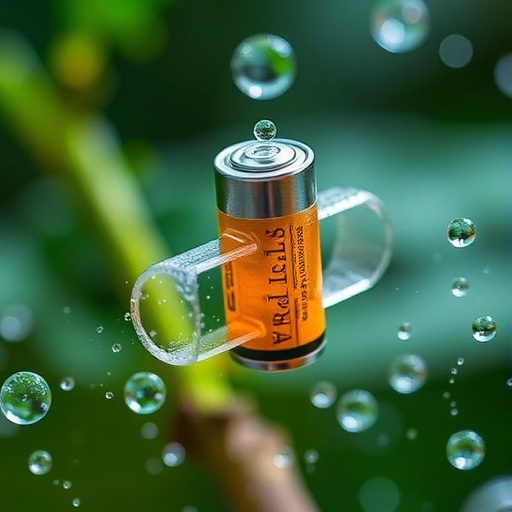
In a remarkable breakthrough set to transform the landscape of portable energy, researchers from North Carolina State University and Rice University have engineered a pioneering stretchable battery that draws moisture directly from ambient air to generate power. This innovative moisture-activated battery (MAB) challenges the conventional paradigms of battery design by harnessing the environment itself as a functional component, thereby sidestepping the use of toxic materials and rigid structures characteristic of traditional energy storage devices. Notably, this technology operates efficiently even in the driest climates, such as deserts, heralding new possibilities for powering Internet of Things (IoT) devices with unprecedented safety, flexibility, and convenience.
The advent of miniaturized electronics and wearable technology has precipitated an urgent need for flexible, lightweight power sources compatible with dynamic, irregular surfaces. Existing batteries, predominantly lithium-ion or alkaline chemistries, often suffer from inherent rigidity and bulky form factors that impede seamless integration into next-generation devices. Moreover, their reliance on hazardous chemicals raises environmental and health concerns, exacerbated by the potential for leakage. While energy harvesters provide an alternative by generating power from ambient conditions, their output is frequently insufficient or inconsistent for sustained device operation. The MAB’s design champions a paradigm shift by amalgamating the convenience of an energy harvester with the reliability and capacity associated with traditional batteries.
At the core of this moisture-activated battery lies a novel composite structure featuring a magnesium anode paired with a silver/silver chloride cathode, separated by a cellulose membrane embedded with lithium chloride salts. This unique separator functions not merely as a physical barrier but as an active medium for electrolyte formation. It absorbs moisture from the surrounding environment, dissolving the lithium chloride salt to produce a saltwater electrolyte essential for ionic conduction within the battery. This approach eradicates the need for pre-impregnated or volatile electrolytes, substantially enhancing safety and extending shelf life by maintaining the battery in an inert state until activated by atmospheric humidity.
A remarkable aspect of the MAB’s architecture is its bioinspired stratagem modeled after pangolin skin. This natural design motif, comprising densely overlapping scales, confers exceptional mechanical resilience and adaptability. While conventional stretchable batteries utilize serpentine interconnectors to maintain electrical continuity under strain, they are often susceptible to energy density reduction due to gaps formed during deformation. The pangolin-inspired layering enables the MAB to maintain minimal gaps, redistributing mechanical stresses evenly across the battery surface. This ensures sustained electrochemical performance under diverse mechanical deformations, including stretching, bending, and twisting, without sacrificing energy storage capacity.
The mechanics underlying this stretchability were elucidated through sophisticated computer simulations conducted in tandem with empirical assessments. Rice University’s mechanical engineering team demonstrated that the integrated design could withstand significant mechanical deformation while preserving charge transfer pathways and internal resistance characteristics. The synergy of materials science and biomechanics is clearly evident in the MAB’s stable electrochemical output, with an open-circuit voltage around 1.6 volts and a specific capacity approximating 52 milliampere-hours per gram. The specific energy density reaches a noteworthy 81 milliwatt-hours per gram, competitive with many commercial batteries, thus affirming the device’s viability for practical applications.
One compelling demonstration of the battery’s capabilities involved powering a wireless Bluetooth-enabled pulse oximeter continuously for approximately 30 hours. This performance aligns closely with that of conventional rigid batteries but with the added advantages of reduced weight, flexibility, and non-toxicity. Beyond wearables, the MAB’s design opens avenues for embedding safe, conformal power sources in robotics, environmental sensing devices, and distributed surveillance systems. The biocompatible and biodegradable nature of the constituents significantly mitigates ecological impact, addressing growing concerns about electronic waste proliferation.
Of particular interest is the integration of an innovative “kill switch,” leveraging the core moisture harvesting principle to enhance security and tamper resistance in sensitive monitoring applications. This feature involves a dry mixture of aluminum and iodine powder housed within an isolated compartment enveloped by a moisture-absorbing cellulose membrane. Upon mechanical pressure—such as an attempt to remove or disable the device—the mixture interacts violently with the harvested moisture, triggering a rapid exothermic reaction that incinerates the device. This self-destructive mechanism not only protects valuable and sensitive data but also prevents unauthorized reuse, representing a significant advancement in device security, particularly for covert surveillance missions.
Empirical tests of the kill switch embedded within a MAB-powered wireless gas sensor demonstrated total device obliteration within three minutes of activation. This rapid response underscores the system’s efficacy in safeguarding against tampering and adds a layer of fail-safe protection previously unattainable in miniature power systems. The innovation embodies a functional integration of energy harvesting, power storage, and security features within a single compact architecture, indicative of future trends in smart device design where multifunctionality is paramount.
The MAB’s development is a testament to the interdisciplinary collaboration between materials scientists, electrical engineers, and mechanical engineers. The project is backed by the Advanced Self-Powered Systems of Integrated Sensors and Technologies (ASSIST) Center at NC State, with strategic funding to bridge industrial innovation and academic research. Graduate and postdoctoral researchers played vital roles in advancing the technology from conceptual frameworks to demonstrable prototypes, underscoring the team’s commitment to transitioning laboratory breakthroughs into real-world deployments.
Looking ahead, this moisture-activated battery paradigm has the potential to redefine energy solutions for the exploding IoT ecosystem. Its convergence of sustainability, safety, mechanical flexibility, and energy density positions it uniquely to tackle challenges posed by wearable health monitors, environmental sensors, and smart infrastructure. With further refinement, scalability, and integration, MAB technology could soon supplant toxic, rigid batteries, heralding an era where ubiquitous electronics operate safely, efficiently, and harmoniously with natural environments.
The publication of these findings in the prestigious journal Science Advances marks a significant milestone that invites further exploration and adoption within the scientific and industrial communities. By demonstrating that a battery can be activated purely by environmental moisture and engineered for stretchability without compromising capacity, the research opens new horizons in battery chemistry and device engineering. As IoT devices proliferate, the demand for such novel power sources that merge eco-friendliness with advanced functionality will be more critical than ever, making this development both timely and transformative.
In conclusion, the moisture-activated battery represents a groundbreaking advancement in energy storage technology, unlocking promising avenues for the future of wearable electronics and IoT devices. Its safe, flexible, and environmentally benign profile coupled with an innovative security mechanism reflects a holistic approach to power solution design, reflecting the growing complexity and sophistication of modern electronic ecosystems. As industries pivot towards greener, smarter technologies, the MAB stands out as a beacon of sustainable innovation with broad-reaching implications across multiple technological frontiers.
Subject of Research: Not applicable
Article Title: Safe, high-performance, moisture-activated batteries for powering next-generation Internet-of-Things devices
News Publication Date: 1-Jul-2026
Web References: http://dx.doi.org/10.1126/sciadv.aee2065
Image Credits: Rajaram Kaveti
Keywords
Batteries, Electrical engineering, Energy storage, Moisture-activated battery, Stretchable battery, Internet of Things, Wearable technology, Flexible power source, Biocompatible battery, Kill switch, Energy harvesting, Sustainable energy
Tags: ambient air energy harvestingeco-friendly energy storageflexible batteries for irregular surfacesflexible power sources for wearablesInternet of Things power solutionsminiaturized electronics energymoisture-activated battery innovationmoisture-powered batteriesnon-toxic battery alternativesself-dissolving spy gadgetsstretchable battery technologysustainable battery materials