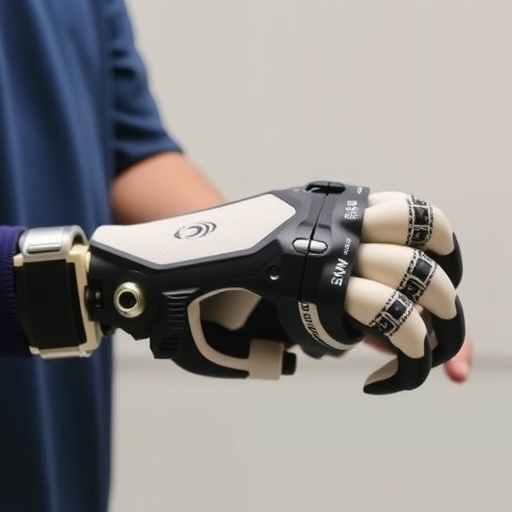
In the ever-evolving landscape of prosthetic technology, a groundbreaking approach led by Dr. Erik Engeberg at Florida Atlantic University is revolutionizing how upper-limb amputees regain control and dexterity. Traditional prosthetic hands often fail to provide intuitive control because they are designed with a “one-size-fits-all” mentality, disregarding the unique anatomical and physiological differences of individual users. This mismatch results in a frustrating experience, where users must adapt extensively to the device rather than the device adapting to them, severely limiting natural usage and often leading to abandonment.
The core challenge in prosthetic hand control lies in translating unstable and faint muscle signals into precise, real-time movements. Muscle signals can fluctuate with sweat, skin elasticity, and day-to-day variations in muscle activity, creating noise that conventional prosthetic systems struggle to interpret effectively. Although recent technologies have improved signal decoding, robustness and adaptability remain elusive due to the complex interplay of anatomical factors and neural control mechanisms unique to each person.
To overcome these barriers, Dr. Engeberg’s team has developed a state-of-the-art system that begins by three-dimensionally scanning the user’s residual limb, creating a bespoke 3D-printed sleeve embedded with an arrays of soft, flexible magnetic sensors. These sensors conform intimately to the user’s skin, precisely detecting subtle changes in muscle shape and pressure as they attempt various hand and wrist movements. Unlike rigid or generic sensors, these compliant arrays collect high-fidelity biomechanical data that reflect the user’s specific intent in real time.
What makes this technology revolutionary is the sensor-sleeve’s personalized architecture. The number of sensors—ranging from 18 to 24 modules—is customized depending on limb size and morphology, ensuring optimal coverage of the residual musculature. This personalized configuration is paired with an individualized artificial intelligence model trained exclusively on the user’s muscle activity patterns, rather than employing generalized datasets. This synergy between tailored hardware and adaptive machine learning allows for precise decoding of complex gestures.
The efficacy of this technology was validated in experiments involving ten participants, including three upper-limb amputees. The system successfully classified 19 distinct hand and wrist gestures, converting muscular intent into dexterous robotic hand control with remarkable accuracy and speed. Published in IEEE Transactions on Neural Systems and Rehabilitation Engineering, these results demonstrate consistent, reliable performance even with repeated use, a critical factor for real-world prosthetic application.
Beyond gesture recognition, the durability of the magnetic sensors was tested by subjecting the devices to over 7,500 robotic force cycles. Throughout prolonged testing, the sensors maintained a stable, linear relationship between applied pressure and sensor output, showcasing exceptional resilience to mechanical stress. Signal clarity, repeatability, and responsiveness were preserved with no significant drift or degradation, addressing a common shortfall in wearable biosensor technologies.
An insightful finding from the research emphasized that there is no universal sensor layout optimal for all users; rather, the effectiveness depends heavily on individual anatomical diversity and residual muscle function. Some users achieved higher accuracy with fewer sensors, while others needed denser sensor arrays. This exemplifies the critical role of tailored sensor placement and quantity, akin to how a prescription is fine-tuned to an individual’s needs, balancing comfort and function.
Dr. Engeberg articulates a future vision where prosthetists could prescribe sensor configurations bespoke to each patient, enabling prosthetics that feel and operate as seamless extensions of the user’s own body. The integration of compliant magnetic sensor technology with AI-driven personalization marks a significant leap toward prosthetic systems that intuitively respond to natural user intent without imposing a learning burden on the wearer.
The study further contributed to the scientific community by aggregating a shared dataset containing muscle activity recordings from both amputee and non-amputee participants. This open resource promises to accelerate broader innovations in prosthetic control algorithms and sensor development, fostering collaborative advances in the field.
Reflecting on the broader impact, Stella Batalama, dean of FAU’s College of Engineering and Computer Science, underscores the practical benefits of such innovations. Bridging the gap between engineering breakthroughs and users’ day-to-day realities transforms lives by restoring lost function, rebuilding confidence, and enabling amputees to engage with their environments in ways that were once unattainable.
Statistically, upper-limb amputation remains a formidable medical challenge. Globally, over 50 million individuals live with limb loss, a figure poised to rise due to diabetes, vascular diseases, trauma, and conflict-related injuries. With approximately 185,000 amputations occurring annually in the United States alone, the urgency for advanced prosthetic solutions tailored to natural hand and finger movement complexity is clear.
The collaborative research, including contributions from graduate student Wen-Yu “Marty” Cheng, signifies a promising convergence of bioengineering, robotics, and artificial intelligence. Their combined expertise is charting new territory in prosthetic development, culminating in systems that empower users with intuitive and responsive control, effectively bridging technology and human biology.
This pioneering work performed by FAU’s interdisciplinary teams is emblematic of the next wave of prosthetic innovation—one where clinical needs guide engineering solutions, and customization is the central tenet of design. By harnessing the power of compliant magnetic sensor arrays and machine learning, the future for upper-limb amputees looks profoundly more hopeful, functional, and integrated with the human experience.
Subject of Research: People
Article Title: Compliant Magnetic Sensor Arrays Enable Real-Time Force Myogram Pattern Recognition for Dexterous Hand Control by Amputees
News Publication Date: 10-Jun-2026
Web References: DOI: 10.1109/TNSRE.2026.3702598
Image Credits: Alex Dolce, Florida Atlantic University
Keywords: Prosthetics, Prosthetic limbs, Sensors, Flexible sensor arrays, Artificial intelligence, Machine learning, Engineering, Bioengineering, Biomedical engineering, Medical technology, Amputation, Robotic sensors, Robot components, Hands, Three dimensional modeling, Technology, Health and medicine
Tags: 3D-printed prosthetic sleevesadaptive prosthetic hand technologyadvances in prosthetic hand dexteritycustom-fitted prosthetic devicesflexible magnetic sensors for prostheticsintuitive prosthetic control systemsmuscle signal decoding in prostheticsneural control adaptation in prostheticsovercoming prosthetic device abandonmentpersonalized prosthetic limb designreal-time prosthetic movement translationupper-limb amputee rehabilitation