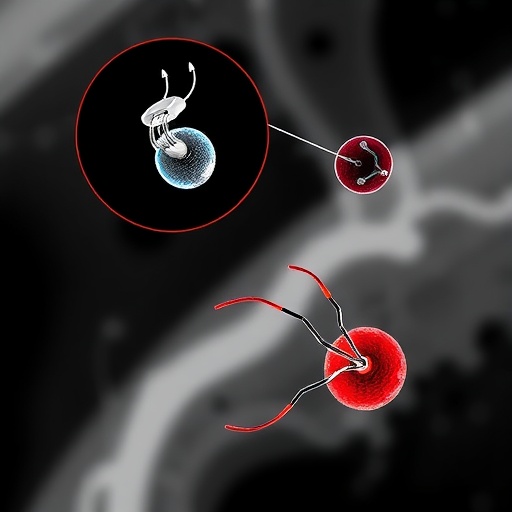
In the relentless battle against thrombotic occlusions that disrupt blood flow and jeopardize organ function, medical science stands on the brink of a transformative leap. Traditional tethered endovascular interventions, such as aspiration catheters and stent retrievers, have long served as reliable tools for clearing large-vessel blockages. These devices excel in stability, rapid clot debulking, and effective retrieval, making them the clinical gold standard. Yet, their reach falters in the labyrinth of tortuous distal vascular branches and the delicate microcirculation, where dense, fibrin-rich thrombi stubbornly resist conventional treatment.
Emerging innovations in tethered technology have yielded remarkable devices that confront some of these challenges head-on. Among them is the so-called “milli-spinner” thrombectomy apparatus, engineered to apply sophisticated compressive and shear forces that compact thrombi to a mere fraction of their original volume. This compaction drastically accelerates clot extraction, with promising results demonstrated in vitro and in porcine pulmonary and cerebral artery models. Complementing mechanical strategies, ultrasound-assisted catheter-directed thrombolysis (USAT) employs gentle acoustic waves to unravel fibrin networks, facilitating deeper and more effective drug delivery. Clinical data, including findings from the ERASE PE registry, underscore USAT’s potential to normalize cardiac stress markers and minimize grave complications such as intracranial hemorrhage.
Despite these advancements, tethered devices remain inherently limited in their ability to confront micro-emboli responsible for the no-reflow phenomenon—a condition where downstream blood flow fails to resume post-treatment due to persistent microvascular obstructions. This significant clinical hurdle has propelled research to focus on the development of untethered, injectable micro- and nanoscale agents capable of autonomous navigation and targeted therapy within the bloodstream. These micro/nano-systems are meticulously crafted to circulate freely, seek out thrombi with high precision, infiltrate dense fibrin matrices, and release thrombolytic agents in a controlled manner upon stimulation.
The diverse landscape of untethered carriers encompasses several sophisticated classes. Lipid-based vectors benefit from prolonged systemic circulation and biocompatibility, whereas polymer-based carriers incorporate stimulus-responsive architectures that enable sensitive drug release upon environmental triggers like pH or enzymatic activity. Inorganic and nanomaterial platforms lend themselves to magnetic and optical actuation, enhancing controllability. Biomimetic constructs, such as platelet membrane-coated nanoparticles, harness natural biological adhesion mechanisms to grasp fibrin with exceptional specificity. Hydrogel and bubble-based systems add further functional versatility, with microbubbles enabling dynamic mechanical interactions under acoustic excitation.
Pioneering work in magnetic actuation has revealed the incredible potential of nanorobot swarms to physically disrupt thrombi while simultaneously delivering therapeutic payloads. These nanorobots, such as heparinoid-polymer-brush-grafted magnetic constructs, can self-assemble and be steered via external rotating magnetic fields, increasing the efficacy of thrombolysis far beyond passive diffusion alone. Notably, Fe₃O₄@mSiO₂ nanorobots equipped with tissue plasminogen activator (tPA) have demonstrated unprecedented capability in navigating through submillimeter M3/M4 cerebral arterial branches inaccessible to conventional catheters. Following clot dissolution, these swarms can be re-aspirated, accomplishing a triad workflow of delivery, amplification, and retrieval—a feat that encapsulates the future of minimally invasive intervention.
Ultrasound-enhanced platforms offer an elegant synergy of diagnosis and therapy. Nanoparticle-shelled microbubbles exhibit cavitation behaviors when activated by diagnostic ultrasound frequencies, generating physical microjets that mechanically disintegrate thrombi and promote deep drug penetration. This closed-loop approach allows ultrasound to not only locate thrombi but also activate treatment agents and monitor therapeutic progress in real time. Meanwhile, near-infrared optical systems contribute precise local thermal energy to soften fibrin structures and advance drug diffusion, although their application is limited by tissue penetration depths.
Integral to these multifaceted interventions is advanced imaging technology, which forms the cornerstone of closed-loop feedback control. Real-time visualization is crucial for assessing thrombus burden, localizing devices and agents, and dynamically adjusting treatment parameters. Multiparametric magnetic resonance imaging (MRI), including T1 mapping and diffusion-weighted imaging, offers non-invasive insights into clot composition and predicts susceptibility to lysis. High-frame-rate ultrasound velocity vector imaging captures dynamic microcirculatory patterns crucial for evaluating micro-embolism presence and treatment response. In a cutting-edge demonstration, Doppler ultrasound facilitated the rotation tracking of a helical microrobot, which was navigated precisely against blood flow within a complex vascular model by adaptively modulating the external magnetic field—all under continuous B-mode ultrasound monitoring.
The future envisioned by researchers like Professors Ben Wang and Qinglong Wang is not a competition but a fusion of tethered and untethered modalities, each complementing the other’s strengths. A tethered catheter system can secure proximal vascular access, facilitate energy delivery, and ensure procedural safety, creating an essential platform for introducing and guiding untethered micro/nanoagents into the most challenging distal and microvascular territories. This integrative approach, powered by artificial intelligence and image-guided control, promises adaptive, patient-specific thrombolysis tailored for maximal efficacy and minimal risk.
However, the path forward is not without significant challenges. Precision navigation of micro/nanorobots amidst complex hemodynamic forces remains an engineering and biological frontier. Ensuring clear and safe post-treatment clearance of these agents—whether through active retrieval, biodegradation, or renal elimination—demands rigorous study. Establishing standardized safety parameters for field-assisted micro/nanorobotic interventions is critical to prevent unanticipated adverse effects. Equally important is the seamless incorporation of these sophisticated technologies into existing clinical interventional workflows, a necessity for widespread adoption.
Addressing these formidable barriers could revolutionize thrombus recanalization, transforming proof-of-concept micro/nanorobotic platforms into clinically deployable solutions. By uniting two complementary technological trajectories under real-time imaging guidance, the medical community stands poised to achieve unprecedented speed, completeness, and safety in restoring vascular patency—from large arteries down to the most elusive microcirculatory channels.
Professor Ben Wang succinctly sums up this emergent paradigm: “By bridging two complementary technology paths under unified imaging guidance, we can achieve faster, more complete, and safer recanalization—from large vessels down to the microcirculation.” This groundbreaking review, authored by a collaborative team including Jiajun He, Zhixin Xia, Lipeng Liao, Xu Li, Xuhao Wu, Jie Shen, Qinglong Wang, and Ben Wang, provides a definitive roadmap to accelerate the translation of micro/nanorobotic thrombolysis from visionary science into everyday clinical practice.
Subject of Research: Micro/Nanorobotic Systems for Imaging-Guided Closed-Loop Thrombus Recanalization
Article Title: Micro/Nanorobotic Systems for Imaging-Guided Closed-Loop Thrombus Recanalization
News Publication Date: June 5, 2026
Web References: DOI: 10.34133/cbsystems.0592
Image Credits: Ben Wang, College of Chemistry and Environmental Engineering, Shenzhen University
Keywords
Applied sciences and engineering, Health and medicine, Physical sciences, Thrombus recanalization, Endovascular intervention, Micro/nanorobots, Magnetic nanorobots, Ultrasound-assisted thrombolysis, Microbubbles, Imaging-guided therapy, Closed-loop control, Artificial intelligence in medicine
Tags: aspiration catheters for clot removalclosed-loop thrombectomy systemsERASE PE registry clinical outcomesfibrin-rich thrombus treatmentimaging-guided thrombus treatmentin vitro and porcine thrombus modelsmicro/nanorobotic thrombus recanalizationmicrocirculation thrombus clearancemilli-spinner thrombectomy devicestent retriever technologytethered endovascular interventionsultrasound-assisted catheter-directed thrombolysis