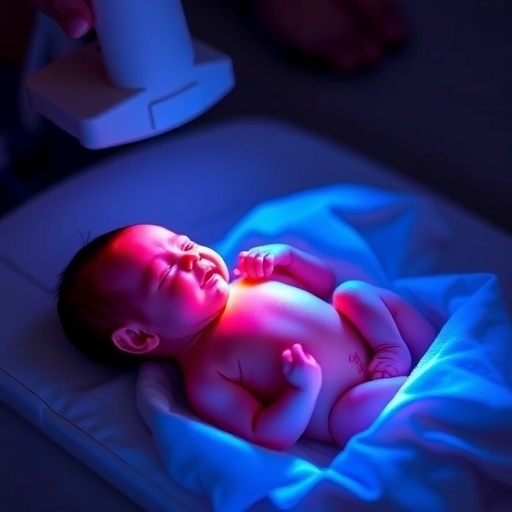
In an illuminating breakthrough published recently in the Journal of Perinatology, researchers J. Mannan and S.B. Amin have provided compelling evidence on how phototherapy—an established treatment for neonatal jaundice—exerts a significant influence on urinary nitric oxide levels in premature infants. This pioneering study, slated for a June 2026 release, delves deep into the biochemical pathways affected by phototherapy, shedding light on not only its therapeutic efficacy but also its broader physiological implications. As neonatal care continues to advance, understanding these nuances is becoming increasingly critical for optimizing treatment outcomes and safeguarding infant health.
Phototherapy has long been a cornerstone in combating hyperbilirubinemia in premature infants, a condition that arises due to an immature liver’s inability to adequately process bilirubin. Excess bilirubin in the bloodstream can cross the blood-brain barrier, leading to neurological damage. While the clinical benefits of phototherapy are undeniably profound, this treatment’s underlying biochemical effects remain incompletely understood. Mannan and Amin’s study tackles this knowledge gap by analyzing how phototherapy modulates nitric oxide (NO) metabolism, a key signaling molecule implicated in vascular regulation and immune responses.
Nitric oxide is synthesized enzymatically by various nitric oxide synthase (NOS) isoforms and functions as a rapid, diffusible signaling molecule. In neonates, NO plays a crucial role in regulating vascular tone, neurotransmission, and host defense mechanisms. Dysregulation of NO expression has been linked to a variety of pathological states, including inflammation, oxidative stress, and impaired blood flow. Therefore, any therapeutic intervention that alters nitric oxide levels in premature infants warrants thorough investigation to preempt unintended consequences.
The research focused specifically on urinary nitric oxide metabolites—nitrites and nitrates—as non-invasive biomarkers of systemic NO production. Given the vulnerability of premature infants to oxidative and inflammatory insults, monitoring changes in NO levels offers a valuable window into their physiological state during phototherapy. Prior studies often overlooked urinary NO quantification in this population, leaving a critical void in understanding how standard treatments modify endogenous molecular signaling pathways.
Mannan and Amin employed a cohort study involving a well-defined group of premature infants undergoing phototherapy for jaundice. Utilizing advanced chemiluminescence assays, they quantified nitrite/nitrate concentrations in urine samples collected before, during, and after phototherapy sessions. Their meticulous methodology also controlled for confounding factors like gestational age, bilirubin levels, and use of supplemental oxygen to isolate the specific effect of phototherapy on NO metabolites.
Findings revealed a marked elevation in urinary nitric oxide metabolites during phototherapy compared to baseline measurements. This increase was statistically significant and correlated positively with the duration and intensity of light exposure. Interestingly, the surge in NO levels persisted transiently post-therapy before normalizing, suggesting a dynamic but reversible modulation of nitric oxide pathways triggered by phototherapy. The temporal patterns observed hint at an adaptive physiological response rather than a harmful side effect.
Biologically, this elevation in NO metabolites could stem from several interrelated mechanisms. Phototherapy’s blue-spectrum light has been hypothesized to induce mild photo-oxidative stress, activating inducible nitric oxide synthase (iNOS) or augmenting endothelial NOS (eNOS) activity in vascular endothelium. Such activation promotes enhanced NO production, possibly aiding in vasodilation and improving tissue perfusion—an effect that could mitigate hypoxic risks commonly associated with prematurity. However, excessive NO can also form reactive nitrogen species, raising concerns about oxidative damage.
In light of these findings, the authors advocate for a nuanced interpretation of phototherapy’s dualistic roles. Beyond its primary function in bilirubin photodegradation, phototherapy appears to act as a modulator of neonatal nitric oxide metabolism, introducing complex biochemical interactions that might influence clinical outcomes. Recognizing this interplay is fundamental to refining phototherapy protocols, potentially adjusting light dosages and exposure durations to balance efficacy with molecular homeostasis.
Moreover, this study opens avenues for future research exploring the protective versus pathological roles of increased nitric oxide during neonatal care. Understanding whether NO modulation confers resilience against common complications in preterm infants—such as pulmonary hypertension, necrotizing enterocolitis, or neurodevelopmental deficits—could revolutionize therapeutic approaches. Investigations might also assess pharmacological agents that fine-tune NO signaling, complementing phototherapy to optimize infant health.
Importantly, the non-invasive nature of urinary NO metabolite measurement underscores its utility as a biomonitoring tool in neonatal intensive care units (NICUs). Real-time tracking of these biomarkers could personalize phototherapy regimens, minimizing risks linked to systemic oxidative stress while maximizing photodegradation efficiency. Integration of such molecular monitoring heralds a shift toward precision medicine, where therapy is dynamically tailored according to biochemical feedback rather than solely clinical metrics.
The research further highlights the interdisciplinary nexus between neonatal care, photobiology, and molecular biochemistry. As light-based therapies gain momentum for a range of neonatal conditions, delineating their molecular footprints becomes indispensable. Studies like Mannan and Amin’s bridge clinical practice and laboratory science, empowering clinicians with deeper insights into how standard interventions ripple through complex neonatal physiology.
While promising, these findings necessitate cautious interpretation. The sample size was limited and derived from a single center, warranting larger multicenter trials to validate the reproducibility and generalizability of results. Additionally, long-term follow-up is crucial to discern whether transient NO fluctuations translate into enduring developmental impacts. Only through comprehensive, longitudinal studies can the balance between phototherapy’s benefits and molecular side effects be accurately calibrated.
In conclusion, the emerging evidence that phototherapy modulates urinary nitric oxide levels in preterm infants reframes our understanding of this widely used neonatal intervention. By illuminating the biochemical pathways engaged during treatment, Mannan and Amin’s work paves the way for optimizing neonatal phototherapy protocols, safeguarding fragile infants, and potentially leveraging NO modulation as a therapeutic target. As neonatal medicine continues to evolve into an increasingly molecular discipline, such insights are invaluable in crafting safer, smarter therapies that resonate with the intricate biochemistry of early life.
Subject of Research:
Effect of phototherapy on urinary nitric oxide levels in premature infants.
Article Title:
Effect of phototherapy on urinary nitric oxide levels in premature infants.
Article References:
Mannan, J., Amin, S.B. Effect of phototherapy on urinary nitric oxide levels in premature infants. J Perinatol (2026). https://doi.org/10.1038/s41372-026-02754-2
Image Credits: AI Generated
DOI: 22 June 2026
Tags: biochemical pathways affected by phototherapyhyperbilirubinemia management in preterm babiesneonatal immune response modulationneonatal jaundice treatment biochemical impactneonatal neurological protection strategiesnitric oxide metabolism in newbornsnitric oxide synthase activity in neonatesoptimizing phototherapy outcomes in premature infantsphototherapy and vascular regulation in infantsphototherapy effects on premature infantsresearch on phototherapy and nitric oxide levelsurinary nitric oxide changes in neonates