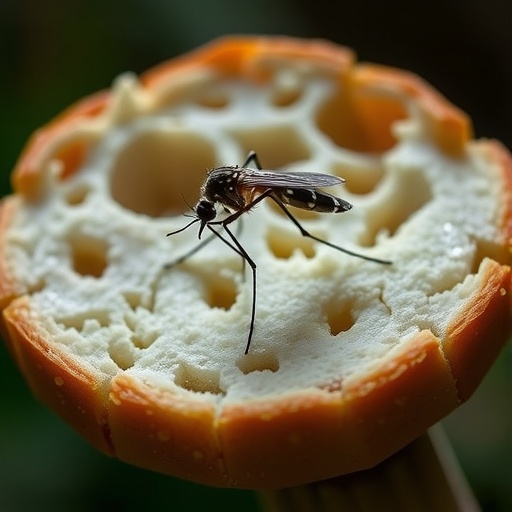
A striking new development from the Johns Hopkins Bloomberg School of Public Health may revolutionize the way we combat malaria by introducing a novel, eco-friendly method for mosquito control. Researchers have uncovered that a distinctive orange-colored yeast, Rhodotorula taiwanensis, originally isolated from a Baltimore sidewalk, possesses remarkable abilities to attract and even trap Anopheles gambiae mosquitoes, the principal vectors responsible for malaria transmission across Africa. This discovery opens promising avenues for creating biodegradable, cost-effective mosquito traps aimed at curtailing this persistent and deadly disease.
Yeasts and fungi maintain intricate symbiotic relationships with insects, much like plants depend on animals for seed dispersal. Fungi employ chemical signals and physical characteristics to entice insects, facilitating their own propagation. The Johns Hopkins research team sought to explore this fungal-insect interaction in the context of mosquito attraction. By systematically evaluating common yeast species, they identified Rhodotorula taiwanensis as uniquely potent in luring female Anopheles gambiae mosquitoes, which are primarily responsible for malaria spread.
Published recently in the Proceedings of the National Academy of Sciences, this study illustrates that the attractiveness of R. taiwanensis hinges on its unique chemical scent profile and sticky biofilm secretion, which not only entices mosquitoes but also serves as a natural adhesive. Notably, the yeast’s volatile organic compounds are dominated by acetone and 3-methyl-1-butanol, simple yet evocative molecules that are distinct from those found in widely known species such as Saccharomyces cerevisiae, the common baker’s yeast.
The researchers delved into the olfactory mechanisms underlying mosquito attraction through behavioral assays, confirming that female Anopheles mosquitoes detect and respond to R. taiwanensis via their odorant receptors. Intriguingly, Drosophila fruit flies, which share some sensory modalities with mosquitoes, were also drawn to the yeast and showed feeding behavior, indicating a broad insect appeal likely evolved to optimize the yeast’s environmental dissemination.
Beyond chemical ecology, this interaction has a physical component: the sticky biofilms produced by R. taiwanensis effectively ensnare multiple mosquito specimens, creating a natural trapping mechanism reminiscent of quicksand. Such biofilms present an opportunity to develop environmentally safe glue-like coatings for traps, potentially replacing toxic insecticides that have become less effective due to growing mosquito resistance.
Further fieldwork revealed that two close relatives of R. taiwanensis—Rhodotorula mucilaginosa and Rhodotorula toruloides—were isolated directly from Anopheles mosquitoes in malaria-endemic regions of Zambia. This discovery demonstrates an ecological overlap between this genus of yeasts and malaria vectors, underscoring a naturally occurring relationship that could be harnessed for vector control.
The study situates R. taiwanensis as part of the mycobiome commonly associated with insects, highlighting its ubiquity across diverse environments such as soil, plants, and fermentation cultures worldwide. The yeast’s widespread distribution across continents and environments increases its potential as a scalable tool in global malaria control efforts.
The implications of this research are significant. Malaria, despite advances in vaccines and antimalarial drugs, continues to impose an immense global health burden, with over 600,000 deaths projected in 2024 alone. The malaria parasite’s ability to rapidly develop drug resistance, alongside growing insecticide resistance in mosquitoes, highlights an urgent need for alternative control strategies. The R. taiwanensis-based trap offers a novel biological approach that could complement existing interventions.
This strategy leverages evolutionary insect-fungal relationships by manipulating mosquito sensory pathways. Unlike traditional methods, Rhodotorula-based traps provide a non-toxic attractant and adhesive combination, promising safer community deployment. Such ecological innovations might redefine vector control paradigms, combining chemical ecology, microbial biology, and environmental sustainability.
Ongoing investigations are assessing whether R. taiwanensis can similarly attract other species of malaria-transmitting mosquitoes and common nuisance mosquitoes in urban settings, such as those in the United States. The broader entomological and ecological impacts of leveraging fungal attractants also illuminate the potential for other fungal species to be studied for pest control innovations.
This interdisciplinary effort arose from collaborative expertise bridging the McMeniman Lab’s focus on mosquito sensory biology and the Casadevall Lab’s specialization in fungal biology. Their work underscores the value of integrating microbial ecology and vector biology in the quest to mitigate one of humanity’s most persistent diseases. By exploring the chemical signaling and bioadhesive properties of environmental yeasts, they offer a fresh tactical front against malaria’s entrenched public health challenges.
With further refinement and field validation, Rhodotorula-based attractant traps could become a transformative, biodegradable alternative to chemical insecticides, reducing environmental harm and possibly lessening the evolutionary pressure that fosters insecticide resistance. The natural specificity and multi-sensory appeal of R. taiwanensis place it at the forefront of vector control innovation.
As this research progresses, elucidating the molecular basis of yeast-insect interactions promises broader insights into symbiotic relationships and offers a model for designing biologically inspired pest control agents. Harnessing nature’s own communication channels between fungi and insects might ultimately enable more precise, sustainable, and effective strategies to combat vector-borne diseases like malaria, potentially saving millions of lives.
Subject of Research: Exploration of the yeast Rhodotorula taiwanensis as an attractant and trapping agent for malaria-transmitting Anopheles mosquitoes.
Article Title: Scent and Adhesion Drive Insect Dispersal of Environmental Yeast
News Publication Date: June 15, 2024
Web References: https://www.pnas.org/doi/10.1073/pnas.2536902123
References: Diego Giraldo, Daniel Smith, Sébastien Ortiz, Stephanie Rankin-Turner, Mary Gebhardt, Lusajo Mwakibete, Ziyang Chen, Reneé Ali, Douglas Norris, Sean Zhang, Arturo Casadevall, Conor McMeniman. Scent and Adhesion Drive Insect Dispersal of Environmental Yeast. Proceedings of the National Academy of Sciences. June 15, 2024.
Keywords: Malaria, Anopheles gambiae, Rhodotorula taiwanensis, mosquito control, fungal-insect interactions, vector-borne diseases, chemical ecology, bioadhesive traps, insect olfactory receptors, biodegradable insect traps
Tags: Anopheles gambiae vector controlbiodegradable mosquito control methodschemical scent profile of yeastseco-friendly mosquito traps for malariafungal-insect chemical signalingJohns Hopkins malaria researchmalaria transmission prevention strategiesnovel biodegradable pest controlRhodotorula taiwanensis yeast mosquito attractionsticky biofilm for insect trappingsymbiotic relationships between fungi and insectsyeast-based mosquito trapping technology