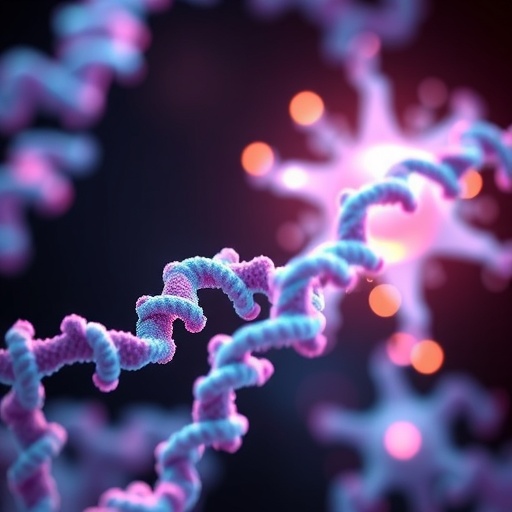
In a groundbreaking advance that bridges molecular biology and evolutionary science, researchers at The University of Osaka have unveiled a novel methodology to resurrect ancestral proteins, specifically rhodopsins, enabling direct experimental investigation of these ancient molecules. This work, published in ACS Omega, outlines an innovative sequence reconstruction technique that integrates structural information and attentively accounts for insertions and deletions in protein sequences — a crucial improvement over conventional alignment methods that struggle with highly variable protein domains.
Microbial rhodopsins constitute a diverse family of membrane-embedded proteins with critical biological functions, ranging from ion transport to photoreception. Despite sharing a common structural feature of seven transmembrane helices, these proteins exhibit remarkable functional diversity, largely attributed to extensive variation in their extramembrane domains. Traditional sequence alignment algorithms fall short in tracing their evolutionary trajectories, as they typically do not handle complex insertions and deletions (indels) effectively, especially in variable regions outside of transmembrane segments.
Addressing these challenges, the team led by Haruto Ishikawa and Yasuhisa Mizutani developed ConsistASR, a structure-guided and indel-aware sequence reconstruction pipeline. This approach leverages three-dimensional structural insight to inform sequence alignment, thereby improving the accuracy of reconstructing full-length ancestral rhodopsin proteins. By carefully modeling sequence variability in extramembrane domains, the researchers were able to faithfully infer ancestral sequences that maintain key structural and functional attributes.
Focusing on two subfamilies of microbial rhodopsins—schizorhodopsins and heliorhodopsins—the study successfully resurrected their ancestral versions and expressed these proteins in Escherichia coli. The functional assays revealed that the ancestral schizorhodopsin exhibited light-driven proton pumping activity, consistent with its modern descendants, whereas the ancestral heliorhodopsin lacked ion transport activity, perfectly aligning with the known characteristics of extant heliorhodopsins.
Notably, the ancestral schizorhodopsin protein exhibited the expected spectral properties and stability, signifying correct folding within the bacterial membrane environment. This functional proof of concept not only validates the reconstruction pipeline but also opens a window into the evolutionary dynamics that have shaped rhodopsin diversification over time. The ability to experimentally produce and assay these ancient proteins allows scientists to study evolutionary adaptations at a molecular level with unprecedented precision.
The significance of this work extends beyond just the rhodopsin family. The ConsistASR platform provides a powerful toolkit that can be generalized to reconstruct other ancestral proteins characterized by variable length sequences and complex indels. Such reconstructions are invaluable for evolutionary biology, synthetic biology, and protein engineering, providing empirical insights into how proteins have evolved to acquire new functions and properties.
This innovative integration of sequence, structural, and functional analysis reflects a broader trend in molecular evolution research, where computational biology synergizes with experimental validation to overcome traditional obstacles. As the genomic and structural databases continue to expand, methods like ConsistASR could revolutionize our understanding of protein evolution and functionality by enabling direct interrogation of ancient biomolecules.
The study also tackles a fundamental evolutionary biology question—how functional diversity arises within a protein family while preserving core structural frameworks. By showing that ancestral proteins can be reconstructed in full length and retain distinct biophysical and functional profiles, the research provides direct empirical evidence for evolutionary trajectories that have resulted in contemporary diversity.
Moreover, the expression of these ancestral rhodopsins in bacterial hosts exemplifies how modern synthetic biology tools can resurrect and characterize long-extinct molecular functions. This not only informs evolutionary theory but also offers potential applications in biotechnology, where ancestral proteins might possess unique stability or functional features suitable for industrial or medical purposes.
In practical terms, illuminating the evolutionary path of microbial rhodopsins aids in comprehending microbial adaptation to various ecological niches, given these proteins’ pivotal role in light-driven energy conversion and environmental sensing. Ancestral protein resurrection thus provides a tangible bridge connecting molecular structure, evolution, and ecological function.
The research was supported by the Japan Society for the Promotion of Science and involved meticulous data analysis strategies, combining phylogenetics, structural biology, and bioinformatics. It underscores the multidisciplinary nature of modern biological discovery, illustrating that resolving complex biological problems often requires integrating diverse scientific perspectives and technologies.
Ultimately, this powerful approach reinvigorates the field of ancestral protein research by not only surmounting critical technical obstacles but also by delivering concrete functional data that validate hypotheses about ancient protein behavior. The availability of the ConsistASR workflow to the broader scientific community encourages collaborative exploration of protein evolution and engineering, heralding a new era of experimentally validated molecular paleobiology.
Subject of Research:
Not applicable
Article Title:
Resurrecting Full-length Ancestral Schizorhodopsins and Heliorhodopsins with Structure-guided, Indel-aware Sequence Reconstruction
News Publication Date:
8-Jun-2026
Web References:
https://doi.org/10.1021/acsomega.6c03010
Image Credits:
Haruto Ishikawa
Keywords:
Molecular biology, Biomolecules, Amino acids, Biomolecular structure, Domain organization, Bacterial proteins, Ancient proteins, Membrane proteins, Extracellular domains
Tags: ancestral protein resurrectionbioinformatics in protein reconstructionevolutionary biology of membrane proteinsexperimental paleobiochemistryindel-aware alignment methodsmicrobial rhodopsins researchmolecular evolution techniquesprotein sequence variability analysisrhodopsin functional diversitystructure-guided sequence reconstructiontransmembrane helix structureUniversity of Osaka protein study