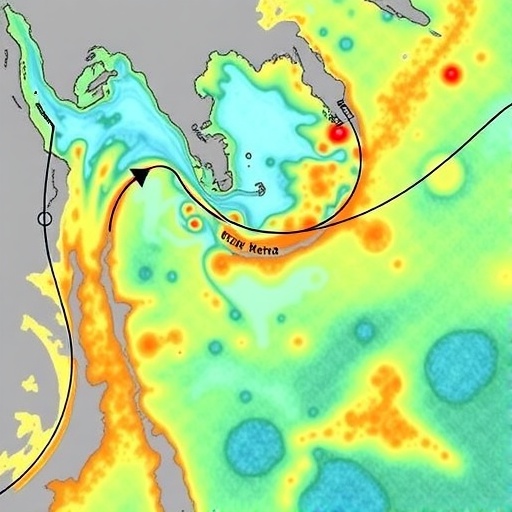
Marine heatwaves (MHWs) have emerged as a critical phenomenon impacting coastal and ocean ecosystems globally, characterized by extended periods of anomalously warm waters that disrupt habitat stability and biodiversity. Historically, monitoring and research efforts surrounding MHWs have predominantly focused on surface temperature observations derived from satellite imagery and buoy data. However, groundbreaking research conducted at the Batten School of Coastal & Marine Sciences and the Virginia Institute of Marine Science (VIMS) has pioneered a paradigm shift by emphasizing the essential need to examine these heatwaves in three dimensions, encompassing the full vertical extent of the water column.
This innovative study, recently published in the Journal of Geophysical Research: Oceans, presents a comprehensive analysis of marine heatwaves in Chesapeake Bay spanning nearly four decades, from 1985 to 2023. Nathan Shunk, a doctoral candidate specializing in coastal physical oceanography, spearheaded this project with mentorship from Assistant Professor Piero Mazzini. Harnessing advanced computational fluid dynamics models developed by VIMS researchers Prof. Pierre St-Laurent and Dr. Marjorie A. M. Friedrichs, the research integrates high-resolution, three-dimensional simulations that account for seasonal variability and depth-dependent thermal stratification. This approach reveals the intricate subsurface thermal structures and evolution of MHWs with unprecedented granularity.
Central to their findings is the introduction of a “vertical marine heatwave” classification—a novel framework that encapsulates the heatwave’s development trajectories across both depth and temporal scales. Unlike traditional metrics that focus on surface temperature anomalies alone, this classification elucidates how heatwaves propagate vertically through the water column, forming dynamic patterns that significantly influence benthic and pelagic ecological processes. To aid scientific communication and applied management, the study articulates a user-friendly visual classification scheme that categorizes observed MHWs based on their spatial coverage, initiation points, and whether heat anomalies manifest concurrently at surface and bottom layers.
The implications of this research extend well beyond academic insight. By capturing a more holistic picture of marine heatwave dynamics, resource managers and coastal stakeholders are better equipped with actionable intelligence to anticipate ecosystem stress and socioeconomic repercussions. Marine heatwaves have been linked to severe declines in fisheries productivity and degradation of sensitive benthic habitats, often compounding other stressors such as hypoxia, acidification, and limited light penetration. The capacity to discriminate subsurface heatwave characteristics enhances predictive modeling and informs early-warning systems, strengthening resilience-building strategies.
In evaluating the thermal variability of Chesapeake Bay—a complex estuarine system with diverse bathymetry—the study uncovers marked differences between surface and deep-water heatwave occurrences. MHWs concentrated near the surface typically exhibit higher frequency, intensity, and shorter duration, but tend to influence more localized surface areas. In contrast, analogous events unfolding in deeper waters tend to be spatially extensive and temporally prolonged but lower in thermal intensity. Such differentiation highlights the critical necessity of subsurface monitoring, as surface-only observations risk underestimating the scope and severity of thermal stress affecting resident biota.
Moreover, the investigation reveals that in shallow regions of Chesapeake Bay, approximately 75% of its area with depths under 30 feet, marine heatwave conditions frequently extend simultaneously to the bottom. This vertical coupling diminishes in deeper channels, especially during warmer seasons like spring and summer, signifying complex physical dynamics such as stratification and internal mixing processes that modulate heat distribution. These insights challenge conventional assumptions and underscore the diversity of thermally-driven ecological impacts across heterogeneous marine habitats.
The significance of this work lies not only in its scientific rigor but also its translation into practical environmental stewardship. Nathan Shunk emphasizes the research’s role as a foundational step towards developing predictive tools capable of providing preemptive alerts for marine heatwaves, granting coastal practitioners vital lead time to mitigate detrimental outcomes. Correspondingly, the Batten School’s Center of Excellence in Environmental Forecasting (CEEF) is advancing such user-centric forecasting applications, integrating this three-dimensional thermal data to support decision-making in fisheries management, habitat conservation, and climate adaptation initiatives.
Looking forward, the research agenda aims to explore the complex interplay between marine heatwaves and oyster reef ecosystems within Chesapeake Bay. This forthcoming work, conducted collaboratively by Mazzini and Assistant Professor Ming Sun, leverages W&M’s Global Research Institute Seed Funding to further extend the understanding of ecological responses to subsurface thermal stress. By unraveling these biophysical interactions, the team seeks to optimize restoration and management policies for keystone species vulnerable to coupled thermal and environmental stressors.
This study exemplifies a critical pivot towards embracing vertical oceanographic perspectives in climate impact research, spotlighting the multidimensional nature of marine heatwaves. The enhanced characterization of full water column conditions challenges the scientific community to revisit monitoring strategies, advocating for sustained investments in subsurface sensor arrays and modeling infrastructure. Only with such comprehensive approaches can researchers and resource managers hope to accurately anticipate the cascading effects of ocean warming on estuarine and coastal systems.
Assistant Professor Piero Mazzini succinctly states, “Surface observations alone are insufficient to capture the full complexity of marine heatwaves, especially in stratified estuarine systems. Integrating vertical temperature profiles allows us to detect significant warming at depth, which profoundly influences benthic habitats and overall ecosystem resilience.” This integrative perspective paves the way for more robust environmental predictions that align with the multifaceted realities of coastal marine environments.
Ultimately, this pioneering research lays the groundwork for a new era of marine heatwave science—one that transcends surface-level interpretations and embraces the depth and dynamism of aquatic thermal phenomena. As global climate change continues to exacerbate ocean warming, the ability to decipher and anticipate vertical heatwave impacts becomes paramount for safeguarding the biodiversity and economic vitality sustained by coastal and estuarine waters worldwide.
Subject of Research: Marine heatwaves in estuarine systems, specifically Chesapeake Bay; vertical thermal structure and spatial-temporal variability of marine heatwaves.
Article Title: Spatial Extent and Vertical Structure of Marine Heatwaves in Chesapeake Bay
News Publication Date: 24-May-2026
Web References:
Journal of Geophysical Research: Oceans, DOI: 10.1029/2025JC022859
Center of Excellence in Environmental Forecasting (CEEF), VIMS – https://www.vims.edu/research/units/centerspartners/ceef/
William & Mary Global Research Institute – https://www.wm.edu/offices/global-research/
Image Credits: Nathan Shunk
Keywords
Estuaries, Climate change, Climate change effects, Hydrology, Oceanography, Coastal processes, Ocean physics
Tags: Chesapeake Bay ecosystem monitoringcoastal resource management strategiescomputational fluid dynamics in oceanographyhigh-resolution ocean temperature modelingimpact of marine heatwaves on biodiversitylong-term marine heatwave trendsmarine heatwaves and coastal habitat disruptionseasonal variability of marine heatwavessubsurface ocean temperature variabilitythermal stratification in marine ecosystemsthree-dimensional marine heatwave analysisvertical marine heatwaves Chesapeake Bay