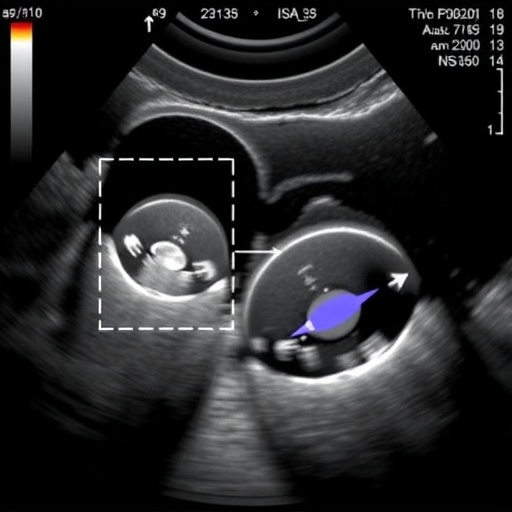
In a remarkable leap forward for prenatal medicine, a groundbreaking study has unveiled a novel, non-invasive technique to evaluate fetal lung maturity, harnessing the power of two-dimensional shear wave elastography (2D-SWE). Conducted on fetal rabbits, this pioneering research not only deepens our understanding of lung development before birth but also holds tremendous promise for revolutionizing fetal care in humans. As premature birth rates remain a persistent challenge worldwide, the ability to accurately assess lung maturity has never been more crucial to neonatal survival and long-term health outcomes.
Fetal lung maturity (FLM) has traditionally been evaluated through invasive procedures such as amniocentesis, which carry inherent risks for both mother and fetus. The introduction of 2D-SWE offers an elegant solution by utilizing ultrasound waves to generate shear waves within the tissue, measuring the stiffness of fetal lung tissue in real-time. This stiffness correlates with the maturation status of the lungs, given the structural and biochemical changes that occur as the lungs prepare for respiration. By offering a quantitative assessment, 2D-SWE is set to transform diagnostic paradigms with its high-resolution imaging capabilities and safety profile.
The study employed fetal rabbits as a robust and ethically sound model due to their physiological similarities in lung development to human fetuses. Researchers meticulously measured lung stiffness at various gestational stages, detecting significant correlations between increasing shear wave velocity and progressive lung maturity. The data revealed that as the lung tissue matured, its elasticity decreased, reflecting the transition from a fluid-filled, compliant organ to a more rigid structure capable of efficient gas exchange after birth. This direct mechanical property assessment stands in stark contrast to traditional biochemical markers, which may not fully capture functional readiness.
Technically, 2D-SWE operates by sending focused ultrasound pulses that displace tissue, generating transverse shear waves whose propagation speed is captured by ultrasound imaging. This speed, affected by tissue stiffness, provides an immediate biomechanical “signature” of organ health. Unlike conventional ultrasonography, which predominantly offers morphological information, shear wave elastography provides quantitative metrics of tissue elasticity or stiffness. This paradigm shift opens the door for novel applications spanning from oncology to hepatology—and now, as this study highlights, fetal lung medicine.
The implications of this technology are profound in neonatal intensive care and obstetrics. Accurate, non-invasive assessment of FLM would enable clinicians to optimally time deliveries, especially in cases complicated by preterm labor risks or maternal illnesses. Currently, uncertainty surrounding lung maturity drives either premature administration of corticosteroids to accelerate fetal lung development or, conversely, delays that might jeopardize neonatal outcomes. The precision afforded by 2D-SWE offers a data-driven approach to these critical decisions, potentially reducing complications such as respiratory distress syndrome (RDS), which remains a leading cause of neonatal mortality.
Moreover, the portability and safety of ultrasound-based 2D-SWE mean it can be widely deployed even in resource-limited settings, where access to sophisticated diagnostic modalities is often lacking. Integration of real-time elastography into routine antenatal examinations could standardize pulmonary evaluation and reduce reliance on invasive testing. This democratization of advanced imaging technology aligns well with global health priorities aimed at reducing perinatal mortality through improved diagnostic accuracy and timely intervention.
From a developmental biology standpoint, the study also sheds light on the biomechanical transformations during lung maturation. The increase in stiffness reflects surfactant production and alveolar differentiation, both crucial milestones for postnatal survival. This biomechanical insight enables clinicians to correlate functional status directly with mechanical properties, potentially offering novel markers to predict complications like pulmonary hypoplasia or neonatal pulmonary hypertension.
While the rabbit model validates the principle, translational steps to human fetuses are anticipated with great enthusiasm. However, challenges exist, including optimizing imaging parameters to accommodate the smaller fetal chest dimensions and accounting for maternal abdominal tissues that can attenuate ultrasound waves. Nevertheless, with rapid advances in ultrasound technology and computing power, these hurdles are surmountable, and clinical trials in humans are likely on the horizon.
The study’s interdisciplinary team combined expertise in veterinary medicine, ultrasound physics, and perinatology to craft an innovative experimental approach. They cross-validated their elastographic measurements against histological analyses of lung tissue, reinforcing the reliability of stiffness as a surrogate for maturity. This rigorous methodological design underscores the robustness of 2D-SWE as a potential clinical tool, ensuring that future studies and eventual clinical approvals are built on solid scientific foundations.
Furthermore, this work contributes to a growing body of literature emphasizing the utility of elastography across diverse biomedical domains. Recent advances have seen shear wave elastography applied in liver fibrosis staging, breast cancer characterization, and musculoskeletal assessments. Extending its applications into fetal medicine represents a logical and exciting frontier, promising to expand diagnostic capabilities while maintaining minimal risk.
As research progresses, automation and artificial intelligence integration could enhance 2D-SWE’s diagnostic accuracy, enabling real-time analysis and decision-support for clinicians. Such innovation could facilitate standardized protocols and reduce inter-operator variability, another common limitation in ultrasound-based diagnostics. Ultimately, clinicians might receive instantaneous feedback on lung maturity status during routine prenatal visits, empowering evidence-based obstetric care.
On the ethical front, the move toward non-invasive assessments aligns with the principle of “do no harm,” minimizing risks to vulnerable fetal patients and their mothers. The elimination of invasive sampling techniques could reduce patient anxiety and procedural complications, further enhancing prenatal care quality. Moreover, early identification of insufficient lung maturity might open new therapeutic windows for antenatal interventions beyond corticosteroids, potentially including regenerative or pharmacological therapies.
Beyond clinical implications, the study exemplifies the synergy between engineering and medicine. The development and refinement of sophisticated imaging modalities like 2D-SWE require collaboration across disciplines, fostering innovation that transcends traditional boundaries. This paradigm fosters technological breakthroughs with profound real-world impacts, elevating patient care standards and expanding scientific horizons.
The economic benefits are also worth noting, as non-invasive, bedside imaging techniques could reduce healthcare costs by preventing premature deliveries and minimizing intensive care stays. Early and accurate detection of lung maturity reduces unnecessary interventions and length of hospitalizations, translating to improved resource allocation and patient outcomes.
As with all emerging technologies, long-term longitudinal studies are needed to validate the predictive value of elastographic measurements in diverse human populations and various pathological conditions, including intrauterine growth restriction and congenital anomalies. These future research endeavors will ensure the generalizability and reliability of 2D-SWE for routine clinical practice.
In summation, the adoption of two-dimensional shear wave elastography for assessing fetal lung maturity represents a paradigm-shifting advancement in prenatal diagnostics. This innovative ultrasound technology combines the sensitivity of biomechanical assessment with the safety of non-invasive imaging, offering new hope for improving outcomes in preterm infants worldwide. As researchers continue to unravel the complexities of lung development through this lens, the future of fetal medicine shines brighter—poised at the intersection of technology, biology, and compassionate care.
Subject of Research: Fetal lung maturity and its assessment via two-dimensional shear wave elastography in a rabbit model.
Article Title: Two-dimensional ultrasound shear wave elastography: an effective method for assessing fetal rabbit lung maturity.
Article References:
Huang, Q., Wang, X., He, Y. et al. Two-dimensional ultrasound shear wave elastography: an effective method for assessing fetal rabbit lung maturity. Pediatr Res (2026). https://doi.org/10.1038/s41390-026-05185-z
Image Credits: AI Generated
DOI: 16 June 2026
Tags: 2D-SWE applications in neonatologyadvancements in prenatal ultrasound technologyassessing lung maturity to prevent premature birthfetal lung tissue stiffness measurementfetal rabbit model for lung researchimproving neonatal respiratory outcomesnon-invasive fetal lung maturity evaluationprenatal diagnosis of lung developmentquantitative imaging of fetal lung maturationsafety of non-invasive prenatal testing methodstwo-dimensional shear wave elastography in prenatal careultrasound elastography for fetal lung assessment