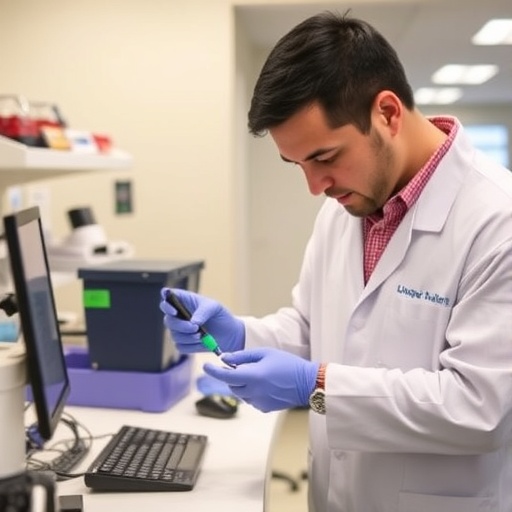
In a significant leap forward in cancer diagnostics, researchers at King Abdullah University of Science and Technology (KAUST) have unveiled a novel stain-free imaging platform that promises to revolutionize tissue sample analysis. This cutting-edge technology could streamline and accelerate the diagnostic process, while offering unprecedented consistency in evaluating pathological specimens. Central to KAUST’s Smart Health initiative, this innovation aims to enhance cancer prevention, early diagnosis, and therapeutic interventions through advanced technological integration.
Traditional pathology techniques have long depended on chemical staining — predominantly Hematoxylin and Eosin (H&E) — to reveal structural details of tissue samples under microscopic examination. While effective, this conventional approach is time-intensive, requiring multiple preparation stages, and is subject to variability influenced by reagent quality, technician skill, and laboratory conditions. Such inconsistencies can inadvertently affect diagnostic accuracy, delaying clinical decision-making. KAUST scientists challenged this paradigm by engineering a novel methodology that circumvents the staining requirement altogether.
The cornerstone of this pioneering platform is an engineered silicon slide capable of generating detailed structural color images intrinsically from unstained tissue samples. By leveraging precise optical interactions at the nanoscale, these slides produce vivid and diagnostically informative images that highlight cellular and extracellular matrix architectures. These direct digital captures provide pathologists with familiar histological visuals but with the advantage of enhanced reproducibility and rapid acquisition. Moreover, the standardized nature of the generated image data paves the way for integration with artificial intelligence (AI) algorithms, promising future automated or assisted diagnostic workflows.
To validate their approach, the KAUST team conducted an extensive study focusing on colorectal tissue specimens, a critical choice given colorectal cancer’s prominence as a leading cancer type in Saudi Arabia and worldwide. They procured samples from 120 patients to rigorously compare the new stain-free imaging system against conventional pathology assessments. Remarkably, this innovative platform achieved a 99% agreement rate with traditional H&E-stained slide diagnoses, underscoring its clinical reliability and diagnostic concordance.
Equally notable was the platform’s impact on workflow efficiency. Eliminating the staining step led to a notable reduction in tissue preparation time by approximately 40 to 50 percent. This accelerated timeline holds profound implications for clinical pathology labs, potentially alleviating bottlenecks and enabling faster turnaround of critical diagnostic information. Furthermore, removing the staining process reduces exposure to hazardous chemicals and minimizes procedural errors linked to reagent variability, further enhancing laboratory safety and consistency.
Professor Qiaoqiang Gan, the lead materials scientist behind the project, emphasized the transformative potential of this technology. He explained that “traditional staining methods introduce variability due to numerous factors such as reagent quality and environmental conditions. By harnessing silicon nanostructures to directly generate consistent digital images, we mitigate these issues, providing more reliable diagnostics and creating a foundation for AI-assisted analysis in clinical settings.” This statement highlights the dual benefit of improved manual pathology review and future advanced computational diagnostics.
Beyond colorectal cancer, the technology’s adaptability was tested on a range of other cancer tissue types including breast, lung, and thyroid samples. The platform proficiently captured essential histological features across these diverse specimens, exhibiting versatility that could expand its clinical utility across multiple oncology disciplines. This broad applicability signals promising potential for the platform as a universal tool in histopathology.
Fundamental to the project’s success was its interdisciplinary collaboration, drawing on expertise in materials science, biomedical imaging, and computational analysis. Such a comprehensive approach ensured the engineered silicon slides were optimized not only for structural imaging quality but also for practical clinical deployment. Currently, the researchers are extending their evaluation by partnering with leading medical institutions like the King Faisal Specialist Hospital & Research Centre (KFSHRC) in Madinah. These efforts will further validate the platform’s real-world performance and inform pathways toward routine clinical integration.
Future research is focused on refining image processing algorithms and developing AI models trained on the consistent digital images produced by this platform. The goal is to augment pathologists’ diagnostic accuracy with machine learning tools capable of rapid feature recognition and classification, thereby relieving some of the growing workload on healthcare systems. Such AI-assisted diagnostics could lead to earlier cancer detection, better prognostic stratification, and more personalized treatment plans.
In addition to clinical applications, the technology holds promise for academic research and drug development, where standardized and high-throughput tissue imaging is invaluable. The ability to rapidly generate stain-free detailed morphological data could accelerate biomarker discovery and therapeutic efficacy studies, fostering innovation beyond diagnostic domains.
Overall, the KAUST-developed stain-free imaging platform represents a paradigm shift in histopathology by dramatically reducing sample preparation time, improving reproducibility, and enabling next-generation AI integration. As this technology moves toward clinical translation, it has the potential to transform cancer diagnostics globally, reducing delays in diagnosis and improving patient outcomes through more reliable and efficient pathology workflows.
Subject of Research: Lab-produced tissue samples
Article Title: KAUST researchers develop technology that could make cancer diagnosis faster
News Publication Date: 15-Jun-2026
Image Credits: KAUST News Website
Keywords
Cancer diagnostics, stain-free imaging, histopathology, colorectal cancer, silicon slides, digital pathology, artificial intelligence, medical imaging, tissue analysis, pathology workflow, biomarker detection, biomedical innovation
Tags: accelerating cancer diagnosticsadvanced tissue sample analysiscancer diagnosis technology innovationconsistency in pathological specimen evaluationdigital pathology without stainingearly cancer diagnosis techniquesnanoscale optical interactions in pathologyovercoming traditional staining limitationssilicon slide optical imagingSmart Health initiative in cancer preventionstain-free imaging platformtherapeutic interventions through imaging