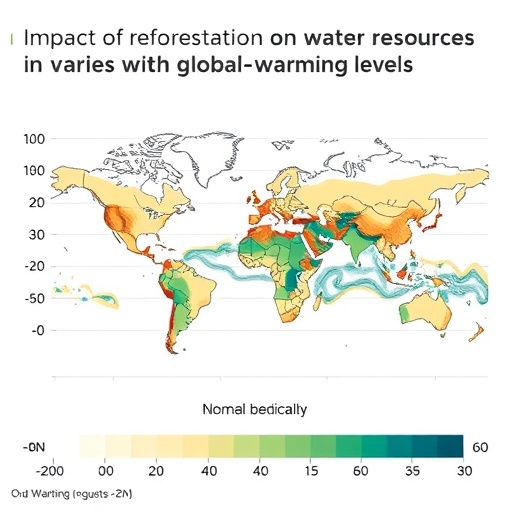
In the ongoing battle against climate change, reforestation has emerged as a prominent natural solution, widely endorsed for its potential to sequester carbon and restore ecosystems. However, new research conducted by scientists at the Institute of Atmospheric Physics at the Chinese Academy of Sciences introduces a nuanced understanding of the hydrological implications of large‑scale tree planting. Their findings demonstrate that the interplay between reforestation and water availability is far from straightforward, revealing a complex dependency on the magnitude of global warming. This groundbreaking study, published in the journal One Earth, employs state-of-the-art Earth system model simulations derived from the CMIP6 project to unravel how different warming scenarios modulate the impact of reforestation on terrestrial water resources.
By analyzing the effects of identical reforestation activities under two divergent future climate pathways, the study presents a stark contrast between the outcomes anticipated under low-warming and high-warming trajectories. Specifically, the low warming scenario corresponds to the SSP1-2.6 pathway, characterized by aggressive mitigation policies leading to limited temperature increases, while the high warming scenario (SSP3-7.0) assumes continued high emissions and consequent elevated global temperatures. Central to the researchers’ inquiry was land water availability, defined as the balance between precipitation inputs and evaporative losses—a critical factor sustaining not only natural ecosystems but also supporting agriculture and human consumption.
Intriguingly, the research reveals that the same scale and extent of reforestation induce almost opposite effects on water availability depending on the warming context. Under the low warming scenario, reforestation acts to slightly augment total global water availability. Nevertheless, this benefit is unevenly distributed, with wetter regions experiencing amplified water abundance and drier areas becoming comparably drier, effectively broadening the disparity between moisture-rich and moisture-poor zones. This “rich get richer” dynamic poses ecological and socio-economic challenges, particularly for regions already vulnerable to water scarcity.
Conversely, in the high warming scenario, the study records an overall reduction in global water availability in response to reforestation efforts. Yet, the intriguing paradox is that this scenario also leads to a more equitable distribution of water resources across regions. This pattern suggests that while total water stores decline under high warming, disparities between wet and dry regions lessen, potentially reflecting fundamental shifts in atmospheric moisture transport and circulation patterns influenced by elevated temperatures.
A deeper dive into per capita water availability further emphasizes the complexity introduced by demographic factors. SSP3-7.0 envisages a substantially larger global population compared to SSP1-2.6, compounding water stress under high warming conditions. This demographic growth exacerbates the per capita water loss, particularly in wetter regions, thereby intensifying competition for dwindling freshwater resources. This insight highlights the critical importance of integrating population dynamics into the assessment of climate adaptation strategies such as reforestation.
To elucidate the mechanisms underlying these divergent hydrological responses, the scientific team conducted a comprehensive moisture budget analysis. Their investigation points to alterations in atmospheric circulation as the key driver behind the contrasting outcomes. Specifically, divergent patterns in the convergence of atmospheric moisture over wet regions were identified, which modulate precipitation distribution and thus influence terrestrial water availability. However, the authors acknowledge that fully deciphering the mechanistic links between warming levels, circulation changes, and hydrological responses demands further research, signifying an open frontier for climate science.
One of the study’s most significant contributions is its resolution of previously apparent contradictions in the scientific literature regarding reforestation’s effect on water availability. Prior investigations yielded conflicting conclusions—some suggested that reforestation led to increased water availability, while others reported reductions. This latest research reframes those findings by demonstrating that both perspectives are contextually valid, contingent on the prevailing climate regime. By incorporating the dimension of background climate state into hydrological assessments, the study advances a more holistic understanding of reforestation’s multifaceted impacts.
The policy implications emanating from these findings are profound. The study cautions against simplistic applications of reforestation as a universal climate mitigation and adaptation tool. Dr. Junji Cao, a co-author, underscores the necessity for policymakers to consider spatial and temporal dimensions when planning reforestation projects. The beneficial role of tree planting in enhancing water resources under a low-emission, cooler climate scenario may invert under hotter futures, potentially aggravating water scarcity challenges. This underscores how adaptive management protocols must be climate-sensitive and flexible to anticipated warming trajectories.
This research ushers in a paradigm shift in evaluating nature-based climate solutions by advocating for climate scenario-specific assessments. It pushes for integrative frameworks that factor in atmospheric dynamics, hydrological cycles, ecological feedbacks, and human demographic trends to accurately predict outcomes of large-scale environmental interventions. The implications stretch beyond academia, influencing watershed management, agricultural planning, and regional water governance under climate change.
Moreover, the detailed and rigorous Earth system model approach adopted in this study sets a new standard for examining coupled climate-ecosystem-water interactions. By utilizing comprehensive CMIP6 simulations, the research harnesses the latest advances in climate modeling, ensuring robustness and contemporary relevance in its projections. This technical emphasis is essential for informing credible climate adaptation strategies and fostering resilience in both human and natural systems.
In light of these insights, future reforestation endeavors require an informed balance between carbon sequestration goals and hydrological realities. The nuanced understanding of climatic and meteorological dynamics governing water cycle responses to vegetation changes will be pivotal in designing effective, sustainable interventions. As global warming continues to pose unprecedented challenges, such integrative and evidence-based approaches highlight the indispensable role of interdisciplinary science in guiding policy and conservation efforts.
Ultimately, this study not only advances scientific comprehension of reforestation’s climate feedbacks but also exemplifies how careful, scenario-based evaluation can clarify complex environmental phenomena. Reforestation remains a vital component of climate action portfolios, yet this research compellingly advocates for its deployment with precision, foresight, and contextual awareness—reminding us that ecological solutions are intertwined with the broader climatic tapestry in which they unfold.
Subject of Research: Hydrological impacts of reforestation under varying global warming scenarios
Article Title: Reforestation increases water inequality under low warming but reduces water availability under high warming
News Publication Date: 15-Jun-2026
Web References:
10.1016/j.oneear.2026.101740
Image Credits: Tao Tang
Keywords: Reforestation, Water availability, Hydrological cycle, Climate change, Atmospheric circulation, CMIP6, Earth system model, Water resources, Anthropogenic climate change, Population dynamics
Tags: atmospheric physics climate researchcarbon sequestration and ecosystem restorationclimate change and water availabilityclimate mitigation and water resourcesCMIP6 Earth system modelsglobal warming effects on hydrologyhydrological cycle under climate changeland water balance and reforestationlarge-scale tree planting consequencesreforestation impact on water resourcesSSP1-2.6 low warming scenarioSSP3-7.0 high warming scenario