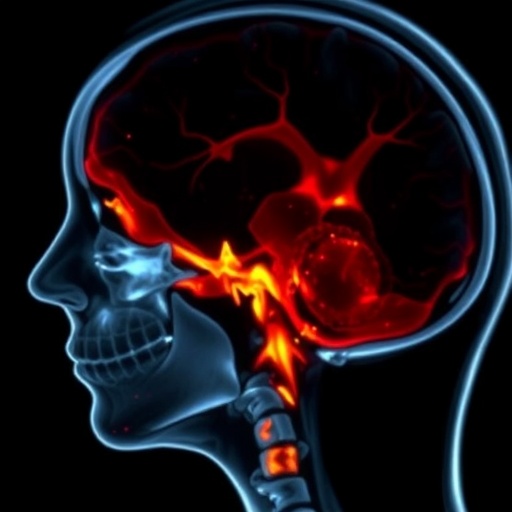

image: FireANTS combines AI and geometry to match features in dense images faster and more accurately, with potential applications in fields like radiology.
view more
Credit: Pratik Chaudhari, James Gee, Rohit Jena
Penn Engineers have developed an open-source algorithm that combines the speed of AI with the precision of geometry to compare complex medical images quickly and accurately, helping detect subtle changes that, over time, can signal disease. In some cases, the new algorithm can accomplish in minutes what would have taken prior techniques an entire week.
Dubbed “FireANTs,” the algorithm operates differently than many AI approaches to analyzing medical images. “Typically, AI systems make predictions based on their training data,” says Pratik Chaudhari, Assistant Professor in Electrical and Systems Engineering and co-senior author of a study in Nature Communications. “FireANTs, by contrast, borrows optimization techniques from modern AI but solves the matching problem mathematically, determining how one image actually corresponds to another without relying too much on guessing based on past examples.”
In tests, the team evaluated FireANTs across over a dozen datasets spanning more than 15,000 image pairs, multiple organ systems, different imaging modalities and various species, showing that the method could generalize across a wide range of imaging challenges.
Because FireANTs operates so quickly — running hundreds to thousands times faster than its predecessor, ANTs, depending upon the problem, with no loss in accuracy — the algorithm could be used not just in medical research, but clinical practice as well.
“In radiology, a large fraction of radiology reads involve follow-up imaging, to see what changes have occurred between scans,” says James C. Gee, Professor of Radiologic Science in Radiology and the study’s other co-senior author. “Image registration can help automatically pinpoint any differences but if the processing takes too long, it simply doesn’t fit into the clinical workflow. The speed makes a huge difference in making this practical for patient care.”
The Challenge of Dense Correspondence
FireANTs is designed to solve a common problem in medical imaging: dense correspondence matching, or the process of identifying similar patterns in data-rich images, like sets of MRIs or CAT scans from the same patient.
This challenge frequently arises in radiology, where clinicians may want to know not just whether two images look substantially different, but exactly how particular regions of tissue have changed over time, and by how much. Even subtle changes in, say, brain volume can matter: unusually rapid shrinkage, for example, could be an early sign of cognitive decline.
The Next Evolution of ANTs
More than a decade ago, Gee’s lab led the development of ANTs, short for Advanced Normalization Tools, an open-source software toolkit for analyzing medical images. While ANTs remains a powerful and widely used tool, it was created before recent advances in AI made it possible to process much larger datasets far more quickly.
When first author Rohit Jena, a doctoral student in Computer and Information Science mentored by both Chaudhari and Gee, tested out the software, he wondered if it could run faster. “ANTs worked much better than existing methods in the literature,” Jena says. “But ANTs simply wasn’t built for the kind of massive datasets that have become standard in medical and biological imaging research today.”
At first, Jena tried adapting ANTs for use on a graphics processing unit (GPU), the same kind of advanced computer chips used to train AI models, a request that frequently appeared in online forums devoted to using ANTs, indicating the project’s value to the research community.
But, after spending time ‘under the hood’ and seeing how ANTs worked, he realized that simply moving the software onto faster hardware would not be enough. He would have to rethink the geometry underlying the algorithm itself.
A Shortcut Through Curved Space
Training a typical AI model is like riding a bicycle on flat ground: optimizing the system involves updating numerical “weights” that exist in Euclidean, or flat, space. In that setting, the direction of travel, just like the bicycle’s handlebars, stays even from one step to the next.
Comparing two dense images, by contrast, is like riding over hills and through valleys. The problem requires updating a “diffeomorphism,” a non-Euclidean object that exists in curved space. To keep the bicycle traveling straight, you have to keep adjusting the angle of the handlebars.
That adjustment, known as parallel transport, is computationally expensive. But Jena wondered whether it could be avoided. What if, instead of constantly adapting the algorithm to the landscape, he could adapt the landscape to the algorithm?
In essence, FireANTs keeps the cyclist stationary, while the world reorients itself, making the journey through curved space behave like the one across flat ground. “Mathematically speaking, the algorithm reaches the same destination with far less computational effort,” says Jena.
Future Directions
Ultimately, the researchers say, the promise of FireANTs lies not just in speed — around two to seven times that of state-of-the-art optimization toolkits deployed on a standard computer chip, and up to three orders of magnitude faster on a GPU — but in what that speed makes possible.
In clinical settings, faster image matching could make advanced analysis more practical. “Being able to perform advanced medical imaging analysis, such as change detection, in real time would be game changing for patients and doctors,” says Gee. “For AI to be clinically useful, there’s a very high bar: medical imaging software has to be both fast and accurate.”
The potential impact also extends beyond standard medical imaging to fields as varied as geospatial mapping and robotics. Because FireANTs reduces computational cost, it could help smaller labs tackle analyses that once required the resources of much larger consortia.
“FireANTs is not just a faster tool,” says Chaudhari. “It’s a way to make advanced image matching both performant and reliable, so researchers and clinicians can work at a scale and speed that wasn’t possible before, unlocking totally new workflows and applications.”
This study was conducted at the University of Pennsylvania’s School of Engineering and Applied Science and at the Perelman School of Medicine and supported by NIH grants R01-HL133889, U24-MH114827, RF1-MH124605, R01-EB031722 and U24-NS135568.
Journal
Nature Communications
DOI
10.1038/s41467-026-72508-3
Method of Research
Data/statistical analysis
Subject of Research
Not applicable
Article Title
FireANTs: Adaptive Riemannian Optimization for Multi-Scale Diffeomorphic Matching
Article Publication Date
9-Jun-2026
COI Statement
The authors declare no competing interests.
Media Contacts
Ian Scheffler
University of Pennsylvania School of Engineering and Applied Science
Holly Wojcik
University of Pennsylvania School of Engineering and Applied Science
Office: 215-573-4607
Journal
Nature Communications
DOI
10.1038/s41467-026-72508-3
Method of Research
Data/statistical analysis
Subject of Research
Not applicable
Article Title
FireANTs: Adaptive Riemannian Optimization for Multi-Scale Diffeomorphic Matching
Article Publication Date
9-Jun-2026
COI Statement
The authors declare no competing interests.
bu içeriği en az 2000 kelime olacak şekilde ve alt başlıklar ve madde içermiyecek şekilde ünlü bir science magazine için İngilizce olarak yeniden yaz. Teknik açıklamalar içersin ve viral olacak şekilde İngilizce yaz. Haber dışında başka bir şey içermesin. Haber içerisinde en az 12 paragraf ve her bir paragrafta da en az 50 kelime olsun. Cevapta sadece haber olsun. Ayrıca haberi yazdıktan sonra içerikten yararlanarak aşağıdaki başlıkların bilgisi var ise haberin altında doldur. Eğer yoksa bilgisi ilgili kısmı yazma.:
Subject of Research:
Article Title:
News Publication Date:
Web References:
References:
Image Credits:
Keywords
Tags: advanced radiology image comparisonAI algorithms for subtle change detectionAI-powered medical image analysiscombining AI with geometry in healthcareefficient analysis of complex medical imagesFireANTs algorithmgeometric accuracy in radiologymedical image processing speed improvementopen-source medical imaging softwarePenn Engineers medical imaging innovationprecision imaging algorithmsrapid disease detection in medical images