A Retro Video Game Revolutionizes Stroke Rehabilitation by Enhancing Arm Motor Function
Stroke survivors often face enduring challenges with motor function, particularly impairments limiting arm movements that severely impact daily living activities. In a groundbreaking study conducted by researchers at Northwestern University, a novel approach to neurorehabilitation leverages a throwback 1990s-style video game to accelerate motor recovery among chronic stroke patients. This innovative system, known as MINT (myoelectric interface for neurorehabilitation) conditioning, harnesses sophisticated electromyographic (EMG) technology paired with engaging gameplay to promote the decoupling and retraining of muscles hindered by abnormal co-activation after a stroke.
The MINT system addresses a critical deficit post-stroke: the brain’s disrupted ability to independently activate muscles, resulting in what neuroscientists term “abnormal coupling,” where muscles contract simultaneously in maladapted patterns. Such co-activation can cause patients to struggle with seemingly simple motor tasks, such as extending the arm forward, because the simultaneous and mistimed firing of muscles leads to constrained and inefficient movement. For instance, a stroke survivor trying to reach straight ahead may find their elbow involuntarily bends due to unintended biceps activation, reflecting this maladaptive neural signaling.
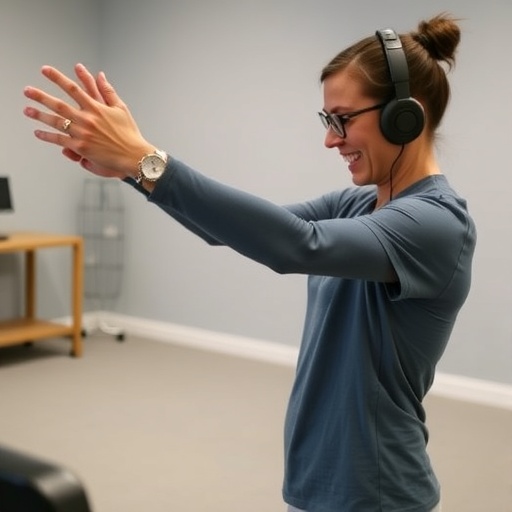
Researchers developed a bespoke video game that translates EMG signals from impaired muscles into interactive in-game actions—a process scientifically rooted in interpreting nuanced muscle electrical activity to control on-screen cursors. Players wear a compact EMG device on their affected arm which detects electrical output from primary muscles like the biceps and deltoids. These signals then allow players to move a cursor in two orthogonal directions: for example, the biceps moves the cursor rightward while the deltoid moves it upward. When muscles remain coupled, cursor movement follows a diagonal trajectory, mirroring simultaneous activation. Crucially, the gameplay incentivizes breaking this diagonal pattern, requiring users to selectively activate individual muscles to hit targets increasingly distant from the diagonal, thus retraining precise motor control through repeated, engaging practice.
This rehabilitation paradigm represents a significant departure from conventional stroke therapies, which often emphasize compensatory strategies. Traditional rehab encourages stroke survivors to use whole-body movements to accomplish tasks, such as leaning forward to compensate for limited arm reach. While effective for task completion, such strategies do not directly remediate the underlying motor impairment. By contrast, the MINT conditioning system targets the neural mechanisms of motor control by focusing explicitly on reducing pathological muscle co-activation and improving independent muscle recruitment. This targeted approach is validated by quantifiable improvements in range of motion and task completion measured via the Wolf Motor Function test, a clinical assessment evaluating the speed and accuracy with which patients perform standard arm-related activities.
The clinical trial supporting this breakthrough involved 59 chronic stroke survivors with moderate to severe arm impairments persisting at least six months post-stroke, including some participants over a decade out from their cerebrovascular event. They trained for six weeks, five days per week at home for 90 minutes a day, supported by one supervised day per week in the laboratory setting. This at-home mobility facilitated a remarkable tenfold increase in therapeutic repetitions, exceeding 300 repetitions daily compared to 30 repetitions typical in clinic-based rehab, illustrating the power of gamification and remote monitoring for overcoming traditional barriers in stroke recovery.
The trial employed a randomized, sham-controlled design, dividing participants into four groups: three received variations of progressive MINT training focused on muscle decoupling, with an emphasis on training two muscles at a time escalating to three-muscle coordination, while the fourth control group engaged in a sham game involving simpler single-muscle tasks without decoupling emphasis. The rigor of this experimental structure allowed the researchers to isolate the specific therapeutic impact of targeted muscle decoupling from general exercise-related gains.
At the conclusion of the intervention, all groups showed improvement, yet patients receiving the three-muscle decoupling regimen demonstrated outstanding gains, achieving up to 7.8 times the improvement observed in the sham group. These enhancements were not transient; patients continued to progress even after therapy cessation, underscoring the durable neural plasticity engendered by targeted myoelectric conditioning. These findings suggest that prolonging and intensifying the training period, particularly on the most dysfunctional muscles, optimizes rehabilitation outcomes.
The scientific principle underlying this success lies in neuroplasticity—the nervous system’s capacity to reorganize and adapt following injury. By decoding muscle activation signals and providing immediate visual and functional feedback, the video game interface reinforces correct neuromuscular patterns, retraining the brain to send more coordinated movement signals. The decoupling of aberrantly synchronized muscles not only improves motor control but also enhances the fluidity and independence of voluntary movements critical for regaining autonomy.
Beyond the technological innovation, participant responses highlight the gamified therapy’s psychosocial benefits. Many reported increased motivation to engage in rehabilitation due to the game’s enjoyable and interactive nature, reflecting burgeoning evidence that patient adherence and mood significantly influence rehab success. This motivational component is vital for translating physiological improvements into meaningful real-world functional recovery.
Looking to the future, Northwestern’s interdisciplinary team—including bioelectronics pioneer John A. Rogers—is advancing the technology to develop a fully wireless EMG system that can be integrated seamlessly into daily life. Plans to enhance game engagement and introduce leg-focused rehabilitation modules promise to expand the applicability of this paradigm to a broader spectrum of motor impairments sustained not only from stroke but potentially other neurological conditions.
This revolutionary research, soon to be published in Neurorehabilitation and Neural Repair, represents a milestone in marrying neuroscience, bioengineering, and patient-centered design. By demonstrating that remote, high-repetition, targeted muscle retraining through an accessible video game platform can substantially accelerate arm recovery, the study sets a new standard for stroke rehabilitation. Such integrative approaches harness the power of technology to unlock neuroplastic potentials long thought limited in chronic stroke populations, thereby offering hope for improved quality of life to millions worldwide.
Subject of Research: People
Article Title: Not provided in the source material
News Publication Date: June 9, 2026
Web References:
Video demonstration of therapy benefits
Video of the MINT game in action
References: Study to be published in Neurorehabilitation and Neural Repair
Image Credits: Kristin Samuelson, Northwestern.edu
Keywords
Motor control, Clinical neuroscience, Neurology, Motor coordination, Motor learning, Voluntary movements, Muscle relaxation, Muscle contraction, Physical rehabilitation, Regenerative medicine, Arms, Regeneration, Limb regeneration, Neuroscience
Tags: abnormal muscle co-activation post-strokearm movement rehabilitation after strokechronic stroke motor recoveryEMG-based stroke therapyinnovative stroke rehabilitation technologyinteractive stroke rehabilitation gamesmotor function improvement in stroke survivorsmuscle retraining with video gamesmyoelectric interface for neurorehabilitationneuroplasticity in stroke patientsstroke rehabilitation techniquesvideo game neurorehabilitation