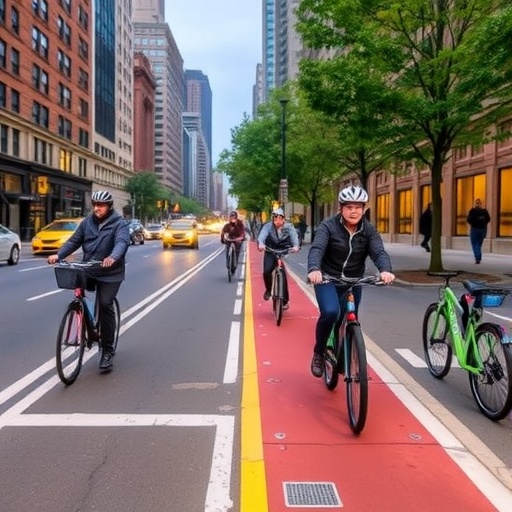
In a groundbreaking study published this week in npj Sustainable Mobility and Transport, researchers from New York University’s Tandon School of Engineering have illuminated the pivotal role that protected bike lanes play in boosting bikeshare usage in New York City. This extensive investigation leverages over a decade of trip data from Citi Bike, New York City’s widely used bikesharing system, dissecting the real-world impact of different cycling infrastructure on ridership patterns. The findings decisively highlight protected bike lanes as a critical factor in fostering increased cycling activity, shaking up long-held assumptions in urban transportation planning.
Protected bike lanes are characterized by physical barriers—ranging from concrete curbs to parked cars and flexible bollards—that distinctly separate cyclists from motor vehicle traffic, creating a safer and more inviting riding environment. In contrast, painted bike lanes merely feature a painted demarcation on the road, offering no physical buffer between cyclists and cars, while sharrows, or shared lane markings, signify space for bicycles but require cyclists to share the roadway with motor vehicles without any dedicated lane. This study meticulously contrasts the effectiveness of these infrastructure types by analyzing roughly 72 million Citi Bike trip records collected from 2013 to 2024, a period marking substantial growth in the system’s patronage.
Initial comparisons appeared to show that both protected and painted bike lanes correlated with increased ridership, with protected bike lanes associated with an 18% rise in trips near stations and painted lanes alongside sharrows delivering around a 14% increase. Yet, the challenge lay in discerning whether these trends reflected genuine causal relationships or were simply the result of bike lanes being installed in areas already witnessing cycling growth. To address this, the researchers harnessed sophisticated statistical methodologies, including propensity score matching and difference-in-differences analysis, enabling them to control for confounding variables such as pre-existing neighborhood characteristics and ridership trajectories.
After rigorous statistical refinement, only protected bike lanes emerged as having a statistically significant causal effect on Citi Bike ridership. The research team quantified this impact as an average increase of approximately 379 rides per station per month following the installation of protected lanes. In stark contrast, painted bike lanes and sharrows failed to demonstrate a similar causal influence, suggesting that the mere presence of painted markings without physical protection is insufficient to meaningfully alter cycling behavior at scale.
Takahiro Yabe, an Assistant Professor at NYU’s Department of Technology Management and Innovation and a scholar at the Center for Urban Science + Progress, emphasizes that “not all bike lanes are created equal.” He stresses that when municipalities deploy cycling infrastructure, nuanced design elements significantly determine whether these installations merely exist as map features or actively transform travel behavior, with profound consequences for urban transportation ecosystems, public health outcomes, and sustainability objectives amid resource constraints.
Marcel Moran, the study’s lead author and currently an Assistant Professor at San José State University who contributed to the research during his fellowship at NYU CUSP, underscored the disparity in political and financial dynamics. He noted that while painted lanes and sharrows often garner less resistance and cost less to implement, “protected bike lanes are truly what can move the needle on ridership.” This finding resonates deeply within urban planning discourse, illuminating a compelling case for prioritizing investment in protected cycling infrastructure to spur substantive increases in active transportation.
Importantly, the investigation also dissected demographic disparities in the effectiveness of protected bike lanes. The researchers observed that positive ridership impacts were statistically significant predominantly in neighborhoods with the lowest proportions of Black residents. Conversely, in communities with higher percentages of Black populations, the study did not detect a clear causal effect on Citi Bike ridership. Malik Salman, a co-author and current NYU CUSP Research Scholar, provides context by noting that infrastructural enhancements alone may be insufficient to overcome systemic barriers such as affordability, inequitable policing practices, and historical exclusion from urban planning processes. Thus, while protected lanes are a vital step, complementary initiatives are necessary to foster equitable cycling adoption across diverse communities.
The analysis further revealed particularly robust ridership gains among older adults, especially in Census block groups with the highest concentration of residents aged 60 to 79. This demographic appears especially responsive to infrastructure improvements that mitigate perceived risks of traffic interactions, which aligns with observations from cities like Copenhagen where an extensive network of protected bike lanes complements high cycling rates among seniors. This dimension of the research spotlights the potential for targeted infrastructure design to enhance mobility and health outcomes for aging urban populations.
This study’s timing coincides with an unprecedented expansion of New York City’s bike network, which has grown from approximately 900 miles of bike lanes in 2014 to about 1,500 miles in 2024, alongside record-breaking usage by Citi Bike, with roughly 45 million trips logged in 2024 alone. The authors advocate that their methodological approach—leveraging large-scale, publicly available bikeshare and bike lane data combined with advanced statistical modeling—offers a replicable framework for other metropolitan areas such as Chicago, Boston, San Francisco, and Washington, D.C., to rigorously evaluate the impacts of their cycling infrastructure investments.
The implications of this study extend well beyond New York City, signaling a transformative shift in how urban planners and policymakers should conceptualize investments in bicycle infrastructure. This research challenges the prevailing notion that all bike lanes uniformly encourage cycling, highlighting that physical protection is a necessary condition to significantly influence ridership in diverse urban contexts. At the intersection of transportation engineering, public health, and social equity, these findings provide a data-driven roadmap for cities grappling with the complexities of expanding sustainable mobility options amid evolving demographic and political landscapes. This convergence of technical rigor and societal relevance positions protected bike lanes as not only a measure of urban design innovation but also as a catalyst for more inclusive, resilient cities of the future.
Subject of Research: Not applicable
Article Title: Heterogeneous impacts of protected bike lanes on bikeshare behavior across demographic groups in New York
News Publication Date: 3-Jun-2026
Web References: https://www.nature.com/articles/s44333-026-00107-2
References: 10.1038/s44333-026-00107-2
Keywords
Transportation engineering, urban mobility, bikeshare systems, protected bike lanes, cycling infrastructure, active transportation, statistical analysis, urban planning, public health, equity in transportation, New York City, data-driven policy
Tags: bikeshare data analysis 2013-2024bikeshare growth factorsbikeshare usage patterns NYCCiti Bike ridership increasecycling infrastructure and community variationNew York University Tandon studypainted vs protected bike lanesphysical barriers for cyclist safetyprotected bike lanes NYCsharrows and cycling safetysustainable urban transport NYCurban cycling infrastructure impact