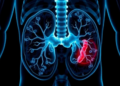
A computer's ability to predict a patient's lifespan simply by looking at images of their organs is a step closer to becoming a reality, thanks to new research led by the University of Adelaide.
The research, now published in the Nature journal Scientific Reports, has implications for the early diagnosis of serious illness, and medical intervention.
Researchers from the University's School of Public Health and School of Computer Science, along with Australian and international collaborators, used artificial intelligence to analyse the medical imaging of 48 patients' chests. This computer-based analysis was able to predict which patients would die within five years, with 69% accuracy – comparable to 'manual' predictions by clinicians.
This is the first study of its kind using medical images and artificial intelligence.
"Predicting the future of a patient is useful because it may enable doctors to tailor treatments to the individual," says lead author Dr Luke Oakden-Rayner, a radiologist and PhD student with the University of Adelaide's School of Public Health.
"The accurate assessment of biological age and the prediction of a patient's longevity has so far been limited by doctors' inability to look inside the body and measure the health of each organ.
"Our research has investigated the use of 'deep learning', a technique where computer systems can learn how to understand and analyse images.
"Although for this study only a small sample of patients was used, our research suggests that the computer has learnt to recognise the complex imaging appearances of diseases, something that requires extensive training for human experts," Dr Oakden-Rayner says.
While the researchers could not identify exactly what the computer system was seeing in the images to make its predictions, the most confident predictions were made for patients with severe chronic diseases such as emphysema and congestive heart failure.
"Instead of focusing on diagnosing diseases, the automated systems can predict medical outcomes in a way that doctors are not trained to do, by incorporating large volumes of data and detecting subtle patterns," Dr Oakden-Rayner says.
"Our research opens new avenues for the application of artificial intelligence technology in medical image analysis, and could offer new hope for the early detection of serious illness, requiring specific medical interventions."
The researchers hope to apply the same techniques to predict other important medical conditions, such as the onset of heart attacks.
The next stage of their research involves analysing tens of thousands of patient images.
###
Media Contacts:
Dr Luke Oakden-Rayner
Radiologist and PhD student
School of Public Health
The University of Adelaide
[email protected]
Professor Lyle Palmer
Professor of Genetic Epidemiology
School of Public Health
The University of Adelaide
[email protected]
Media Contact
Luke Oakden-Rayner
[email protected]
@UniofAdelaide
http://www.adelaide.edu.au
############
Story Source: Materials provided by Scienmag