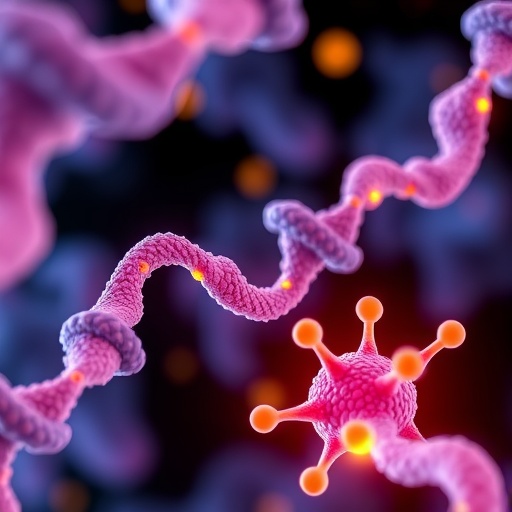
In a groundbreaking stride towards the convergence of quantum physics and biology, scientists have uncovered a revolutionary method to harness quantum sensing within proteins—nature’s own molecular machinery. Until now, the domain of quantum sensing was predominantly dominated by solid-state materials, such as diamonds embedded with microscopic defects known as nitrogen-vacancy centers. These defects allowed the detection of subtle magnetic fields with astonishing precision, but the rigid, inorganic frameworks limited their applicability in biological contexts. The recent research breakthrough, however, transcends these limitations by embedding quantum sensing capabilities directly into biological proteins, opening the door to a new era of quantum biosensing and remote biological control.
The team of researchers, led by Professor Dominik Bucher from the Technical University of Munich’s (TUM) School of Natural Sciences, has demonstrated for the first time that flavoproteins—naturally occurring, light-sensitive proteins found in many organisms—can exhibit spin-correlated radical pairs with unique quantum mechanical characteristics. These radical pairs are essentially coupled electron spins that possess extraordinary sensitivity to weak magnetic fields, a hallmark of quantum effects within biological systems. Previously, the quantum properties in such proteins were theorized or observed indirectly, but this study marks a milestone by optically detecting and manipulating these quantum states using radio frequency fields.
At the heart of the experiment, the researchers exposed flavoproteins to blue light, initiating a photochemical reaction that produces spin-correlated radical pairs within the protein matrix. These pairs form due to electron transfer reactions triggered by the absorbed photons, generating pairs of unpaired electrons with correlated spins. Such spin pairs are profoundly influenced by their magnetic environment, leading to changes in their spin dynamics that the team ingeniously linked to changes in the proteins’ luminescence intensity. This optical readout method circumvents the need for complex electronic apparatus, facilitating highly localized and non-invasive sensing.
The experimental setup’s novelty lies in the application of radio waves to manipulate the electron spins within the radical pairs. By precisely tuning radio frequency excitation, the scientists succeeded in altering the quantum states of the radical pairs, which directly modulated the luminescence emitted by the flavoproteins. This controllable interaction between electromagnetic fields and protein spin states not only confirms the presence of coherent quantum effects in living-compatible environments but also sets the stage for the development of quantum-controlled biological functions.
The implications of these findings stretch far beyond academic curiosity. Unlike traditional solid-state quantum sensors, which are discrete physical devices often bulky and incompatible with living tissues, protein-based quantum sensors have the innate advantage of being genetically encoded within cells. This attribute allows for ubiquitous and minimally invasive deployment inside living organisms. The prospect of building quantum sensors into cellular structures offers unprecedented spatial resolution and sensitivity for monitoring physiological processes in real time.
Furthermore, the ability to manipulate quantum spin states in proteins via external radio waves introduces a paradigm shift in our capability to remotely control cellular biochemistry. Professor Bucher hints at the fascinating potential to regulate cellular activities, including gene expression, with fine temporal and spatial precision using non-invasive electromagnetic fields. This approach could revolutionize therapeutic modalities, allowing researchers to modulate disease-related pathways or activate therapeutic genes with pinpoint accuracy, all controlled externally through radio wave signals.
The study hinges on a particular flavoprotein known as cryptochrome, a protein extensively studied in the context of magnetoreception—the ability of certain species, such as migratory birds, to sense Earth’s magnetic field for navigation. Cryptochrome’s inherent spin-correlated radical pairs have long been suspected to function as natural quantum sensors in avian species. By leveraging this natural phenomenon, the research team has not only validated cryptochrome’s quantum capabilities but has also repurposed these biological components for engineered quantum sensing applications.
Contributions to the research came from interdisciplinary collaboration among experts from the Munich Center for Quantum Science and Technology (MCQST), the University of Freiburg, and the University of Marburg. The proteins utilized were supplied by Prof. Erik Schleicher’s lab at Freiburg, known for pioneering work on flavoproteins, ensuring high-quality biological specimens. This synergy between physics, chemistry, and biology underscores the multidisciplinary nature required to advance quantum biotechnology.
Despite being foundational research, the immediate applications are compelling. Kun Meng, the study’s first author, envisions a spectrum of biotechnological innovations ranging from ultra-sensitive biological quantum sensors capable of probing intracellular magnetic fields, to advanced bioelectronic interfaces that communicate with living tissues wirelessly. In particular, the wireless control of cell activities via radio wave interaction could pave the way for new classes of bio-hybrid devices, integrating quantum technologies seamlessly with life sciences.
From a technical standpoint, the detection method benefits from purely optical readouts, leveraging changes in fluorescence of the flavoproteins without necessitating invasive electrodes or complicated cryogenic environments typically required in solid-state quantum sensors. The room-temperature operation aligns well with physiological conditions, thus promising broad compatibility with diverse biological systems. This could ultimately lead to in vivo quantum sensing platforms capable of mapping magnetic field distributions at nanoscale resolutions within complex biological tissues.
The success of this study also stimulates philosophical questions about the role of quantum coherence and entanglement in biological processes, a topic that has fascinated scientists for decades. Demonstrating coherent spin manipulation in flavoproteins revives interest in quantum biology, heralding new research avenues that may reveal how quantum phenomena contribute to life itself, and how they can be harnessed for technological innovation.
Looking ahead, the researchers plan to deepen their understanding of spin dynamics in other photoreceptor proteins and expand the toolkit of genetically encodable quantum sensors. The tuning of these protein quantum systems may allow selective sensitivity to different electromagnetic field parameters, enabling customized sensing platforms suited for a variety of biomedical and environmental applications.
In conclusion, this pioneering research not only affirms the feasibility of protein-based quantum sensing but also establishes a versatile framework for developing next-generation bio-quantum devices. The integration of quantum mechanics with living organisms heralds an era where monitoring and control of biological systems can be accomplished with unprecedented specificity and minimal invasiveness, promising transformative impacts on medicine, biotechnology, and fundamental biology.
Subject of Research: Cells
Article Title: Optically detected and radio wave-controlled spin chemistry in flavoproteins
News Publication Date: 29-May-2026
Web References:
DOI: 10.1038/s41587-026-03158-5
Keywords
Quantum sensing, flavoproteins, radical pairs, spin chemistry, cryptochrome, biomolecular quantum sensors, optically detected magnetic resonance, radio wave control, quantum biology, molecular spintronics, biosensing, remote gene regulation
Tags: biological quantum sensorsflavoproteins quantum propertiesmagnetic field sensitivity in proteinsnitrogen-vacancy centers alternativesoptically detected quantum statesquantum biology breakthroughsquantum biosensing applicationsquantum effects in molecular machineryquantum sensing in proteinsradio wave control of proteinsremote biological control techniquesspin-correlated radical pairs