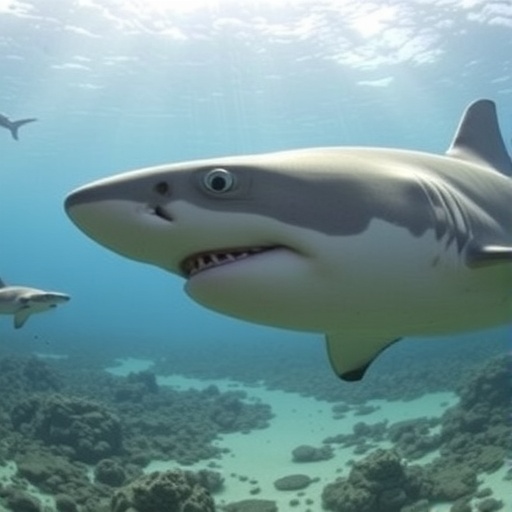
In recent years, the conservation of shark populations has garnered significant scientific and public attention, largely due to the crucial ecological roles these apex predators play in marine ecosystems. However, new research from Florida International University (FIU) suggests that safeguarding sharks requires more than just protecting the species themselves—it necessitates managing the availability of their prey. This pioneering study, focusing on Caribbean reef sharks in the Bahamas, reveals a complex interaction between predator presence and prey abundance that is reshaping conservation strategies.
The research leverages an impressive methodological approach, deploying 631 underwater cameras to systematically monitor shark movements and quantify the biomass of prey fish across various reef habitats. This comprehensive data collection enabled the researchers to construct robust statistical models that elucidate shark habitat preferences, specifically highlighting their affinity for small, densely populated reef areas teeming with prey. Unlike previously held assumptions that general prey abundance suffices for predator presence, this study emphasizes the spatial concentration of prey as a critical factor enhancing feeding efficiency and survival.
Caribbean reef sharks exhibit a clear preference for confined reef regions where prey fish biomass is not only abundant but densely aggregated, reducing the energetic costs associated with foraging. This spatial selectivity likely enhances the sharks’ ability to secure meals with minimal effort, which is especially vital given the energy demands of their predatory lifestyle. Furthermore, these strategic hunting grounds may offer additional benefits by granting sharks easier access to adjacent habitats and reducing their own vulnerability to larger predatory sharks, thereby shaping the intricate predator-prey dynamics within reef ecosystems.
The findings underscore a nuanced ecological interplay: while overfishing and hunting remain prominent threats to shark populations, the depletion of prey species could indirectly undermine shark survival by diminishing critical foraging grounds. This indirect impact of overfishing on predator populations introduces a challenging layer for conservationists, who must now consider prey fish biomass management as an integral component of effective shark protection protocols.
Moreover, the study highlights the distinct behavioral patterns of Caribbean reef sharks, which tend to frequent steep reef walls and deeper reef zones. These habitat preferences align with established knowledge about their ecological niches but also provide fresh insight into their spatial ecology relative to prey availability. Such detailed behavioral data refine our understanding of shark movement ecology and can inform more targeted conservation measures.
An additional dimension to this research is the apparent avoidance behavior Caribbean reef sharks exhibit towards larger shark species, which typically inhabit bigger reef areas rich in prey. This interspecific interaction likely influences the smaller reef sharks’ habitat choice, adding complexity to ecosystem management efforts that must account for multiple predator hierarchies.
The implications of this multi-faceted research are profound. Conservation policies that focus exclusively on banning shark fishing may fall short if they neglect the health and structure of reef ecosystems that support prey density. Protecting these reef habitats to maintain a complex structure that offers shelter for prey fish is essential to sustain robust predator populations. Reef complexity thus emerges as a cornerstone for both sustainable fisheries and shark conservation.
Equally important is the revelation that prey conservation, an often overlooked aspect, essentially supports apex predator sustainability. Overfishing of prey species can create trophic cascades that ultimately threaten shark populations, emphasizing the need for integrated management approaches that address the entire marine food web.
This FIU-led study calls for a paradigm shift in marine conservation tactics. It advocates holistic ecosystem-based management that balances predator protection with the stewardship of prey species and habitat integrity. By doing so, it may halt or even reverse the decline of critical shark populations while preserving marine biodiversity.
Importantly, the use of computational simulation and statistical modeling in this research provides a powerful tool for marine ecologists, enabling the prediction of shark presence based on prey biomass and habitat characteristics. Such analytical advancements bolster the scientific rigor underpinning conservation strategies, facilitating evidence-based policymaking.
In conclusion, this study contributes a vital scientific perspective that may redefine how marine conservationists and policymakers approach shark population recovery. By explicitly linking prey abundance and spatial distribution to shark habitat preferences, it champions a comprehensive conservation framework that transcends traditional species-centric approaches and embraces the intricate interconnectedness of marine ecosystems.
The study’s findings resonate beyond the Caribbean reefs, offering insights applicable to global shark conservation. As marine ecosystems worldwide grapple with the combined pressures of overfishing, habitat degradation, and climate change, this research provides a timely reminder of the intricate ecological balances underpinning apex predator survival and the critical need to manage all trophic levels effectively.
Subject of Research: Animals
Article Title: The Need to Manage Prey Fish Biomass to Support Shark Conservation
News Publication Date: 6-May-2026
Web References: DOI: 10.1111/acv.70067
Image Credits: Andy Mann
Keywords: Marine life, Marine biology, Marine ecology, Marine conservation, Marine ecosystems, Marine food webs, Oceans
Tags: Caribbean reef shark habitat preferencesconservation of apex predatorsecological role of sharks in coral reefsfeeding efficiency of apex marine predatorsFlorida International University shark researchmarine biodiversity hotspotspredator-prey interactions in marine ecosystemsprey abundance impact on sharksprey aggregation effects on shark behaviorshark conservation strategiesspatial distribution of reef fish biomassunderwater camera monitoring of sharks