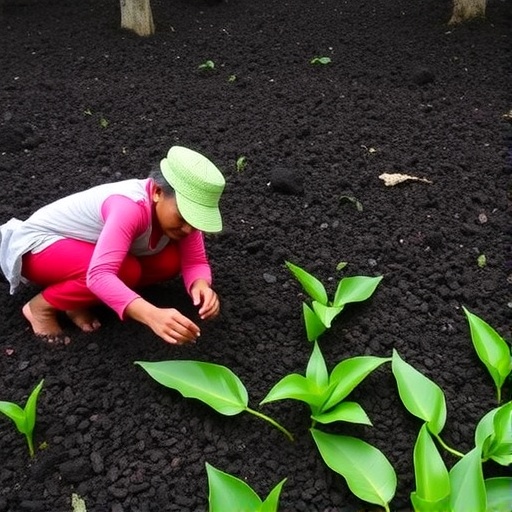
In the rapidly evolving quest to sustain agricultural productivity amid mounting environmental challenges, tea cultivation stands at a critical crossroads. The beloved Camellia sinensis plant, foundational to one of the world’s most consumed beverages, brushes up against persistent soil degradation and contamination issues across global tea plantations. These soils suffer from long-term fertilizer overuse, monoculture practices, acidification, nutrient depletion, heavy metal contamination, and climate stress, all imperiling both crop yield and safety. A comprehensive review published in the journal Biochar illuminates a promising strategy to counter these threats through the application of biochar—a carbon-rich material derived from pyrolyzed biomass under low-oxygen conditions—as a soil amendment to foster healthier tea soils and more sustainable production.
Tea cultivation is uniquely demanding on soil resources. The acidic and nutrient-poor soils in which tea flourishes often become further degraded by conventional agricultural practices. Intensive fertilizer application can exacerbate soil acidification and nutrient leaching, while simultaneously mobilizing toxic heavy metals such as cadmium, lead, and arsenic. These contaminants threaten plant vitality and, critically, concentrate within tea leaves, raising profound food safety concerns for global consumers. The review by Md Shafiqul Islam and Shangwen Xia synthesizes a wealth of field and laboratory data to expose how biochar amendments interact with soil properties, microbial communities, and nutrient cycling to remediate these compounding stresses.
At the core of biochar’s beneficial influence is its ability to buffer soil pH. By tempering acidity, biochar enhances cation exchange capacity—a measure of the soil’s ability to retain essential nutrients such as potassium, calcium, and magnesium. Improvements to soil structure follow, as biochar increases porosity, thereby boosting water retention and aeration. These physical and chemical modifications collectively fortify the rhizosphere, the critical zone surrounding tea roots, optimizing conditions for healthy root growth and nutrient uptake. Such a hospitable environment encourages sustained tea productivity and resilience against abiotic stresses.
Besides physicochemical improvements, biochar profoundly alters tea soil microbiomes. The porous architecture of biochar provides niches for beneficial microorganisms, shifting community dynamics toward taxa involved in nutrient cycling and carbon turnover. Enhanced microbial activity promotes biological nutrient availability while contributing to soil stability and resilience against external perturbations. This microbial modulation can have cascading effects on tea plant health and vigor, underscoring the multifaceted nature of biochar’s soil remediation potential.
The implications for fertilizer efficiency are particularly noteworthy. Biochar’s nutrient-holding capacities reduce losses from leaching and volatilization, effectively increasing nutrient use efficiency. By localizing ammonium, phosphorus, and other key elements in the root zone, biochar enables tea plants to access these nutrients more consistently, reducing the need for excessive external fertilizer applications. Empirical studies highlighted in the review observed significant improvements in root proliferation, leaf biomass, shoot density, and bud weight associated with biochar, either when applied alone or alongside organic and mineral fertilizers.
One of the most compelling and consumer-relevant findings relates to tea quality and flavor profiles. Tea quality hinges on a complex interplay of biochemical compounds including free amino acids, flavonoids, soluble sugars, and catechins. Biochar-amended soils appear to support the biosynthetic pathways that produce these compounds, potentially enhancing the sensory balance of tea’s flavor and aroma. Nevertheless, the review emphasizes that these quality improvements depend heavily on precise biochar production parameters—feedstock selection and pyrolysis temperature—and the specific soil types and management regimes where it is deployed.
Food safety considerations further underscore biochar’s promise. The material’s surface chemistry enables it to adsorb heavy metals, effectively immobilizing them in soil matrices. This sequestration reduces bioavailable heavy metal fractions accessible to tea plants, thus markedly lowering toxic metal accumulation in harvestable leaves and buds. In regions where soil contamination is a pressing public health concern, this attribute of biochar offers a critical intervention to safeguard consumer health and maintain market viability of tea products.
Despite these encouraging advances, the review authors caution that biochar is not a universal remedy. The heterogeneity in biochar properties determined by feedstock and pyrolysis conditions means that performance varies widely. Moreover, local soil characteristics and environmental contexts play pivotal roles in determining outcomes. Thoughtful matching of biochar formulations to site-specific needs, informed by robust soil diagnostics and agronomic goals, is essential for maximizing benefits and avoiding unintended consequences.
The role of biochar extends beyond agronomic advantages to broader environmental sustainability goals. Because biochar contains stable forms of carbon that resist decomposition, it functions as a long-term carbon sink within soils. This carbon sequestration capability positions biochar application as a practical element of climate-smart agriculture frameworks aimed at mitigating greenhouse gas emissions. Additionally, some evidence suggests biochar amendments can reduce emissions of nitrous oxide and carbon dioxide from soils, further contributing to climate change mitigation efforts within tea-growing landscapes.
A notable gap identified in the review is the lack of extensive, long-duration field trials, particularly in tropical tea production hotspots. Understanding how biochar interacts with diverse tea cultivars over multiple growing seasons—and how biochar itself ages and alters in situ—is critical to developing guidelines that ensure sustainable and predictable application strategies. Furthermore, elucidating the mechanistic underpinnings of microbial responses and the stability of heavy metal immobilization will be vital to unlocking the full potential of biochar.
Ultimately, this review positions biochar as a multifaceted tool that aligns with the imperatives of sustainable agriculture. By enhancing soil health, optimizing nutrient dynamics, ensuring food safety, and contributing to climate resilience, biochar could transform tea cultivation systems facing mounting environmental and agronomic challenges. However, realizing this potential demands integrated, site-specific research and long-term monitoring to harness biochar’s properties responsibly and effectively. Tea farmers and industry stakeholders stand to benefit significantly from these scientific insights, empowering a transition to more robust, safe, and sustainable tea production worldwide.
Subject of Research:
Biochar application in tea cultivation for soil health improvement, microbial interaction enhancement, nutrient cycling optimization, and heavy metal detoxification.
Article Title:
Biochar–soil–tea nexus: a review of soil health, microbial interactions, and sustainable Camellia sinensis cultivation
News Publication Date:
March 9, 2026
Web References:
Biochar Journal
DOI: 10.1007/s42773-026-00580-5
Image Credits:
Md Shafiqul Islam & Shangwen Xia
Keywords
Biochar, tea cultivation, Camellia sinensis, soil health, microbial communities, nutrient cycling, heavy metals, soil acidification, fertilizer efficiency, food safety, carbon sequestration, sustainable agriculture
Tags: biochar application in acidic soilsbiochar for sustainable tea farmingclimate resilience in tea agriculturefood safety in tea productionheavy metal contamination in tea soilsimproving tea crop yield with biocharmitigating soil acidification in tea gardenspyrolyzed biomass for soil healthreducing fertilizer overuse in tea cultivationsoil amendment benefits of biocharsustainable practices for Camellia sinensistea plantation soil degradation solutions