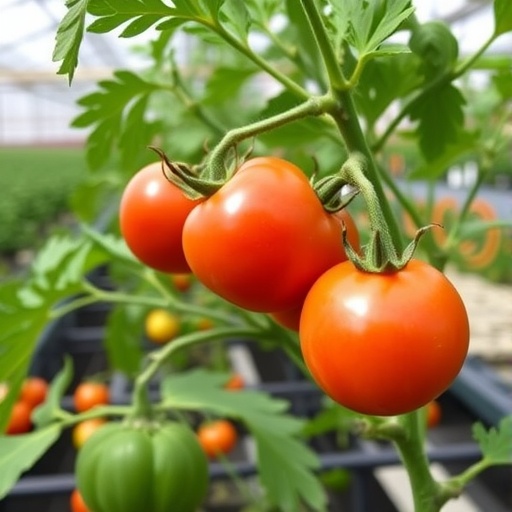
Greenhouse cultivation of cherry tomatoes represents a significant segment of horticulture, prized for the fruit’s enhanced flavor profile, nutritional value, and robust consumer demand across global markets. However, sustainable intensification of production is often constrained by suboptimal nutrient management practices. Among essential macronutrients, phosphorus stands out due to its critical role in plant development, influencing root morphogenesis, onset of flowering, and fruit set. Despite repeated fertilization leading to elevated soil phosphorus reserves, the bioavailability of this element often remains limited, as it frequently forms complexes or undergoes fixation into mineral forms inaccessible to plants.
Addressing this longstanding challenge, a pioneering study led by Yu Lan and colleagues explores a biologically driven solution to unlock locked phosphorus pools in greenhouse soils. Their research, recently published in the journal Biochar, investigates a sophisticated synergy between biochar and phosphorus-solubilizing Bacillus bacteria—a consortium engineered to harness and enhance the natural phosphorus cycling within soil microecosystems. Biochar, a carbon-rich byproduct generated from rice husk pyrolysis, serves as a highly porous substrate providing an ideal niche for microbial colonization and activity.
This integrated biochar-Bacillus consortium demonstrates remarkable efficacy by not only increasing the proportion of plant-available phosphorus in the rhizosphere but also reshaping the microbial community dynamics, favoring beneficial taxa that further promote phosphorus mobilization. The underlying mechanisms include elevated microbial biomass phosphorus and increased enzymatic activity, specifically alkaline phosphatase, which catalyzes the hydrolysis of organic phosphorus compounds, rendering phosphorus in forms accessible to root uptake.
In a controlled greenhouse experiment, four distinct treatments were evaluated: a no-treatment control, application of biochar alone, Bacillus inoculation alone, and the combined biochar-Bacillus treatment. This design allowed for a precise disentanglement of individual and synergistic effects on soil nutrient status and plant physiological traits. Key findings revealed that the consortium treatment augmented rhizosphere phosphorus availability by over 10%, while microbial biomass phosphorus surged by an extraordinary 175%, signifying an enhanced microbial phosphorus storage pool. Alkaline phosphatase activity, pivotal for phosphorus transformation, exhibited a 68% increase, underscoring an activated microbial enzymatic network.
These biochemical and microbial enhancements translated into palpable improvements in plant root architecture. The consortium-stimulated root systems were characterized by increased root length, expanded surface area, elevated root volume, and a higher number of root tips. Such root system plasticity facilitates superior nutrient foraging capacity, essential under conditions of nutrient limitation. Consequently, phosphorus uptake efficiency of the cherry tomatoes rose significantly, nearly 20% above control plants, demonstrating a more efficient internal nutrient economy.
Moreover, the study unveils a compelling connection between nutrient dynamics and reproductive morphology. The biochar-Bacillus treatment promoted a higher ratio of fruit-bearing lateral branches, essentially optimizing the inflorescence architecture. While individual fruit mass experienced a marginal decrease, the total number of fruits per plant increased notably, culminating in a net yield enhancement exceeding 23%. This yield increment signifies not only improved nutrient acquisition but also a critical developmental adjustment in plant architecture favoring reproductive output.
Advanced microbial community analyses revealed enrichment of Bacillus and Sphingomonas genera within treated soils, both known for their plant-growth-promoting and phosphorus-solubilizing capabilities. The soil microbiome restructuring fostered by the consortium suggests emergent properties beyond mere nutrient provision, potentially involving altered hormonal signaling or suppression of pathogens. Structural equation modeling performed by the researchers delineated an interconnected causality chain linking microbial biomass phosphorus, enzymatic activity, root system traits, and yield components, highlighting the complex multidimensional nature of agronomic improvements induced by this biotechnological approach.
The implications of these findings extend beyond biological insight; they propose a scalable, environmentally thoughtful strategy for greenhouse tomato production. Reliance on biochar to deliver beneficial microbial agents aligns with sustainable agriculture paradigms by reducing dependence on chemical fertilizers, mitigating nutrient runoff, and restoring soil ecological function. The approach serves as a blueprint for integrating soil microbiome management with crop developmental biology to potentiate productivity gains.
While the study marks a significant advance, the authors note the necessity for further investigations to dissect the molecular and hormonal pathways whereby enhanced phosphorus availability modulates inflorescence morphogenesis. Understanding these regulatory axes will refine biochar-microbial consortia applications and may open avenues for targeted manipulation of floral development and fruit set in other horticultural systems.
In sum, this research contributes a vital nexus between soil science, microbiology, and plant developmental biology, showcasing how tailored biochar-based microbial consortia can effectuate sustainable intensification in greenhouse cherry tomato cultivation. By unlocking soil phosphorus reserves and improving root and inflorescence architecture, this strategy holds promise for elevating yield while preserving environmental integrity.
Subject of Research: Enhancement of phosphorus bioavailability and plant growth through a biochar-Bacillus microbial consortium in greenhouse cherry tomato cultivation.
Article Title: Synergistic biochar‑Bacillus consortium enhances phosphorus availability, root architecture, and inflorescence development in greenhouse cherry tomato.
News Publication Date: March 1, 2026.
Web References: http://dx.doi.org/10.1007/s42773-026-00586-z
References: Liu, S., Shi, Y., Zhang, A. et al. Synergistic biochar‑Bacillus consortium enhances phosphorus availability, root architecture, and inflorescence development in greenhouse cherry tomato. Biochar 8, 66 (2026).
Image Credits: Sainan Liu, Yongjia Shi, Aijia Zhang, Yuwei Huang, Dianyun Cao & Yu Lan.
Keywords: biochar, Bacillus, phosphorus availability, greenhouse tomato, root architecture, soil microbiome, phosphorus mobilization, alkaline phosphatase, sustainable agriculture, microbial consortium, inflorescence development, crop yield enhancement.
Tags: biochar and microbial synergybiochar for greenhouse tomato cultivationenhancing phosphorus bioavailability in soilimproving cherry tomato yieldsmicrobial inoculants in greenhouse farmingphosphorus fixation and plant uptakephosphorus solubilizing Bacillus bacteriarhizosphere microbial community modulationrice husk biochar applicationssoil phosphorus cycling mechanismssustainable intensification of tomato productionsustainable nutrient management in horticulture