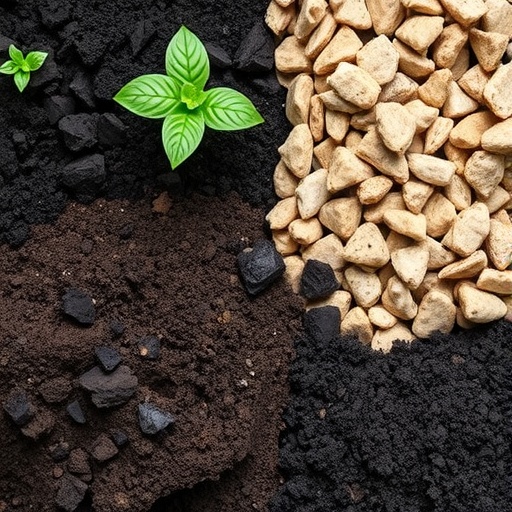
A groundbreaking study published in the journal Biochar has unveiled a novel approach to transforming agricultural and industrial waste into advanced porous carbon materials with significant potential for soil and water conservation. This pioneering research integrates state-of-the-art laboratory techniques with game theory-driven decision-making models to identify optimal biochar-derived materials that promote environmental sustainability and resource efficiency.
As global challenges related to waste management and environmental degradation escalate, scientists are increasingly focusing on innovative methods to repurpose biomass and industrial by-products. Morph-genetic porous carbon (MGPC) emerges as a promising solution due to its exceptional physicochemical properties. MGPC is a sophisticated form of activated biochar distinguished by its extensive surface area, resilient carbon framework, and intricate microporous architecture. These features enable MGPC to effectively interact with water molecules, essential nutrients, and various soil contaminants, making it a valuable candidate for enhancing soil quality and water retention.
The research team embarked on producing MGPC using eight diverse waste feedstocks, including rice straw, vineyard prunings, palm tree prunings, sawdust, vinasse, poultry slaughterhouse residues, paper mill waste, and tissue paper manufacturing by-products. Each feedstock underwent pyrolysis at 400 °C under controlled low-oxygen conditions to generate preliminary biochar. Subsequent activation processes were conducted at 800 °C, employing potassium hydroxide, phosphoric acid, or carbon dioxide, to augment the biochar’s porous structures and surface chemistry, yielding a total of 64 distinct MGPC variants.
To critically evaluate these materials, the researchers applied Brunauer-Emmett-Teller (BET) analysis, a sophisticated technique that quantifies essential surface characteristics such as specific surface area, pore volume, and pore size distribution. These metrics are crucial in determining the capacity of porous materials to adsorb water and solutes, directly influencing their effectiveness in soil amendment and pollutant immobilization. The wide range of feedstocks and activation methods generated complex performance profiles across multiple criteria.
Selecting the most promising MGPC variant among the 64 samples presented a formidable challenge due to the trade-offs across different performance parameters. Simple ranking or averaging methods failed to provide a holistic solution. To overcome this, the research team innovatively turned to the Condorcet algorithm, a refined game theory-based decision-making tool that compares options in pairwise contests. This method facilitated the identification of samples exhibiting consistently high performance across all criteria, thereby circumventing subjective biases often inherent in weighting schemes.
Dr. Seyed Hamidreza Sadeghi, the corresponding author, emphasized the transformative aspect of this integrative methodology: “Our objective transcends mere material synthesis; we sought to establish a systematic and reproducible framework to pinpoint MGPC materials offering optimal properties for soil and water conservation.” By bridging BET characterization with game theory, the study advances a rigorous and transparent decision-making platform, crucial for accelerating the practical deployment of biochar technologies.
The results highlighted that chemically activated MGPC samples, particularly those treated with potassium hydroxide at a 1:2 ratio, exhibited superior structural features and adsorption capacities. Among the prioritized samples, variants derived from rice straw, sawdust, palm tree pruning waste, vineyard pruning waste, and tissue factory waste—each subjected to KOH activation at the specified ratio—demonstrated remarkable specific surface areas and micropore volumes. Notably, the rice straw-derived MGPC achieved the highest BET surface area, measuring an impressive 1071.47 m² per gram, underscoring its exceptional adsorptive potential.
These findings carry profound implications for environmental engineering and sustainable agriculture. The conversion of widely available agricultural residues and industrial wastes into value-added porous carbon materials addresses critical challenges such as soil fertility degradation, water scarcity, and contamination. MGPC can serve as an efficient soil amendment, improving water retention and nutrient availability while adsorbing pollutants, thereby fostering healthier ecosystems and enhancing agricultural productivity.
Furthermore, this study sets a precedent in the field of materials science by integrating decision science tools into the evaluation of complex material systems. The Condorcet algorithm’s pairwise comparison approach provides a transparent, justifiable, and replicable selection mechanism, enhancing confidence in material prioritization and accelerating innovation pipelines. This framework can be adapted to other domains where multifaceted performance criteria complicate decision-making processes.
While laboratory characterization has yielded promising data, the researchers acknowledge the necessity of rigorous field-scale investigations to validate MGPC’s efficacy under varying soil and climatic conditions. Future work will focus on long-term assessments of soil health improvements, water conservation metrics, and potential environmental impacts, ensuring that these materials can be effectively translated into real-world applications.
This research emerges at a critical juncture when global agricultural systems face increasing pressures from climate change, population growth, and resource depletion. MGPC offers a scalable, sustainable strategy to convert waste into functional materials that support ecosystem resilience and circular economy principles. By coupling cutting-edge material synthesis with advanced decision algorithms, this study lays the foundation for innovative environmental technologies that can transform agricultural and industrial residues into valuable assets.
The significance of this work extends beyond immediate environmental applications, potentially influencing policy frameworks related to waste valorization, resource management, and sustainable agriculture. Stakeholders including farmers, industries, and environmental agencies may benefit from adopting these high-performance biochar materials, reducing reliance on non-renewable inputs and mitigating environmental pollution.
In conclusion, the integration of advanced porous carbon materials derived from waste and the application of game theory-based decision making represent a leap forward in addressing intertwined global challenges of waste management, soil degradation, and water scarcity. This innovative approach exemplifies how interdisciplinary research can unlock new pathways toward sustainable environmental stewardship and resource conservation.
Subject of Research: Experimental study on transforming agricultural and industrial wastes into morph-genetic porous carbon for soil and water conservation.
Article Title: Introducing priority morph-genetic porous carbon for potential applications in soil and water conservation through game theory.
News Publication Date: 2-Mar-2026
Web References: DOI: 10.1007/s42773-025-00505-8
References:
Sadeghi, S.H., Zare, S., Gharehmahmudli, S. et al. Introducing priority morph-genetic porous carbon for potential applications in soil and water conservation through game theory. Biochar 8, 35 (2026).
Image Credits: Seyed Hamidreza Sadeghi, Somayeh Zare, Sudabeh Gharehmahmudli, Habibollah Younesi, Fengbao Zhang, Mahboubeh Mirzahosseini, Padideh Sadat Sadeghi, Mehdi Homaee, Yahya Parvizi, Shen Nan & Yao Li.
Keywords
Morph-genetic porous carbon, biochar, soil conservation, water retention, waste valorization, pyrolysis, activation, BET analysis, game theory, Condorcet algorithm, environmental remediation, sustainable agriculture.
Tags: activated biochar production methodsadvanced porous carbon materialsagricultural waste pyrolysisbiochar for soil conservationbiochar microporous architecturebiochar water retention enhancementgame theory in environmental decision-makingindustrial biomass repurposingmorph-genetic porous carbon propertiesresource-efficient waste managementsustainable soil quality improvementwaste-to-biochar transformation