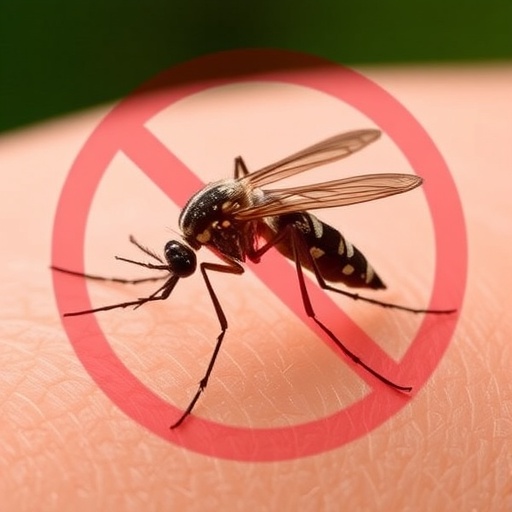
Every summer, millions of people rely on DEET-based repellents to protect themselves from the relentless bite of mosquitoes. Yet, groundbreaking new research conducted by Clément Vinauger, an associate professor at Virginia Tech, alongside Claudio Lazzari from the University of Tours, France, reveals an unsettling twist in the story of mosquito repellency. Their study, published in the Journal of Experimental Biology, shows that mosquitoes, specifically the yellow fever mosquito Aedes aegypti, are capable of associative learning that can alter their innate aversion to DEET. This discovery challenges long-held assumptions about how repellents function and carries profound implications for public health and vector control strategies worldwide.
The yellow fever mosquito, known for transmitting dangerous diseases such as dengue, Zika, yellow fever, and chikungunya, inflicts tens of millions of infections annually. The study focuses on this species because controlling its behavior is critical to reducing disease transmission. Utilizing a Pavlovian conditioning approach—a learning process famously demonstrated by Ivan Pavlov’s experiments with dogs—researchers trained mosquitoes to associate the scent of DEET with a rewarding stimulus: a blood meal or sugar. Such conditioning implies a cognitive flexibility in these insects that could undermine the effectiveness of repellents.
In a controlled experimental setup, mosquitoes were tethered behind a mesh barrier with access to warm blood placed just out of their reach. As they attempted to feed, scientists introduced DEET odor simultaneously. After repeated exposure across four trials, the results were striking: over 60 percent of conditioned mosquitoes attempted to feed when presented solely with DEET scent. This behavioral shift from avoidance to attraction reveals the mosquito’s capacity to override its deterrent instincts through learning, a trait previously underestimated in insect vectors.
To examine real-world relevance, researchers further tested the mosquitoes’ choice between two human hands: one untreated and one treated with a standard concentration of DEET. Untrained mosquitoes predictably avoided the DEET-coated hand, affirming its repellent effect. Conversely, mosquitoes that had undergone conditioning were attracted to the DEET-treated hand, a profound indication that associative learning can alter natural responses. The same associative effect was detected when sugar replaced blood as the reward, highlighting the insect’s versatility in learning mechanisms.
This paradigm-shifting evidence emphasizes that mosquito behaviors are not governed exclusively by the chemical properties of repellents. As explained by Vinauger, the mosquito brain’s plasticity allows for learned experiences to modulate instinctual responses. This intricate neural rewriting, where DEET’s valence flips from aversive to appetitive, adds a cognitive dimension to mosquito-host interactions, complicating strategies that rely solely on chemical repellents.
Despite the unsettling nature of these findings, DEET remains the gold standard of insect repellents due to its proven efficacy, especially in tropical regions burdened by mosquito-borne diseases. Vinauger stresses that the study’s conclusions should not deter public use of DEET but rather inform best usage practices. Specifically, continuous protection may require regular reapplication to maintain effective concentrations, preventing mosquitoes from associating fading DEET scents with successful feeding opportunities.
The decrement of DEET concentrations on treated fabrics further complicates protection. As the chemical efficacy wanes over time, mosquitoes might learn to tolerate or even prefer the scent, potentially reducing the protective value of treated clothing under real-life conditions. This cautionary note invites a re-evaluation of current application guidelines and the temporal dynamics of repellent efficacy in the field.
Vinauger’s expertise stems from years of probing mosquito behavior and sensory processing. During his Ph.D. work in Lazzari’s lab and postdoctoral research at the University of Washington, he contributed to pioneering insights demonstrating mosquitoes’ ability to learn and memorize olfactory cues tied to blood meals and defensive host behaviors. His team at Virginia Tech continues to uncover the complexities of mosquito sensory integration, such as combining olfactory and visual signals to precisely track hosts or altering preferences based on scent from personal care products.
These findings underscore the remarkable sophistication of mosquito neural processing. They not only detect chemical signals but also interpret and adapt behaviors accordingly, reflecting a level of cognitive flexibility that complicates control attempts. Understanding these neural circuits and behavioral adaptations is critical to developing more effective interventions that anticipate and outmaneuver mosquito learning capabilities.
As Aedes aegypti extends its geographic range and evolves resistance to insecticides, the urgency to comprehend its biology intensifies. Vinauger highlights the need for integrative research at molecular, neural, and behavioral levels to decrypt mosquito adaptability. Only with this comprehensive understanding can new control measures circumvent the pitfalls posed by learned repellent tolerance, paving the way for next-generation vector management.
In essence, this study reveals a fundamental oversight in mosquito repellant strategy design: the assumption that repellents elicit immutable aversive responses based solely on their chemistry. The reality of mosquito associative learning forces a rethinking of vector control paradigms, emphasizing dynamic interaction between chemical stimuli and insect cognition. Such nuance could explain variable repellent performances in the field and the persistence of mosquito-borne disease despite widespread DEET use.
This new knowledge also raises intriguing questions for future research, such as deciphering the neural pathways that encode and modify repellent perception, exploring whether other insect vectors exhibit similar adaptive behaviors, and investigating alternative compounds or delivery systems less prone to associative override. Addressing these questions is paramount for sustaining the progress made in reducing vector-borne diseases worldwide.
As we continue to grapple with the public health challenges posed by Aedes aegypti, the insights from Vinauger and colleagues illuminate a path toward smarter, behaviorally informed mosquito control strategies. They remind us that the mosquito brain is not a passive responder to chemical deterrents but an active interpreter of experience—and that harnessing this knowledge may be the key to outsmarting one of humanity’s deadliest foes.
Subject of Research:
Behavioral neuroscience of Aedes aegypti mosquitoes and associative learning related to DEET repellency.
Article Title:
Associative learning switches DEET valence from aversive to appetitive in Aedes aegypti
Web References:
Clément Vinauger, Virginia Tech Faculty Page
Journal of Experimental Biology Article
DOI Link
Image Credits:
Virginia Tech
Keywords:
Mosquito behavior, DEET repellent, associative learning, Aedes aegypti, vector-borne diseases, insect cognition, neural plasticity, Pavlovian conditioning, mosquito control, insect repellent resistance, sensory integration, public health
Tags: Aedes aegypti learning behaviorchallenges in mosquito repellent usecognitive flexibility in insectsDEET mosquito repellent effectivenessimpact of DEET on mosquito behaviormosquito associative learningmosquito resistance to repellentsmosquito-borne disease preventionPavlovian conditioning mosquitoespublic health implications of mosquito adaptationvector control strategiesyellow fever mosquito control