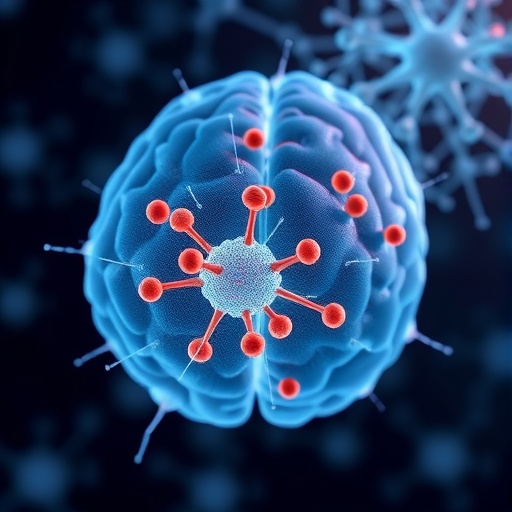

image: Researchers at the University of Cincinnati and Johns Hopkins Health developed a treatment for brain cancer that uses three drugs embedded in a nanofiber mesh.
view more
Credit: Joseph Fuqua II
Researchers with the University of Cincinnati and Johns Hopkins Medicine developed a potential treatment for brain cancer that uses nanofibers embedded with a combination of drugs that work in concert to target tumors.
The drugs proved more effective in combination than when administered alone and can provide both immediate and long-lasting doses to kill cancer cells.
Lead author Daewoo Han, an assistant professor in UC’s College of Engineering and Applied Science, and UC Distinguished Research Professor Andrew Steckl incorporated the drugs into electrospun fiber membranes, creating a nanofiber drug delivery system. Steckl’s NanoLab at the University of Cincinnati is a leading developer of this technology that uses an electric field to create a multilayered fiber mesh for drug delivery, among other uses.
“This combination is pretty powerful,” Steckl said.
Glioblastoma is the most common and aggressive form of brain cancer in adults. Researchers at UC and Johns Hopkins found that the three federally approved drugs used to treat glioblastoma (temozolomide, acriflavine and PT2385) work better in combination than they would alone, a pharmaceutical phenomenon called synergism.
“When you add them together, three things can happen,” Steckl said. “The combination is negative; the effect is additive, like one plus one equals two; or it’s synergistic, which is like one plus one equals three.”
The study was published in the journal ACS Biomaterials Science & Engineering. The research was supported with a grant from the National Institutes of Health.
Steckl said glioblastoma is extremely difficult to treat because its heterogeneous cells allow for mutations that help the cancer evade treatment.
“It’s tough to control,” Steckl said. “It comes in through the window and when you close the window, it comes through the door. And when you close that, it comes through the chimney.”
Glioblastoma also has high recurrence. And the blood-brain barrier limits the effectiveness of other traditional chemotherapies.
“Our NanoMesh system was designed to solve these issues by enabling localized long-term delivery of multiple synergistic drugs directly at the tumor site after surgery,” UC’s Han said.
UC researchers worked with a team at Johns Hopkins Medicine, including Betty Tyler, a professor of neurosurgery, and postdoctoral researcher Hasan Slika. Tyler said researchers are looking to attack the disease with combinations of therapies.
“Unfortunately, cancers know how to pivot to evade therapeutic treatment,” she said. “So we’re approaching treatment multidimensionally.”
Tyler has helped develop other cutting-edge therapies now commonly used to treat cancer.
“Current therapies have increased patient survival and given them more birthdays,” she said. “But we’re still working on improving options.”
In animal trials, all untreated mice with glioblastoma died within 19 days. But a majority of mice treated with the three-layer nanofiber mesh survived twice as long. And 40% survived past the 120-day conclusion of the experiment in a plateau that stretched for more than 80 days.
Han said using electrospun fiber mesh, doctors can precisely control the dosage and release and the implant geometry, which contribute to its effectiveness. And just as the blood-brain barrier protects the brain from toxins, the barrier also protects the body from the toxic side effects of the medicine applied to the brain, Han said.
UC researchers are now working on optimizing the long-term release of medicines using advanced nanofiber structures. And the delivery system has broad potential in applications for other difficult-to-treat diseases, Han said.
“What’s next will be very exciting,” Han said. “Our ultimate goal is moving forward to a clinically translatable system that improves both survival and quality of life for patients with difficult-to-treat cancers, including glioblastoma.”
Journal
ACS Biomaterials Science & Engineering
DOI
10.1021/acsbiomaterials.5c01482
Method of Research
Experimental study
Subject of Research
Animals
Article Title
Codelivery Material System of Polymer Microfiber Structures for Synergistic Localized Therapy of Glioblastoma
Article Publication Date
14-May-2026
COI Statement
No conflicts to report.
Media Contact
Michael Miller
University of Cincinnati
Office: 513-556-6757
Journal
ACS Biomaterials Science & Engineering
Funder
NIH/National Institutes of Health
DOI
10.1021/acsbiomaterials.5c01482
Journal
ACS Biomaterials Science & Engineering
DOI
10.1021/acsbiomaterials.5c01482
Method of Research
Experimental study
Subject of Research
Animals
Article Title
Codelivery Material System of Polymer Microfiber Structures for Synergistic Localized Therapy of Glioblastoma
Article Publication Date
14-May-2026
COI Statement
No conflicts to report.
Tags
/Health and medicine/Diseases and disorders/Cancer
/Health and medicine/Diseases and disorders/Cancer/Brain cancer
/Health and medicine/Diseases and disorders/Cancer/Brain cancer/Glioblastomas
/Applied sciences and engineering/Engineering
/Applied sciences and engineering/Engineering/Bioengineering
/Applied sciences and engineering/Engineering/Bioengineering/Biomedical engineering
/Applied sciences and engineering/Engineering/Bioengineering/Biomedical engineering/Biomaterials
/Applied sciences and engineering/Engineering/Bioengineering/Biomedical engineering/Medical technology
bu içeriği en az 2000 kelime olacak şekilde ve alt başlıklar ve madde içermiyecek şekilde ünlü bir science magazine için İngilizce olarak yeniden yaz. Teknik açıklamalar içersin ve viral olacak şekilde İngilizce yaz. Haber dışında başka bir şey içermesin. Haber içerisinde en az 12 paragraf ve her bir paragrafta da en az 50 kelime olsun. Cevapta sadece haber olsun. Ayrıca haberi yazdıktan sonra içerikten yararlanarak aşağıdaki başlıkların bilgisi var ise haberin altında doldur. Eğer yoksa bilgisi ilgili kısmı yazma.:
Subject of Research:
Article Title:
News Publication Date:
Web References:
References:
Image Credits:
Keywords
Tags: brain cancer treatment innovationcombination drug therapy for tumorsglioblastoma multiforme researchJohns Hopkins Medicine cancer researchlong-lasting cancer treatmentmultidrug therapy for glioblastomananofiber mesh for chemotherapynanofiber-based drug deliverynanotechnology in oncologysustained drug release in cancertargeted drug delivery systemsUniversity of Cincinnati cancer study