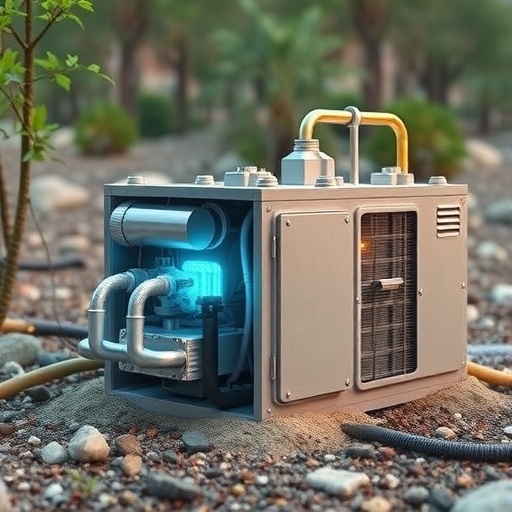
In a groundbreaking advancement merging environmental sustainability with cutting-edge nanotechnology, researchers have unveiled a revolutionary droplet-based electricity generator (DEG) system designed to harvest energy directly from treated municipal wastewater. This novel approach highlights a promising avenue for cities struggling with freshwater scarcity and escalating energy demands, offering a dual-purpose technology that not only recovers valuable electrical energy from wastewater but also actively contributes to pollutant removal through electrocatalytic processes.
The innovative method capitalizes on the triboelectric nanogenerator (TENG) principle, a technology that harvests mechanical and electrostatic energy through contact electrification and electrostatic induction. While TENGs have been explored in various contexts, their application in municipal wastewater energy recovery has remained largely untapped. By focusing on the energy potential contained within secondary effluents—wastewater after primary treatment—the research team led by Dr. Beidou Xi has demonstrated an effective solution that harvests energy often lost during effluent discharge.
At the heart of the DEG system is a contact layer fabricated from hydrophobic films such as perfluoroethylenepropylene copolymer (FEP), polytetrafluoroethylene (PTFE), and polypropylene. When wastewater droplets impact these films, the interaction generates a charge differential attributed to triboelectrification. Of the materials tested, FEP exhibited superior performance, facilitating a maximum output voltage of 22.47 volts and a current of 2.11 microamperes for a single device. This electrical output translates to a peak power delivery of approximately 15.18 microwatts, a magnitude sufficient to power 15 light-emitting diodes (LEDs) with just one droplet.
Scaling up the technology, the researchers assembled a multi-device DEG system, connecting six individual units in parallel. Post-rectification, the collective system exhibited enhanced electrical output capable of continuously illuminating LEDs without any external power input. This significant advancement underscores the system’s potential to be integrated into existing municipal wastewater treatment plants as a self-sustaining energy harvesting module that could simultaneously offset energy consumption and lower operational carbon footprints.
Critical to the system’s efficiency is the quality of the wastewater itself. The team observed that effluents with reduced dissolved solids and lower ion concentrations improved electron transfer efficiency between droplets and the hydrophobic film. This finding reveals a notable dependency of triboelectric performance on wastewater chemistry. However, once effluent standards comply with China’s rigorous Grade I-A discharge criteria, different treatment modalities exert minimal impact on generator performance, suggesting the system’s adaptability to various treated wastewater qualities.
Beyond energy harvesting, the DEG system demonstrated remarkable functionality in active pollutant removal. The harvested electrical energy was redirected to stainless steel electrodes submerged within the municipal wastewater. The resulting electrochemical reactions effected a reduction in ammonium nitrogen levels by approximately 12% and chemical oxygen demand (COD) by over 40%. The generation of microscopic gas bubbles during electrolysis facilitated electro-flotation, a process where contaminants attach to the bubbles and are thus separated from the water more effectively. This mechanistic synergy enhances treatment efficacy without the need for external power sources.
Interestingly, the utilization of alternating current generated by the DEG system delivered an ancillary benefit: mitigating electrode passivation. The reversible polarity of the current prevented the accumulation of mineral layers on electrode surfaces, which often hampers electrochemical efficiency. This dynamic maintenance of electrode activity ensures sustained treatment performance, a crucial factor for long-term deployment in wastewater treatment contexts.
The electrocatalytic prowess of the DEG system extended to the degradation of dyes, a persistent class of wastewater pollutants. Using methyl orange as a test contaminant, the six-device configuration powered electrocatalytic degradation over a continuous 54-hour period without auxiliary energy inputs. The systematic decline in ultraviolet-visible absorption peaks associated with methyl orange signified the effective breakdown of its chemical bonds, achieving a COD removal efficiency exceeding 91% and a decolorization rate over 96%. Such results emphasize the system’s capability to treat complex organic pollutants through sustainably harvested electricity.
This research epitomizes the broader implications of TENG technology in sustainable environmental engineering. By unlocking energy embedded in secondary effluents, facilities traditionally dependent on external power can evolve into resource recovery hubs, leveraging wastewater not as a liability but as a renewable energy asset. This paradigm shift has the potential to revolutionize water treatment infrastructure, integrating green energy generation directly into wastewater management while enhancing pollutant removal.
Dr. Beidou Xi emphasizes the dual benefits of this approach: “Our study not only demonstrates a novel method for secondary effluent energy harvesting using TENG technology but also introduces a sustainable framework for wastewater resource recovery and carbon reduction.” Such integrative strategies, combining material science, electrochemistry, and environmental engineering, may well set the stage for next-generation municipal wastewater facilities that align with global carbon neutrality targets.
The study’s successful demonstration opens doors for future exploration—integrating larger-scale TENG systems, optimizing film materials for increased electron transfer, and coupling with advanced treatment technologies to tackle diverse pollutants. Moreover, the DEG system’s ability to function independently of external power underscores its potential utility in decentralized water treatment, especially in energy-constrained or remote regions.
In light of mounting environmental pressures and urbanization, this pioneering work offers a tangible pathway for sustainable wastewater management. By transforming treated effluent into a self-powered cleaning mechanism, the droplet-based electricity generator system showcases a visionary approach to mitigating water-energy nexus challenges while advancing the global agenda for clean water and sustainable development.
Subject of Research: Not applicable
Article Title: A droplet-based electricity generators (DEGs) system for harvesting secondary effluent energy
News Publication Date: 1-Mar-2026
References: DOI: 10.1016/j.jes.2025.05.020
Image Credits: Credit: Thomas Hawk from Openverse
Keywords
Power industry, Industrial sectors, Energy infrastructure, Energy resources, Energy, Physics, Conservation of energy, Energy transfer, Free energy, Technology, Applied sciences and engineering, Nanotechnology, Electricity, Electrical power, Electrical engineering, Electrical power generation, Energy harvesting, Power systems, Electrometry, Experimental physics
Tags: contact electrification energy systemsdroplet-based electricity generator technologyelectrocatalytic pollutant removalhydrophobic film energy harvestingmunicipal wastewater energy recoverynanotechnology in environmental sustainabilityperfluoroethylenepropylene copolymer energy generatorrenewable energy from treated wastewatersecondary effluent energy potentialsustainable wastewater energy harvestingtriboelectric nanogenerator wastewater applicationwastewater-driven power generation