
Credit: Paul Chariou
Researchers at Case Western Reserve University are applying drug-delivery technology to agriculture to control parasitic roundworms more effectively and safely.
The tiny roundworms, or nematodes, cause $157 billion in crop failures worldwide each year, other researchers estimate, largely because they're beyond the reach of pesticides. The chemicals disperse poorly into soil, while the parasites feed at plant roots well below the surface.
As a result, farmers apply large amounts of pesticides, which can increase the chemical concentrations in food or run off and damage other parts of the environment, all of which have costs.
But biomedical engineering researchers at Case Western Reserve may have found an effective solution.
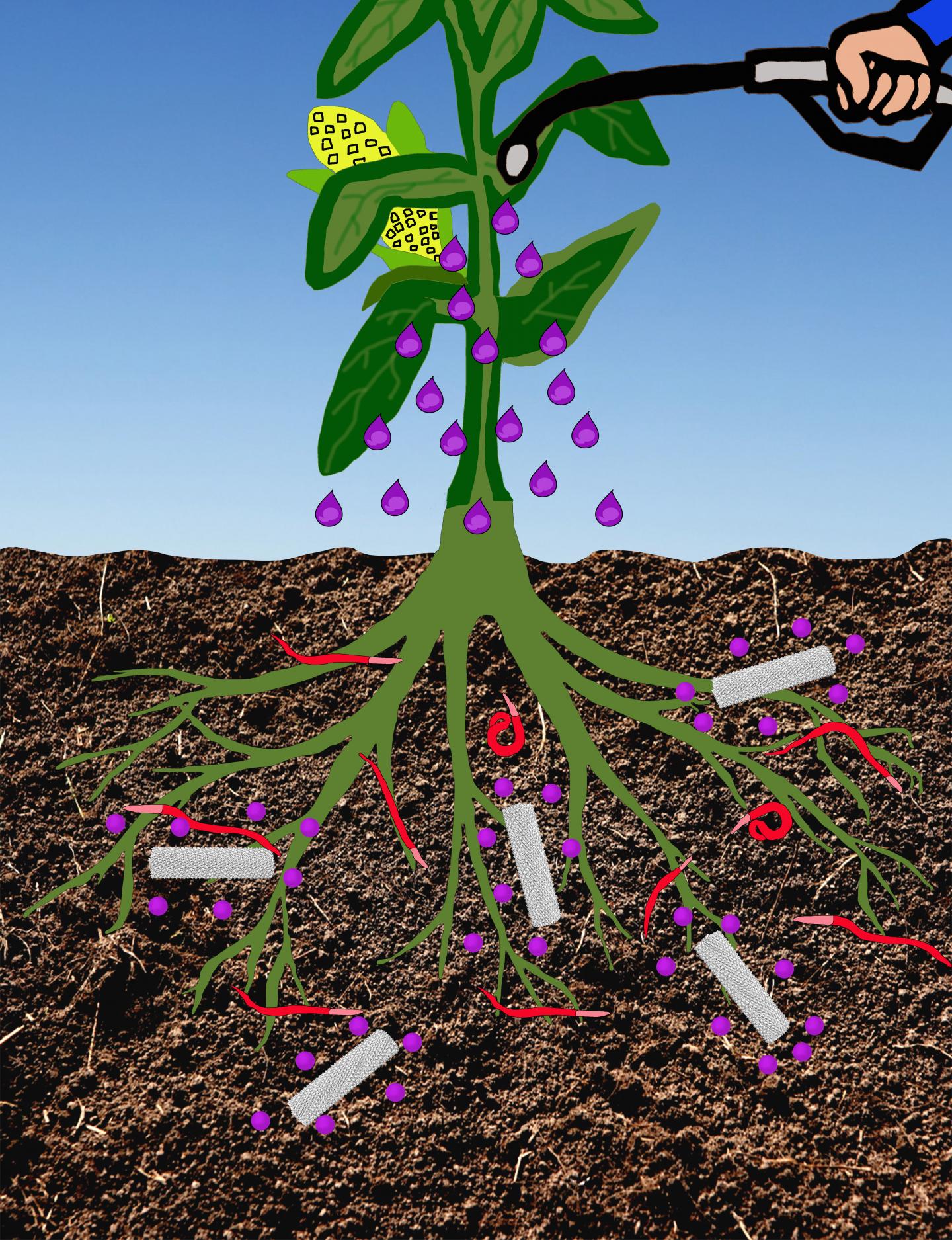
"We use biological nanoparticles–a plant virus–to deliver a pesticide," said Paul Chariou, a PhD student in biomedical engineering at Case Western Reserve and author of a study on the process published in the journal ACS Nano. "Use of the nanoparticle increases soil diffusion while decreasing the risk of leaching and runoff, reducing the amount of chemical in food crops and reducing the cost to treat crops."
Chariou worked with Nicole Steinmetz, the George J. Picha Professor in Biomaterials appointed by the Case Western Reserve School of Medicine.
Parasitic nematodes feed on a wide range of crops, including corn, wheat, coffee, soybeans, potatoes and a host of fruit trees. Damage they cause at the roots impairs the plants' ability to absorb water and nutrients, which can kill young plants and reduce yields in mature plants.
To try to deliver more pesticide to the roots, the researchers used tobacco mild green mosaic virus (TMGMV). The virus is used in Florida as a pesticide to control an invasive weed, but is benign to nematodes.
TMGMV can infect tomatoes, eggplant and other solenaceous plants, but is not a threat to nearly 3,000 other plant species that suffer nematode infections.
The virus self-assembles into a tube-like structure, 300 nanometers long by 18 nanometers wide, with a hollow channel 4 nanometers wide.
As a proof of concept for this study, the researchers tested the plant virus-derived nanoparticles with a nematicide called crystal violet, which has been used to kill nematodes on skin but not in agriculture.
The researchers capitalized on surface chemistry to load the positively charged crystal violet molecules into the negatively charged channel of the virus-nanoparticle. Each virus particle carried about 1,500 crystal violet molecules.
In lab experiments with conditions mimicking crop soils with a pH of 5, the nematicide remained attached as the virus particles were applied to and diffused through the soil. "At the root level, the nematicide diffuses out of the virus over time," Chariou said. Warmer and more acidic soils caused the chemical to be released faster.
In testing with the nematode Caenorhabdiis elegans, in a liquid culture, the scientists confirmed that nematodes were paralyzed and killed by treatment with the drug-infused virus-nanoparticle – this is because the drug diffuses out of its carrier over time allowing it to interact with the nematodes. As a secondary killing mechanism, the researcher also noted that the roundworms were eating the nanoparticles. The crystal violet was released in the animals' stomachs, paralyzing and killing them.
Most importantly, nematicide-carrying virus particles dispersed better when applied to the soil surface and made more molecules available to kill nematodes at the root level.
Chariou and Steinmetz are now testing the delivery system using chemical pesticides approved for crops and developing a computer model to better understand and, ultimately, optimize the nanoparticle's ability to diffuse through soil.
###
Media Contact
Kevin Mayhood
[email protected]
216-534-7183
@cwru
http://www.case.edu
############
Story Source: Materials provided by Scienmag