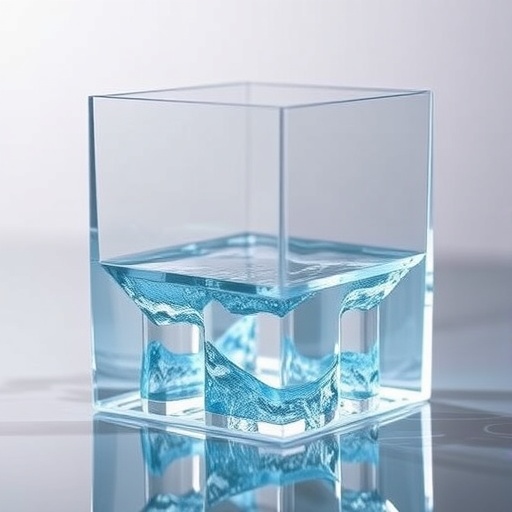
In a remarkable breakthrough that promises to reshape the future landscape of material science and industrial manufacturing, researchers at the National Institute of Advanced Industrial Science and Technology (AIST) have engineered an exceptional type of oxide glass. This glass, notable for its colorless transparency and an ultra-high Young’s modulus exceeding 130 GPa, was fabricated using a conventional melt-quenching technique. This method reconciles industrial scalability with extraordinary mechanical performance, a combination rarely achieved in oxide glass materials.
Glass has long been revered for its versatility, serving myriad applications ranging from the delicate glass envelopes of light bulbs to the resilient strands of optical fibers transmitting data across continents. However, despite this versatility, the ongoing demand for glass materials with enhanced mechanical durability and reliability has driven research toward high-strength variations. Traditionally, chemically strengthened glass—achieved through fragile ion exchange processes at the glass surface—has dominated such pursuits. While effective in many respects, these processes impose inherent restrictions, including limitations on minimal glass thickness and environmental concerns stemming from alkali waste.
In the realm of material synthesis, alternative high-performance glasses have emerged from cutting-edge techniques like aerodynamic levitation and laser heating. These processes facilitate the creation of high-elastic-modulus oxides but come with their own set of limitations. Chief among these is the size constraint, as these methods typically preclude the production of glass objects larger than a few millimeters in diameter. This size bottleneck significantly curtails their industrial applicability, restricting their adoption in commercial manufacturing pipelines.
Contrary to such limitations, industrial glass production overwhelmingly favors conventional melt-quenching due to its versatility and scalability. Yet, the pursuit of oxide glasses that can unite a high Young’s modulus with a glass transition temperature conducive to efficient shaping has historically proven elusive. Materials with high bond dissociation energies, often containing rare-earth elements or tantalum oxide (Ta2O5), promise elevated stiffness, but they typically come with the downside of overly high glass transition temperatures, complicating molding and shaping processes. Balancing these conflicting requirements was a long-standing challenge in oxide glass design.
The team at AIST navigated this complex landscape to fabricate glasses that simultaneously deliver mechanical robustness and manufacturability. The produced glass samples achieved Young’s modulus values surpassing 130 GPa—well above typical commercial glass standards—while maintaining a glass transition temperature near 700 °C. The glass samples also boasted practical dimensions, exceeding 3 millimeters in thickness and 60 millimeters in diameter, underscoring the potential for large-scale production using existing industrial techniques rather than experimental or laser-based methods.
What sets this development apart is the elimination of traditional chemical or physical strengthening techniques. The inherent elasticity and hardness stemmed purely from the optimized composition and melt-quenching process. Such advancements hint at a paradigm where glass materials can be both mechanically resilient and produced with higher throughput and sustainability. Critically, the efficient shaping enabled by the glass transition temperature reduces energy consumption and environmental footprint during manufacturing.
Thermal analyses further revealed exciting opportunities for fiber drawing, a critical process for telecommunications and composite materials. The glass’s properties suggest fibers could be produced exhibiting approximately twice the Young’s modulus of conventional glass fibers, potentially revolutionizing the strength-to-weight ratios in fiber-reinforced composites and broadening the horizons for durable, lightweight materials in aerospace and electronics.
Another noteworthy characteristic is the glass’s thermal expansion coefficient, measured at less than 80 x 10⁻⁷ K⁻¹. This low coefficient is vital for maintaining dimensional stability in environments with fluctuating temperatures, reducing mechanical stress and enhancing longevity. Moreover, by fine-tuning the glass’s chemical composition, this thermal property can be precisely controlled, enabling tailored solutions across diverse applications.
Beyond the glasses themselves, related glass-ceramic materials present an avenue for further enhancement. Controlled crystallization processes can heighten the Young’s modulus even more, providing an intricate balance of crystalline and amorphous phases that yield improved mechanical properties without sacrificing transparency or shape.
The implications of this work are far-reaching. From electronic device screens demanding thin, durable protective layers, to optical components requiring both clarity and resilience, and extending to the development of next-generation fiber-reinforced composites, this novel glass lays a versatile foundation. Particularly exciting is its potential as a thin, elastic cover glass produced without chemical strengthening, a paradigm shift that could lower production costs, reduce environmental impact, and open industrial pathways previously impractical or too costly.
Underpinning this achievement is a broader narrative about the convergence of materials science innovation with industrial pragmatism. The ability to leverage conventional melt-quenching processes while breaking new ground in mechanical performance epitomizes a balance between cutting-edge research and scalable manufacturing—a necessary step for meaningful real-world adoption.
Helming this research, Dr. Hirokazu Masai and colleagues have illuminated possibilities through rigorous experimental methodologies, supported by substantial funding from the Japan Society for the Promotion of Science. Their work, published in the Journal of the Ceramic Society of Japan, is more than a technical accomplishment—it is a gateway to advanced, sustainable materials offering exceptional performance for future technological demands.
This discovery not only challenges prevailing limitations in oxide glass production but also opens vibrant avenues for innovation across sectors. As the quest for stronger, more reliable, and environmentally sustainable materials accelerates, such breakthroughs will doubtlessly play a pivotal role in defining the next wave of industrial materials science.
Subject of Research: Materials Science – High-strength Oxide Glass Fabrication
Article Title: High-modulus Oxide Glasses Fabricated by the Melt-quenching Method
News Publication Date: 1-May-2026
Web References: DOI: 10.2109/jcersj2.26015
Image Credits: National Institute of Advanced Industrial Science and Technology (AIST)
Keywords
Oxide Glass, High Young’s Modulus, Melt-quenching, Glass Manufacturing, Thermal Expansion, Glass Fibers, Industrial Glass, Material Strength, Glass-Ceramic, Optical Transparency
Tags: advanced materials for industrial applicationsaerodynamic levitation in glass synthesiscolorless transparent high-strength glassenvironmentally friendly glass production methodshigh elasticity in pristine glasshigh-strength glass for optical fiberslaser heating for high-performance glasslimitations of ion exchange glass strengtheningmechanical durability of oxide glassmelt-quenching technique for oxide glassscalable industrial glass manufacturingultra-high Young’s modulus glass