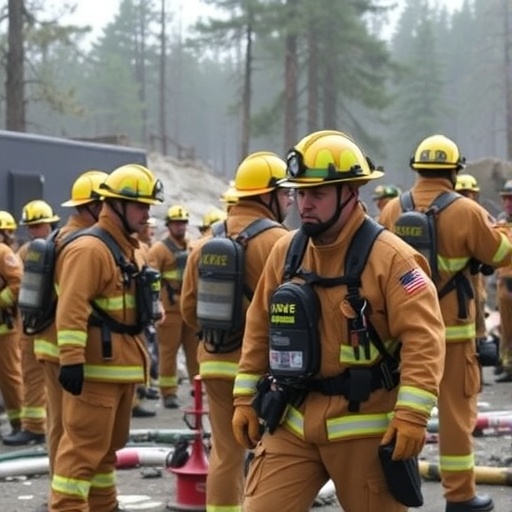
In an unprecedented approach to understanding the physical and psychological toll on disaster responders, a research team led by Hiroshima University undertook a comprehensive, data-driven analysis during the 2024 Noto Peninsula earthquake emergency response. As natural disasters surge in frequency and intensity worldwide, the resilience and health of humanitarian personnel and responders who operate at the frontline have become critical focal points. Traditionally, investigations into the burden borne by disaster responders were retrospective, relying on post-event surveys and anecdotal reports. However, this study capitalized on cutting-edge real-time data acquisition technologies to document and analyze fatigue determinants as the disaster response unfolded.
Central to this innovative research was the deployment of the Japanese Surveillance in Post-extreme Emergencies and Disasters, or J-SPEED+, an advanced mobile application designed to monitor responders’ health metrics and work conditions on a daily basis. From January through March 2024, during the acute phase and subsequent recovery period following the earthquake, disaster responders submitted responses across a broad set of 46 survey questions. These encompassed nuanced variables such as occupational role, type of activity undertaken, environmental challenges, physical symptoms, perceived task clarity, and fatigue levels quantified through a validated 10-point visual analog scale.
Analyzing an impressive dataset comprising 15,067 complete records from 5,569 unique responders, the research delineated two distinct temporal phases within the response period: an initial intense operational phase and a prolonged secondary operational phase. Notably, the first phase exhibited greater fluctuation in reported fatigue levels, implicating the dynamic and often chaotic nature of early disaster interventions. The second phase revealed a more homogenized distribution of lower fatigue scores, highlighting possible implementation of adaptive measures or diminishing operational tempo.
One of the most striking revelations from this meticulous analysis was the outsized influence that organizational and systemic factors exerted on responder fatigue. Conceptual clarity and stability in command systems played a pivotal role; responders who encountered ambiguous task descriptions or inconsistent instructions consistently reported higher fatigue. This echoes findings from prior calamities, such as the 2011 Great East Japan Earthquake, where poorly defined roles precipitated chronic physical and mental exhaustion among emergency personnel.
Beyond task clarity, environmental conditions and operational logistics emerged as powerful contributors to responder fatigue. Responders subjected to unsafe working environments, often exacerbated by adverse weather and insufficient protective measures, endured heightened physical strain. Coupled with this was the notable absence or denial of essential meal and rest breaks, which amplified fatigue levels beyond what could be attributed to individual factors like experience or occupational role. The implications underscore the imperative for disaster management systems to safeguard the basic physiological needs of their responders, akin to fueling a high-performance engine to maintain efficacy and longevity.
Occupational analysis further enriched these insights. Administrative supporters and logisticians experienced elevated fatigue levels potentially linked to the complexity and unfamiliarity of their emergent roles during disaster conditions. Equally, Health Emergency Operations Center (HEOC) personnel, tasked with the real-time orchestration of resources and coordination of field operations, faced considerable cognitive and decision-making loads contributing to their fatigue profile. These findings highlight the multifaceted demands on responders spanning physical labor and intensive mental management.
Communication quality surfaced as an underrated yet vital component affecting responder well-being. Insecure or inefficient communication pathways, especially prominent in the early stages of the earthquake response, directly correlated with increased fatigue, likely due to added stress and uncertainty. This suggests that fostering robust and transparent communication channels within disaster response hierarchies is not merely a logistical concern but a health-preserving strategy.
The significance of these findings extends beyond individual health, touching on broader public safety and system-level efficacy. Fatigue impairs cognitive faculties critical for decision-making, situational awareness, and safe execution of tasks. Consequently, an exhausted workforce jeopardizes both their safety and that of disaster-affected communities relying on their intervention. As such, fatigue management emerges as a linchpin in optimizing disaster response outcomes.
Building on these insights, the research team advocates for the integration of structured fatigue mitigation protocols. These include mandating scheduled breaks, ensuring accessibility to meals, and providing psychological support to maintain responder resilience throughout protracted operations. Furthermore, enhancing command clarity through rigorous simulation exercises and role delineation is essential for preempting coordination inefficiencies that fuel fatigue.
The effective utilization of the J-SPEED+ app also stands out as a transformative tool. By enabling continuous health monitoring and fostering prompt response to emerging fatigue signals, such digital innovations can revolutionize responder management. However, optimizing user engagement via clear guidelines and motivational frameworks remains a priority to fully harness this technology’s potential.
Ultimately, this pioneering real-time study ushers a paradigm shift from reactive acknowledgment of disaster responder fatigue toward proactive system redesign. By prioritizing responder health and well-being within emergency frameworks, disaster response agencies can cultivate sustainable operational capacities. This ensures that responders not only endure but thrive in delivering critical services amid the growing challenges posed by natural calamities globally.
The research collaboration included experts from Hiroshima University and the University of Occupational and Environmental Health, supported by the Japan Science and Technology Agency (JST) SPRING program. Their collective efforts illuminate a vital dimension of disaster response that bears profound implications for policy development, operational protocol, and technological integration in emergency management worldwide. As the frequency of disasters escalates, such evidence-based approaches are indispensable in safeguarding the engines driving global humanitarian interventions.
Subject of Research: People
Article Title: Key Contributors to Fatigue in Disaster Responders: Analysis of the 2024 Noto Peninsula Earthquake
News Publication Date: 18-Mar-2026
Web References:
https://doi.org/10.1016/j.shaw.2025.11.003
Image Credits: Photo provided by Tatsuhiro Nagata / Hiroshima University
Keywords
Disaster Response, Fatigue, Disaster Responders, Earthquake, Real-time Monitoring, Health Emergency Operations Center, J-SPEED+ App, Occupational Health, Command Systems, Fatigue Management, Disaster Preparedness, Japan
Tags: command structure challenges in disaster responsedisaster responder fatiguedisaster response resilience strategiesenvironmental impacts on responder fatiguefrontline humanitarian personnel healthJ-SPEED+ mobile applicationNoto Peninsula earthquake 2024occupational roles in disaster responsephysical and psychological toll on respondersreal-time data monitoring in disaster managementunclear task assignments in emergenciesvalidated fatigue measurement scales