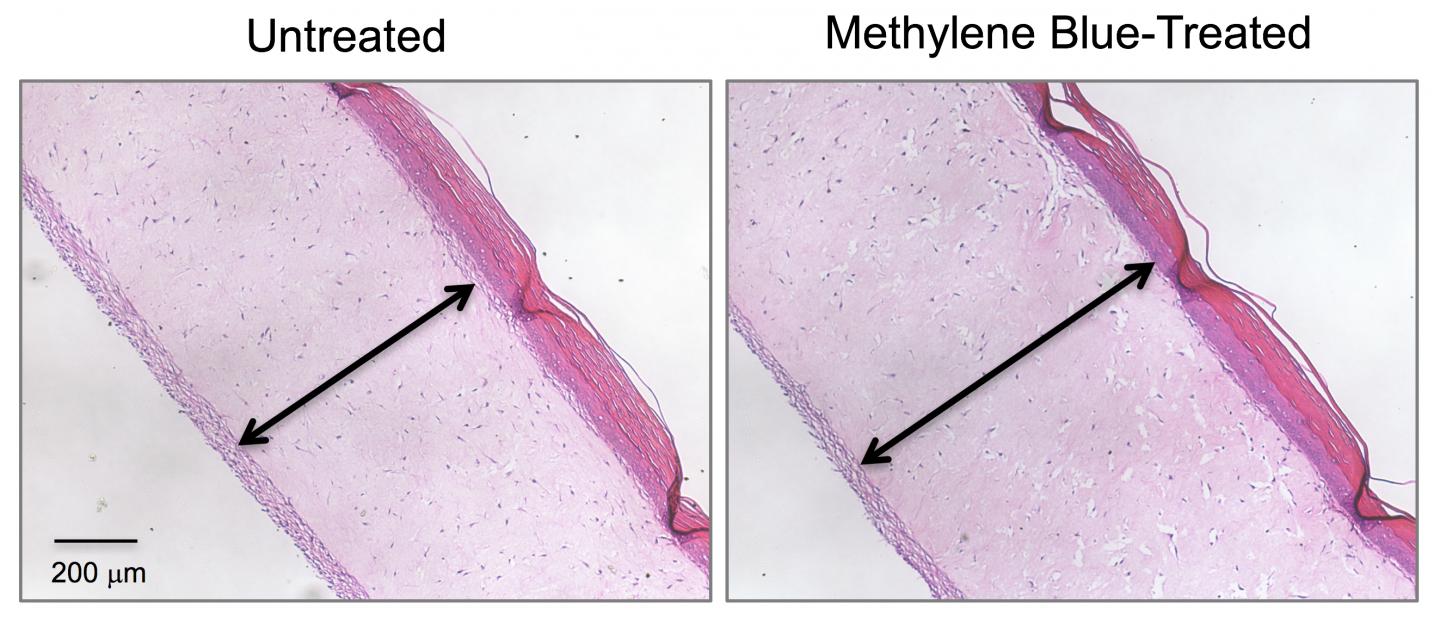
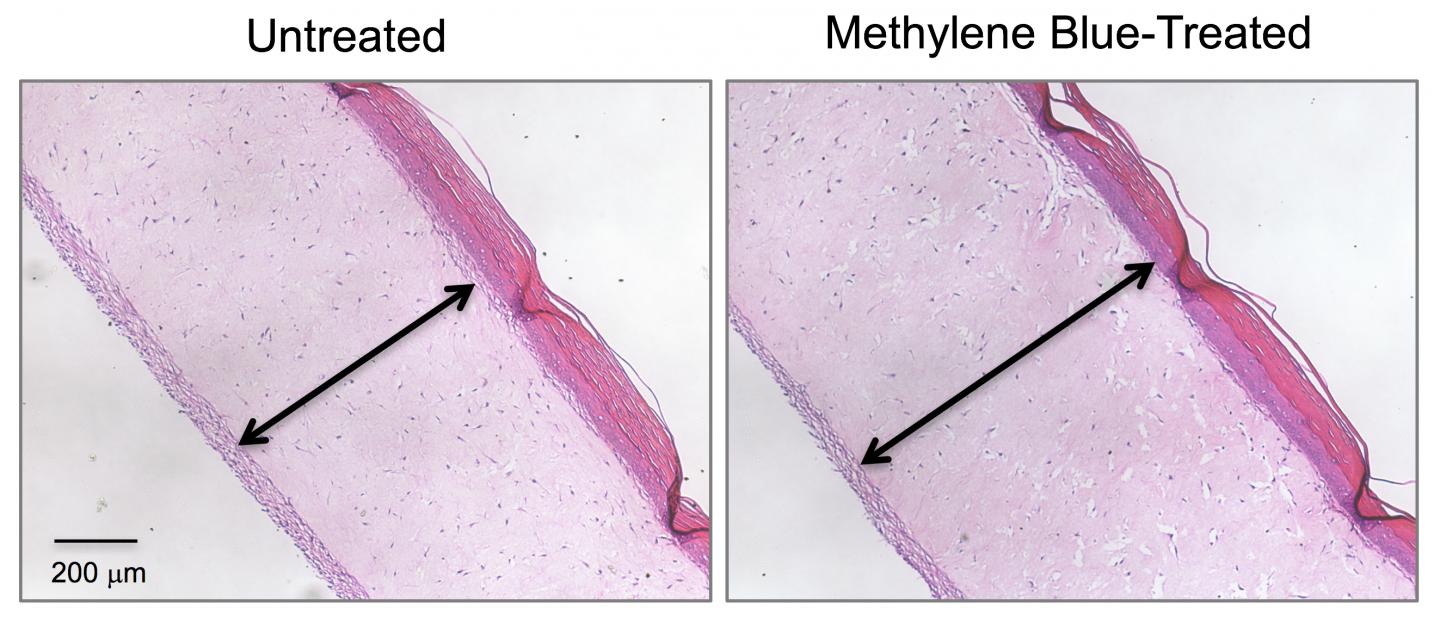
Credit: Zheng-Mei Xiong/University of Maryland
New work from the University of Maryland suggests that a common, inexpensive and safe chemical could slow the aging of human skin. The researchers found evidence that the chemical–an antioxidant called methylene blue–could slow or reverse several well-known signs of aging when tested in cultured human skin cells and simulated skin tissue. The study was published online in the journal Scientific Reports on May 30, 2017.
"Our work suggests that methylene blue could be a powerful antioxidant for use in skin care products," said Kan Cao, senior author on the study and an associate professor of cell biology and molecular genetics at UMD. "The effects we are seeing are not temporary. Methylene blue appears to make fundamental, long-term changes to skin cells."
The researchers tested methylene blue for four weeks in skin cells from healthy middle-aged donors, as well as those diagnosed with progeria–a rare genetic disease that mimics the normal aging process at an accelerated rate. In addition to methylene blue, the researchers also tested three other known antioxidants: N-Acetyl-L-Cysteine (NAC), MitoQ and MitoTEMPO (mTEM).
In these experiments, methylene blue outperformed the other three antioxidants, improving several age-related symptoms in cells from both healthy donors and progeria patients. The skin cells (fibroblasts, the cells that produce the structural protein collagen) experienced a decrease in damaging molecules known as reactive oxygen species, a reduced rate of cell death and an increase in the rate of cell division throughout the four-week treatment.
Next, Cao and her colleagues tested methylene blue in fibroblasts from older donors (>80 years old) again for a period of four weeks. At the end of the treatment, the cells from older donors had experienced a range of improvements, including decreased expression of two genes commonly used as indicators of cellular aging: senescence-associated beta-galactosidase and p16.
"I was encouraged and excited to see skin fibroblasts, derived from individuals more than 80 years old, grow much better in methylene blue-containing medium with reduced cellular senescence markers," said Zheng-Mei Xiong, lead author of the study and an assistant research professor of cell biology and molecular genetics at UMD. "Methylene blue demonstrates a great potential to delay skin aging for all ages."
The researchers then used simulated human skin (a system developed by Cao and Xiong) to perform several more experiments. This simulated skin–a three-dimensional model made of living skin cells–includes all the major layers and structures of skin tissue, with the exception of hair follicles and sweat glands. The model skin could also be used in skin irritation tests required by the Food and Drug Administration for the approval of new cosmetic products, Cao said.
"This system allowed us to test a range of aging symptoms that we can't replicate in cultured cells alone," Cao said. "Most surprisingly, we saw that model skin treated with methylene blue retained more water and increased in thickness–both of which are features typical of younger skin."
The researchers also used the model skin to test the safety of cosmetic creams with methylene blue added. The results suggest that methylene blue causes little to no irritation, even at high concentrations. Encouraged by these results, Cao, Xiong and their colleagues hope to develop safe and effective ways for consumers to benefit from the properties of methylene blue.
"We have already begun formulating cosmetics that contain methylene blue. Now we are looking to translate this into marketable products," Cao said. "We are also very excited to develop the three-dimensional skin model system. Perhaps down the road we can customize the system with bioprinting, such that we might be able to use a patient's own cells to provide a tailor-made testing platform specific to their needs."
###
In addition to Cao and Xiong, other study co-authors affiliated with the UMD Department of Cell Biology and Molecular Genetics include: former laboratory technician Mike O'Donovan, postdoctoral research associate Linlin Sun, graduate student Ji Young (Julie) Choi and undergraduate researcher Margaret Ren.
This research was supported by the Maryland Innovation Initiative. The content of this article does not necessarily reflect the views of this organization.
The research paper, "Anti-Aging Potentials of Methylene Blue for Human Skin Longevity," Zheng-Mei Xiong, Mike O'Donovan, Linlin Sun, Ji Young Choi, Margaret Ren and Kan Cao, was published online in the journal Scientific Reports on May 30, 2017.
Media Relations Contact: Matthew Wright, 301-405-9267, [email protected]
University of Maryland
College of Computer, Mathematical, and Natural Sciences
2300 Symons Hall
College Park, MD 20742
http://www.cmns.umd.edu
@UMDscience
About the College of Computer, Mathematical, and Natural Sciences
The College of Computer, Mathematical, and Natural Sciences at the University of Maryland educates more than 7,000 future scientific leaders in its undergraduate and graduate programs each year. The college's 10 departments and more than a dozen interdisciplinary research centers foster scientific discovery with annual sponsored research funding exceeding $150 million.
Media Contact
Matthew Wright
[email protected]
301-405-9267
@UMDRightNow
http://www.umdrightnow.umd.edu/
############
Story Source: Materials provided by Scienmag