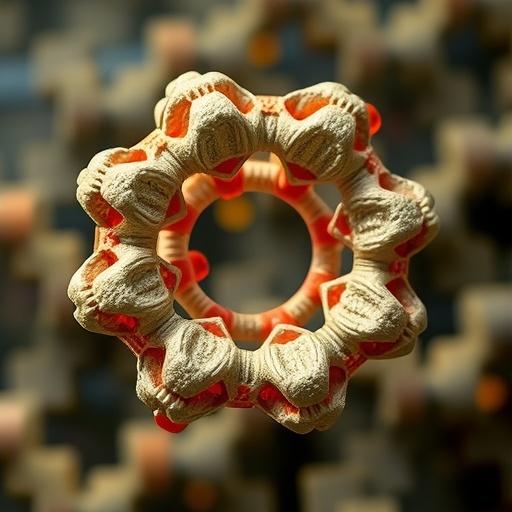
In the quest to engineer sophisticated nanostructures that mimic nature’s intricate designs, researchers have long been fascinated by viral capsids—remarkable protein shells that protect genetic material with unparalleled efficiency. Traditionally, the maximal highly symmetric assembly achievable from a single building block protein has been the 60-subunit icosahedron, a marvel first elucidated decades ago. However, viruses themselves routinely break this limitation, forming capsids composed of hundreds or thousands of identical protein subunits arranged with what is known as quasisymmetry. This phenomenon allows the same protein to occupy symmetrically non-equivalent positions, endowing viral capsids with extraordinary size and versatility beyond the constraints of strict symmetry.
Until now, translating the power of quasisymmetric assemblies into designed, one-component protein nanocages has presented profound challenges. The core difficulty lies in programming a single type of protein subunit to adopt multiple distinct conformations and engage in varied interactions depending on its location within the assembly. Such structural heterogeneity within an ostensibly one-component system defies straightforward design principles, as every subunit must be chemically identical yet functionally diverse. Overcoming this barrier promises transformational advances in nanotechnology, enabling delivery platforms for biologics that boast substantial internal volumes while maintaining uniformity and ease of manufacturing.
A groundbreaking study led by Lee et al. has now revealed a principled approach to realize one-component quasisymmetric protein nanocages. Drawing inspiration from spontaneous symmetry breaking—a fundamental concept in physics where symmetrical systems transition to asymmetric states—the team hypothesized that strong, engineered interactions combined with programmable subunit curvature could drive the emergence of quasisymmetry naturally. By encoding subtle biases into the building blocks’ design blueprint, they allowed the system to resolve itself into complex architectures characterized by both hexagonal and pentagonal packing arrangements, akin to viral capsids but fully artificial in origin.
Central to this success was an innovative methodology that integrated a parametric model of cage architecture with RoseTTAFold diffusion-based generative modeling. This synergistic computational framework enabled in silico exploration of vast configurational spaces while precisely tuning the protein subunits’ interfaces and intrinsic curvatures. The outcome was a diverse suite of designed assemblies spanning triangulation numbers (T) from 3 to 36. These nanocages encompassed 180 to a staggering 2,160 identical subunits, stretching diameters from 68 nanometers up to an impressive 220 nanometers—dimensions surpassing many known natural protein assemblies.
To validate their computational breakthroughs, the researchers employed electron microscopy techniques that decisively confirmed the formation of the predicted quasisymmetric architectures. High-resolution cryogenic electron microscopy further elucidated the structural basis of symmetry breaking within the T=3 cages by resolving the subtle interface variations that govern the differentiation of hexons and pentons. This detailed visualization underscored a transformative principle: global architectural complexity and structural heterogeneity can arise spontaneously from meticulously programmed subunit-level properties without the need to genetically encode multiple protein types.
Beyond advancing fundamental understanding, the study’s findings herald exciting avenues for technological application. By offering a modular and rational design approach, the research unlocks the potential for constructing large, robust nanocages optimized for therapeutic delivery. These engineered protein shells could encapsulate biologics with precise control over size and geometry, facilitating targeted transport and release in biomedical contexts. Moreover, the capacity to shape complex non-icosahedral assemblies reminiscent of clathrin coats expands the landscape of possible biomimetic constructs with relevance to cellular machinery emulation.
Importantly, the combination of parametric geometric representation with machine learning-enabled design tools exemplifies a new paradigm in protein nanotechnology. This framework gracefully balances the rigidity required for structural integrity with the flexibility necessary to explore non-trivial assembly patterns. It demonstrates that by focusing on collective system characteristics rather than rigid subunit constraints, researchers can harness emergent phenomena like symmetry breaking to gain unprecedented control over nanoscale architecture.
The implications of this research extend into broader scientific realms as well. It provides a novel lens through which to view biomolecular symmetry and complexity, suggesting that natural macromolecular machines may exploit similar physical principles during their self-assembly. By dissecting and recreating these intricate processes from first principles, synthetic biology stands poised to design next-generation materials and devices with tailor-made functions previously limited to living organisms.
As the field pushes forward, the marriage of structural biology, computational design, and synthetic protein engineering will underpin revolutionary progress. The authors’ roadmap demonstrates that large quasisymmetric assemblies no longer remain the sole province of evolution but can be crafted with atomic-level precision on demand. This advance sets the stage for transformative innovations in nanomedicine, bioengineering, and materials science, charting a course toward biomimetic constructs capable of performing highly specialized tasks.
By expanding the size range and complexity of single-component protein cages, Lee and colleagues have effectively opened a new frontier in biomolecular design. Their work underscores the tremendous power of engineered symmetry breaking and offers a versatile platform for the next generation of biologically inspired nanotechnology. The study signifies a leap toward realizing synthetic systems with the grandeur, adaptability, and functional sophistication of natural viral assemblies—heralding a new era in protein nanocage design.
In sum, this pioneering research not only elucidates the physical principles behind quasisymmetric viral architectures but also provides a robust, programmable toolkit for creating such structures artificially. It stands as a testament to the power of integrating advanced computational methods with fundamental biophysical insights to overcome longstanding challenges. The work ushers in promising opportunities for deploying these engineered nanocages across numerous scientific and medical fields where precise control over nanoscale structure and function is paramount.
Subject of Research: Design and assembly of one-component quasisymmetric protein nanocages.
Article Title: Design of one-component quasisymmetric protein nanocages.
Article References:
Lee, S., Chmielewski, D., Wang, S. et al. Design of one-component quasisymmetric protein nanocages. Nature (2026). https://doi.org/10.1038/s41586-026-10554-z
Image Credits: AI Generated
DOI: https://doi.org/10.1038/s41586-026-10554-z
Tags: advanced protein assembly engineeringdesign principles for protein nanocagesengineered nanostructures for biologics deliveryicosahedral protein assembliesmultifunctional protein subunitsprotein nanocage structural heterogeneityprotein subunit conformational diversityquasisymmetric protein assembliesquasisymmetry in protein designscalable protein nanocage manufacturingsingle-component protein nanocagesviral capsid mimicry