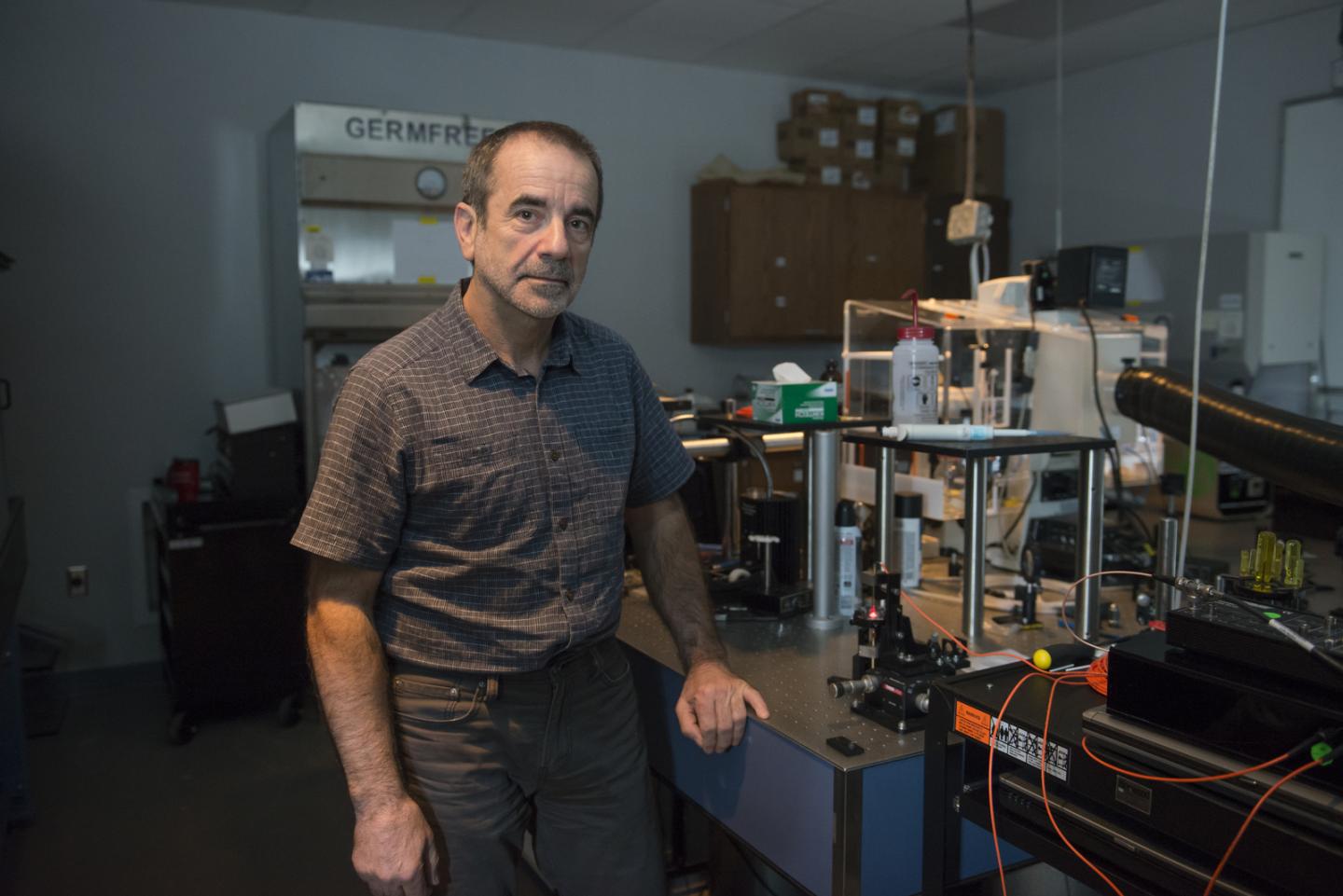
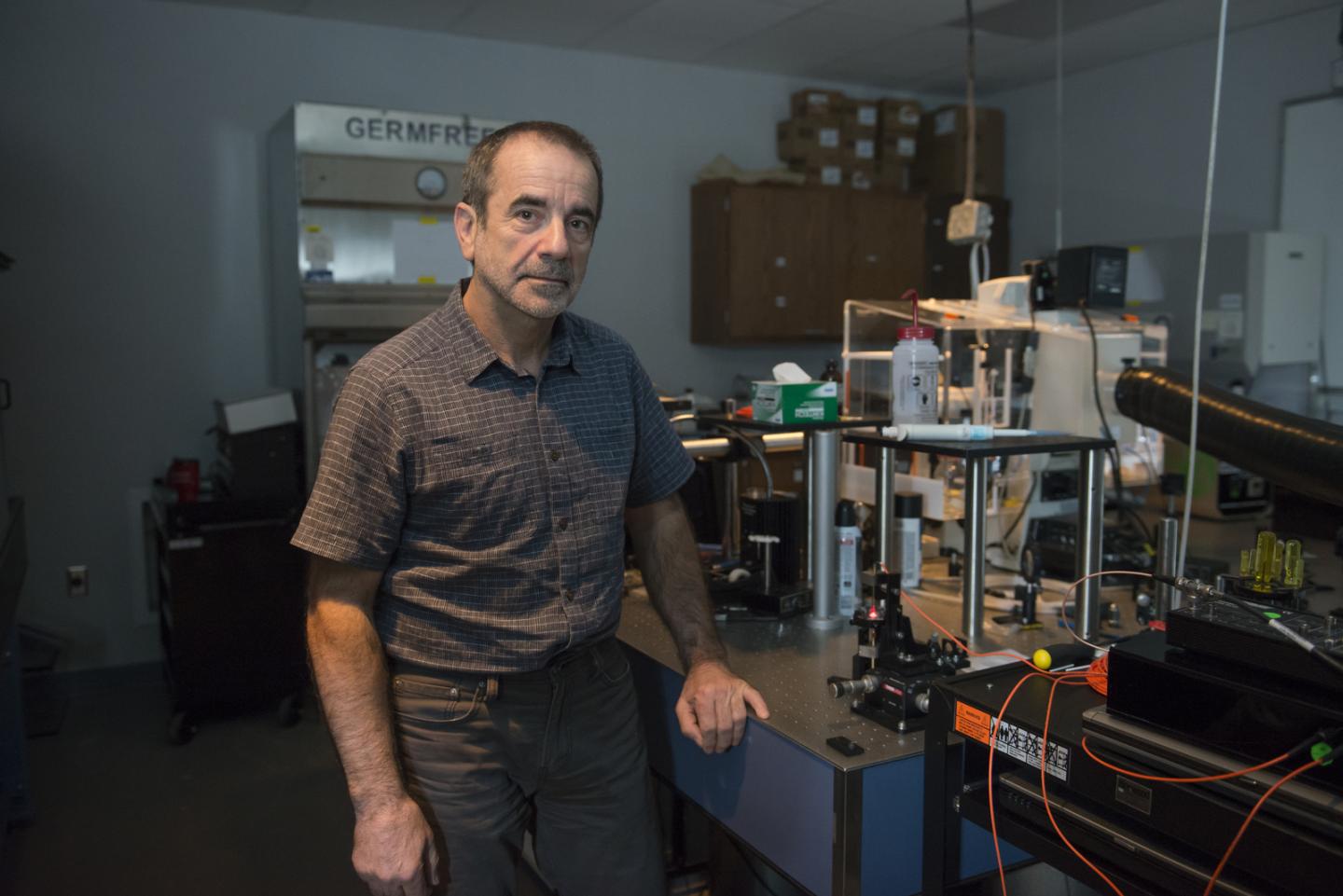
Credit: University of Central Florida
University of Central Florida researchers have developed a new and better way of detecting interactions between light and matter at the atomic level, a discovery that could lead to advances in the emerging field of two-dimensional materials and new ways of controlling light.
Scientists typically use spectrometry tools to study the way light interacts with a gas, liquid or solid. That method is described as "inelastic," meaning the light's energy is altered by its contact with matter.
A team led by Professor Aristide Dogariu of UCF's CREOL, The College of Optics & Photonics, has pioneered a way to detecting such interaction on a single layer of atoms – an exceedingly hard task because of the atom's minute size – using a method that's "elastic." That means the light's energy remains unchanged.
"Our experiment establishes that, even at atomic levels, a statistical optics-based measurement has practical capabilities unrivaled by conventional approaches," Dogariu said.
As reported this month in Optica, the academic journal of The Optical Society, it's the first demonstration of an elastic scattering, near-field experiment performed on a single layer of atoms.
The researchers demonstrate this novel and fundamental phenomenon using graphene, a two-dimensional, crystalline material. Their technique involved random illumination of the atomic monolayer from all possible directions and then analyzing how the statistical properties of the input light are influenced by miniscule defects in the atomic layer.
The method provided scientists not only with a simple and robust way to assess structural properties of 2D materials but also with new means for controlling the complex properties of optical radiation at subwavelength scales.
The team's finding that its method is superior to conventional ones is of broad interest to the physics community. Beyond that, it could lead to other advances.
Graphene and other two-dimensional materials have properties that researchers are trying to leverage for use in display screens, batteries, capacitors, solar cells and more. But their effectiveness can be limited by impurities and finding those defects requires sophisticated microscopy techniques that are sometimes impractical. Dogariu's research has yielded a more effective way of discovering those defects — a potentially valuable technique for industry.
The finding that a single layer of atoms modifies properties of light and other electromagnetic radiation has implications for controlling light at subwavelength scales in photonic devices such as LEDs and photovoltaic cells.
###
The research team also included Roxana Rezvani Naraghi of UCF's College of Optics & Photonics and Department of Physics; Luiz Gustavo Cancado, of UCF's College of Optics & Photonics and the Federal University of Minas Gerais in Brazil; and Felix Salazar-Bloise of Polytechnic University of Madrid in Spain.
Media Contact
Mark Schlueb
[email protected]
407-823-0221
@UCF
http://www.ucf.edu
############
Story Source: Materials provided by Scienmag