The marimba, a majestic instrument celebrated for its warm, earthy tones, holds a cherished place in orchestras worldwide. Its voice, spanning bright, articulate high notes to deep resonant bass, captivates musicians and audiences alike. Yet the cost of marimbas—often ranging from a thousand to over twenty-five thousand dollars—poses a formidable barrier, particularly for educational institutions and aspiring musicians with limited resources. At the heart of this expense lies Honduran rosewood, the traditional material used for the instrument’s bars, prized not only for its unique acoustic qualities but also for its rarity and high market value.
Amartya Bhattacharya, a passionate student of Northeastern University deeply enamored with the marimba’s expressive potential, embarked on a mission to democratize access to this instrument. His focus centered on whether more affordable but equally effective alternative materials could replicate the sonic beauty and playability of the traditional rosewood bars. The challenge was twofold: to identify candidate materials that mimic the mechanical and acoustic properties of rosewood while also ensuring durability to withstand frequent use.
Bhattacharya approached this problem with a rigorous scientific lens, evaluating both natural woods and synthetic polymers as potential substitutes. Key parameters under scrutiny included density, which influences the instrument’s durability and the weight players feel; the loss factor, linked to how quickly a material’s vibrations dissipate, affecting resonance and sustain; and Young’s modulus, a measure of material stiffness that correlates strongly with pitch and tactile feedback. Through meticulous analysis of these characteristics, Bhattacharya sought to uncover bars that could reproduce the tonal quality and response musicians expect from traditional marimbas.
After extensive testing, hickory wood surfaced as the most promising candidate from an acoustical perspective. Not only was hickory significantly less costly than Honduran rosewood, but it also exhibited a Young’s modulus comparable to rosewood, suggesting that it would respond similarly when struck. The ratio of Young’s modulus to density was particularly noteworthy, indicating that bars crafted from hickory would be close in size and mass to rosewood bars for the same pitch. This size consistency is critical; it ensures that transitions between practice instruments and professional-grade marimbas remain seamless for performers.
However, not all materials evaluated met the stringent requirements. Spruce, for instance, possessed a favorable Young’s modulus-to-density ratio akin to rosewood. Yet its higher damping characteristics, reflected in greater loss factors, implied that sounds produced would decay too rapidly. Such a property is problematic for marimba playing, especially during rolling techniques where players create a continuous, sustained tone by rapidly alternating mallet strikes. A material with excessive damping undermines this technique by cutting off resonance prematurely, diminishing the instrument’s expressive range.
The scientific methodology underpinning Bhattacharya’s work hinges on a deep understanding of material science principles applied to musical acoustics. Density governs how long a marimba will endure the rigors of playing; heavier, denser woods tend to last longer but risk becoming unwieldy. The loss factor, mathematically related to internal friction within the fibers of the wood, determines how “live” or resonant a bar sounds, influencing the instrument’s sustain and tonal character. Young’s modulus directly relates to the bar’s stiffness, affecting how it vibrates to produce precise pitches and the tactile feedback experienced by the musician.
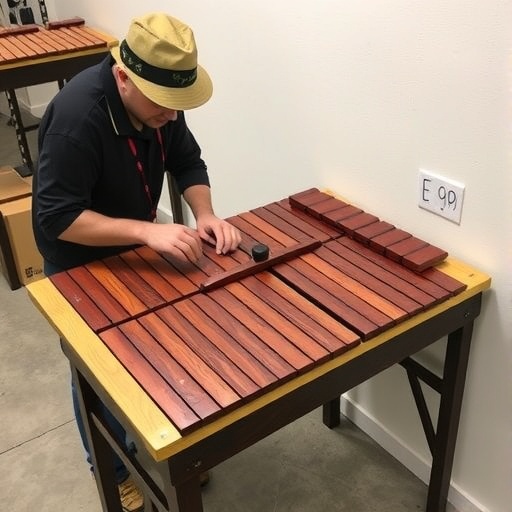
Bhattacharya’s analysis signifies a crucial step toward affordable marimbas without compromising sound quality. Future plans include fabricating full-sized bars from promising materials such as hickory and conducting thorough acoustic and durability tests on them. By physically producing bars and assessing their performance in realistic playing conditions, Bhattacharya aims to validate his theoretical findings and refine methods to enhance material properties.
One avenue under consideration is thermal and pressure treatment of hickory wood bars to increase their density, potentially improving durability and fine-tuning acoustical properties. Additionally, he aims to expand the scope of research to encompass alternative woods like bamboo, which might offer sustainable and cost-effective options while maintaining acoustic integrity.
The endeavor to find accessible materials for marimbas aligns with broader efforts in musical instrument research geared toward inclusivity and sustainability. Traditional woods like Honduran rosewood face environmental pressures due to overharvesting, increasing costs, and shrinking supplies. Developing viable synthetic or naturally abundant wood substitutes could mitigate these challenges, ensuring that future generations can enjoy and perform on quality marimbas.
Bhattacharya’s work also underscores the importance of integrating acoustics science with practical musicianship. By grounding his approach in quantitative material properties and connecting these to the nuanced demands of marimba performance techniques, he bridges the gap between laboratory analysis and real-world application. His research reflects a holistic vision—where scientific inquiry enhances artistic expression by making treasured instruments more available and affordable.
The marimba stands as the pinnacle of pitched percussion instruments, celebrated for its dynamic range and subtle articulations. Innovations in material science spearheaded by enthusiasts like Bhattacharya promise to expand this instrument’s reach. As he prepares to present these insights at the 190th Meeting of the Acoustical Society of America, the anticipation builds for a new era where tradition and technology harmoniously converge to reshape musical possibilities.
In conclusion, the intersection of physics, material science, and musical artistry offers exciting prospects for transforming the marimba from an elite instrument into a widely accessible one. Through diligent research analyzing density, resonance, and stiffness, Bhattacharya’s findings highlight hickory as a cost-effective substitute for Honduran rosewood. Such advancements could revolutionize percussion education and performance, enabling diverse communities to experience the richness of the marimba’s voice without prohibitive costs.
Subject of Research: Acoustical and material analysis of alternative materials for marimba bars to find cost-effective substitutes for traditional Honduran rosewood.
Article Title: Democratizing the Marimba: Acoustic Science Unlocks Affordable Alternatives to Rosewood
News Publication Date: May 14, 2026
Image Credits: Amartya Bhattacharya
Keywords
Musical acoustics, marimba, percussion instruments, material science, Honduran rosewood, hickory, Young’s modulus, resonance, density, acoustic properties, sustainable materials, musical instruments
Tags: affordable marimba innovationalternative rosewood substitutescost-effective percussion instrumentsdemocratizing musical instrument accessdurable marimba bar materialseducational instrument accessibilitymarimba acoustic propertiesmechanical properties of marimba barsnatural wood alternatives for marimbasNortheastern University music researchsustainable musical instrument materialssynthetic polymers in music