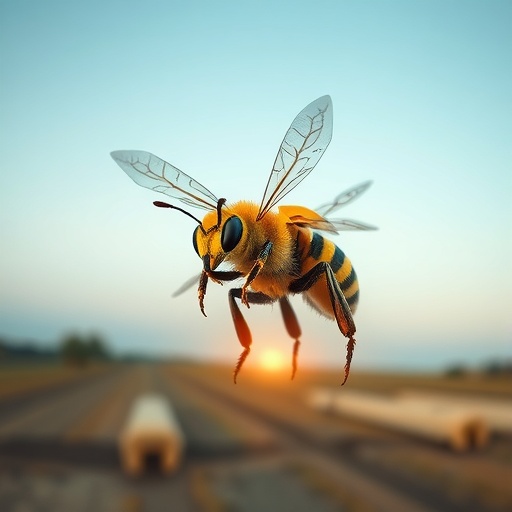
In the quest to unlock more efficient autonomous navigation in robotic systems, a groundbreaking study has drawn inspiration from the humble honeybee’s learning flights, a biological marvel of spatial awareness and homing precision. Researchers Ou, Hagenaars, Jankowski, and colleagues have developed a novel robotic navigation system that mimics these natural processes to guide drones through complex and unstructured environments with remarkable accuracy. This breakthrough is poised to redefine how robots navigate in GPS-denied spaces, from dense forests to indoor hangars.
Central to this innovative approach are two simulation environments that underpin the development and validation of the navigation algorithms. The first, a simplified simulator, models drone flight paths using noisy sensor inputs to replicate real-world odometric drift. This setup, incorporating Gaussian noise to mimic inaccuracies in heading and velocity estimates, allows the researchers to quantify path integration errors and establish the spatial limits in which the drone can reliably home—what they term the “local homing area” (LHA). Here, the drone’s trajectory during a three-minute outbound flight covers a block-like search pattern with periodic directional changes, followed by a direct inbound flight. Simulating both compass-less and compass-based navigation modalities revealed stark contrasts in accuracy, underscoring the traditional challenges autonomous systems face without reliable heading references.
Complementing this is a visually realistic simulator built on NVIDIA’s Isaac Sim platform. This environment recreates a lifelike forest scene populated with randomly distributed 3D trees, providing a testbed for the neural network-based visual homing component. By training the convolutional neural network in such a complex visual landscape, the system learns to infer the drone’s home vector solely from omnidirectional images. This setup critically bridges the gap between theoretical navigation models and the high-dimensional visual inputs encountered in real-world scenarios, reflecting the complexity of natural habitats honeybees navigate.
The learning flight itself is a keystone behavior adapted directly from honeybee flight patterns. By executing a wasp-like looping trajectory around the home position, the drone captures visual data and associates it with its odometry-derived spatial coordinates. The learning phase generates an extensive set of panoramic images synthesized with position and heading labels obtained through path integration. Training an attention-based convolutional neural network with this self-supervised data empowers the drone with robust visual cues to guide its homing behavior, despite the inevitable positional uncertainties introduced by sensor noise.
At the heart of this system lies an elegant transformation of the drone’s spatial understanding. A raw vector pointing from the drone’s current position to the home base is rotated into the drone’s body-fixed frame, providing the neural network with ground truth labels reflective of the drone’s perspective. This 2D home vector, representing direction and distance, forms the target output during training and the control input during navigation. It empowers the drone to iteratively refine its heading and motion, culminating in successful homing within a maximum radius defined by the LHA.
Pragmatic challenges such as strong wind conditions that induce substantial drone tilts are deftly addressed with sophisticated image pre-processing techniques. These methods dynamically correct horizon line distortions in the panoramic images by adjusting the center of the linear-polar unwrapping procedure based on either onboard inertial data or computer vision detection of the horizon itself. By compensating for tilt-induced visual artifacts, the system maintains reliable image cues for the neural network, preserving homing accuracy even under adverse environmental perturbations.
The intellectual novelty of the navigation system extends to its neural network architecture. Two models are proposed: a compact network optimized for computational efficiency and an attention network that leverages Inception modules with spatial attention mechanisms to emphasize salient regions of the high-resolution panoramic imagery. The attention network’s ability to flexibly attend to critical visual features dramatically improves homing accuracy, enabling robust performance with a modest parameter count that fits the constrained hardware of the onboard Raspberry Pi computer.
The seamless integration of perception and control is demonstrated in a custom-built quadcopter platform equipped exclusively with onboard processing capabilities. This drone employs an omnidirectional camera with a catadioptric lens to capture 360-degree panoramic views, an optical flow sensor and LiDAR for odometry, and a flight controller running PX4 firmware to manage motor commands. Critically, external localization aids such as GPS or magnetometers are disabled to validate true autonomy. The drone processes raw sensor data, performs neural inference, and generates flight commands internally, epitomizing self-sufficient robotic navigation.
The researchers also benchmark their approach against classical homing strategies. A snapshot-based method relying on exhaustive pixel-wise image rotation and difference measurements serves as a computationally intensive baseline, while a perfect memory scheme stores all learning images to allow exhaustive comparisons. The proposed learning flight-induced neural homing strategy far outperforms these benchmarks by virtue of its efficiency and generalization, requiring fewer computational resources and achieving higher precision within the LHA.
Real-world experimentation further underscores the system’s robustness. Trials span diverse indoor facilities with motion capture ground truth, large-scale indoor hangars, and outdoor fields with natural variability in terrain and lighting. In these scenarios, the drone executes complex outbound search patterns before returning via odometry-guided flight and culminating in neural network-guided homing. Success is consistently marked by drone arrival within half a meter of the original takeoff point. The system’s versatility is highlighted by its ability to perform under varying spatial scales and environmental complexities.
Obstacle avoidance is another hallmark of this biologically inspired navigation system. Using a finite-state machine approach and reactive detect-and-avoid logic, the drone employs LiDAR sensors partitioned into left, center, and right sectors. On detecting obstructions below set distance thresholds, the drone adaptively chooses evasive maneuvers, such as lateral rotations and forward movements, while maintaining its navigation goals. This dynamic interplay between perception, obstacle avoidance, and visual homing ensures the drone can navigate cluttered environments without external assistance.
The study also explores three distinct network training modes—offboard offline, onboard offline, and onboard online learning—each tailored to varying operational constraints. Offboard learning utilizes a high-performance ground station that processes extensive virtual rotation and color augmentation, expanding the effective size of the training dataset. Onboard offline learning streamlines these augmentations to accommodate limited processing power on the Raspberry Pi. Most impressively, onboard online learning enables in-flight, asynchronous network training during the learning flight itself, allowing rapid deployment post-learning without external infrastructure.
Altogether, this comprehensive integration of biologically inspired learning flight patterns, advanced neural networks, realistic sensory simulations, and hardware-software co-design provides a compelling blueprint for future autonomous robots. Mimicking the elegant efficiency of honeybees, these systems herald a new era in which drones can navigate GPS-denied and visually complex environments with unprecedented autonomy and resilience, laying the groundwork for applications ranging from search-and-rescue missions to environmental monitoring.
Subject of Research: Autonomous robotic navigation inspired by honeybee learning flights
Article Title: Efficient robot navigation inspired by honeybee learning flights
Article References: Ou, D., Hagenaars, J.J., Jankowski, M.R. et al. Efficient robot navigation inspired by honeybee learning flights. Nature (2026). https://doi.org/10.1038/s41586-026-10461-3
Image Credits: AI Generated
DOI: https://doi.org/10.1038/s41586-026-10461-3
Keywords: autonomous navigation, visual homing, honeybee inspiration, path integration, convolutional neural networks, omnidirectional vision, robotic drones, GPS-denied environments, obstacle avoidance, learning flight
Tags: autonomous drone navigation GPS-denied environmentsbiological inspiration for robotic systemscompass-based vs compass-less navigationdrone navigation in unstructured environmentsGaussian noise in sensor modelinghoming precision in roboticslocal homing area in drone navigationodometric drift in drone flightpath integration errors in roboticsrobot navigation inspired by honeybee flightssimulation environments for drone navigationspatial awareness in drones