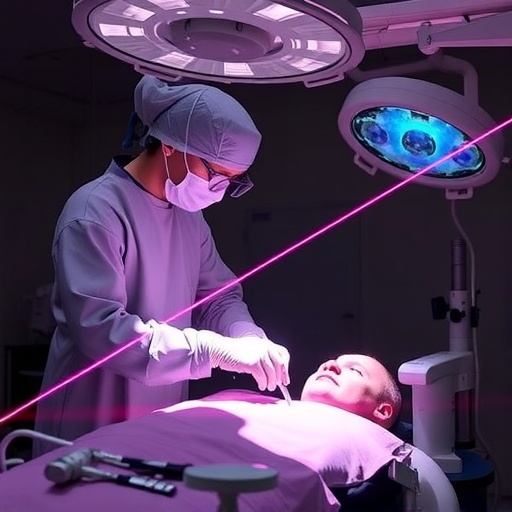
In the evolving landscape of surgical technology, a pioneering approach promises to redefine how surgeons navigate the hidden complexities beneath the human body’s surface. Surgery, a field intricately tied to the delicate balance between precision and risk, often hinges on a surgeon’s capacity to interpret visual cues and rely on extensive experience. Yet, beneath the visible layers of tissue lie vital structures such as nerves and blood vessels, which elude direct sight and pose significant hazards during operations. Even with meticulous technique, inadvertent damage to these subsurface features can escalate a routine procedure into a life-threatening challenge.
Emerging at this critical juncture is the innovative integration of photoacoustic imaging into robot-assisted laparoscopic surgery—a domain where cutting-edge imaging converges with robotic precision to enhance surgical outcomes. Photoacoustic imaging represents a remarkable hybrid technology that harnesses the interaction between light and sound to visualize subsurface anatomical details inaccessible to conventional imaging. By illuminating deep tissue with laser pulses, this approach exploits the photoacoustic effect: tissue components absorb optical energy and emit ultrasonic waves that can be captured and processed to create detailed maps of hidden structures.
Dr. Kai Zhang, an associate professor at Worcester Polytechnic Institute, spearheads this transformative research. His team’s groundbreaking work, slated for presentation at the 190th Meeting of the Acoustical Society of America, showcases how photoacoustic imaging, when embedded into laparoscopic interventions, can materially improve surgeons’ spatial awareness. Specifically, the technique yields real-time three-dimensional reconstructions of neurovascular bundles—clusters of nerves and blood vessels whose integrity is paramount to patient safety and post-surgical function.
Robot-assisted laparoscopic surgery itself is a paradigm shift. It utilizes miniature cameras and robotic instruments introduced through small incisions, enabling minimally invasive procedures that reduce patient trauma, minimize pain, and shorten recuperation periods. However, despite these advancements, the risk remains: up to 2% of such procedures encounter accidental severing of blood vessels hidden beneath tissue surfaces. These incidents potentially trigger severe complications including hemorrhage, neurological damage, or even fatality.
Dr. Zhang’s innovative probe design combines the principles of photoacoustics with advanced signal processing. In practice, pulsed laser light penetrates tissue and is absorbed by chromophores such as hemoglobin within blood vessels. This absorption induces thermoelastic expansion and generates ultrasonic waves, which are captured by ultrasensitive transducers integrated into the probe. Sophisticated algorithms then reconstruct these acoustic signals into volumetric imagery representing the precise location and branching patterns of essential neurovascular networks.
The true clinical breakthrough lies in the seamless fusion of this imaging data with the laparoscopic video feed through augmented reality visualization. Surgeons receive a composite view overlaying the detailed anatomy beneath the surface directly onto their operative field. This real-time guidance fosters unparalleled situational awareness, enabling surgeons to circumvent critical structures that would otherwise be invisible. Such integration not only minimizes intraoperative errors but also has profound implications for tailoring surgical strategies dynamically as anatomy is encountered.
While the current validation of this technology focuses on radical prostatectomy—a complex procedure involving the excision of the prostate gland in cases of cancer—its modular nature predicates broad applicability. The underlying photoacoustic system can readily be adapted to diverse laparoscopic and minimally invasive surgeries, spanning gynecological, urological, and general abdominal interventions. This versatility amplifies the potential impact on healthcare outcomes across myriad specialties.
Moreover, Dr. Zhang envisions further enhancements through refined image processing, miniaturization of probe components, and synchronization with robotic control systems. These advancements could usher in an era where surgical robots not only assist in mechanical precision but also interpret and respond to embedded physiological intelligence, elevating surgery from a manual art to a synergistic interplay of human expertise and machine-derived insight.
This research epitomizes the confluence of acoustics, optics, and biomedical engineering, illustrating how interdisciplinary innovation propels medicine toward safer, more effective interventions. It underscores the crucial role of photoacoustic techniques in augmenting clinical imaging, offering surgeons an unprecedented window beneath the skin, transforming uncertainties into informed action.
As the field of minimally invasive surgery continues to grow, the demand for augmented visualization tools becomes ever more pressing. Integrating photoacoustic imaging heralds a revolutionary shift, positioning surgeons to navigate the hidden complexities of human anatomy with enhanced confidence, precision, and patient safety. The future of surgery may well depend on illuminating what was once invisible.
Subject of Research: Integration of photoacoustic imaging in robot-assisted laparoscopic surgery to visualize subsurface neurovascular structures.
Article Title: Illuminating Hidden Anatomy: Photoacoustic Imaging Enhances Safety in Robot-Assisted Surgery
News Publication Date: May 11, 2026
Image Credits: Kai Zhang
Keywords
Surgery, Robot-assisted laparoscopy, Photoacoustic imaging, Neurovascular bundles, Medical imaging, Minimally invasive surgery, Augmented reality, Biomedical engineering, Acoustic imaging, Laser imaging, Surgical innovation, Radical prostatectomy
Tags: advanced imaging for minimally invasive surgeryDr. Kai Zhang surgical imaging researchenhancing surgical safety with imaginghybrid light and sound imaging techniqueslaser-induced acoustic imaging in surgeryphotoacoustic imaging for surgical guidanceprecision surgery with photoacoustic technologypreventing nerve and blood vessel damage in surgeryreal-time intraoperative imaging solutionsrobot-assisted laparoscopic surgery technologysubsurface anatomical visualization methodsWorcester Polytechnic Institute medical innovation