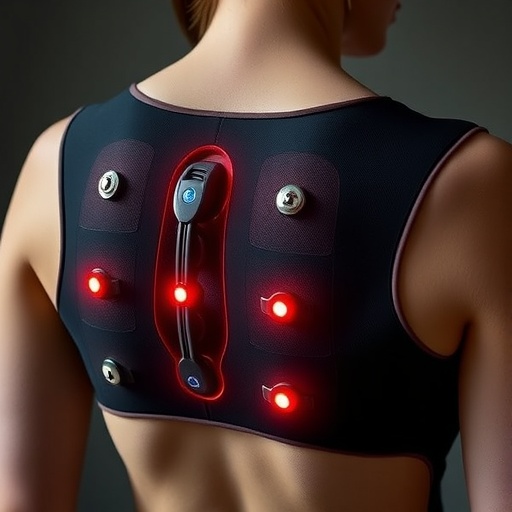
In the rapidly evolving landscape of virtual reality (VR), multisensory immersion has long been the holy grail for researchers and developers. Visual and auditory fidelity have advanced by leaps and bounds, yet one critical sense remains elusive: touch. The tactile dimension in VR experiences is frequently reduced to coarse vibrations or rudimentary haptic feedback, often resulting in sensations that feel imprecise, blurred, or unsatisfyingly artificial. At the heart of this limitation lies a technical challenge—the unintended spread of electrical current among electrodes designed to stimulate tactile nerve endings, causing mixed or smeared sensations. A groundbreaking study led by Professor Xiangmin Xu and colleagues from the South China University of Technology promises to rewrite this narrative through an innovative fabric-based electrotactile system that delivers refined, localized touch sensations with unprecedented clarity.
Current electrotactile technologies rely on arrays of electrodes that activate the skin’s nerve endings through mild electrical pulses. Despite their promise, these systems grapple with a persistent problem: lateral current diffusion. When a single electrode in a multi-electrode array is energized, the electrical current tends to stray sideways, stimulating neighboring nerve fibers besides the intended target. This phenomenon dilutes the distinctness of sensations, akin to reading Braille with blurred fingers where each raised dot’s meaning becomes ambiguous. Professor Shu, a key member of the team, succinctly encapsulates the dilemma, highlighting how the lateral crosstalk between electrodes severely hampers tactile resolution and perceptual accuracy.
The research team’s seminal advancement arises from an ingenious “stimulation-inhibition electrode unit” design, which encapsulates an activating electrode at the center, encircled by a peripheral electrode emitting inhibitory current of the opposite polarity and approximately one-quarter the amplitude. This arrangement ingeniously counterbalances the sideways spread of the stimulating current, effectively confining electrical activity strictly around the central electrode’s footprint. Rigorous computational modeling using COMSOL Multiphysics simulations validated this design’s efficacy, showing that the stimulation-inhibition units drastically reduce the lateral current spillover without compromising the density of electrode packing. Unlike prior concentric-ring models tailored for electromyography signal isolation on broader scales, this novel structure meticulously targets near-field electrical interference between adjacent pads in tightly clustered arrays.
Fabrication of the electrode array incorporates advanced screen-printing techniques with a novel platinum-carbon composite ink on breathable nylon. Choice of the textile substrate is deliberate—the flexible fabric conforms intimately to the fingertip’s contours, facilitating natural movements while ensuring wearer comfort during prolonged usage. A robust thermoplastic polyurethane (TPU) encapsulant shields the electrodes from mechanical wear and environmental exposure. Electrical characterization revealed minimal initial trace resistance under 20 Ω, with marginal increases to approximately 50 Ω even after repeated use with 30 individual participants, underscoring remarkable durability. Additionally, the physiological state of the skin affected performance beneficially; natural moisture lowered electrode-skin impedance slightly, enhancing stimulation efficiency without exceeding safety thresholds.
To experimentally assess the system’s performance, the researchers enlisted thirty healthy young adults for a series of tactile pattern recognition tasks within an immersive VR setting. Participants donned VR headsets paired with fingertip-mounted electrode arrays and were asked to discern between primitive stroke patterns (horizontal, vertical, and diagonal strokes), geometric shapes (such as crosses, squares, rectangles), and more intricate figures including smiley and sad faces. These tests were conducted under controlled conditions both with and without activation of the inhibitory electrodes. The differences were striking: activation of inhibitory electrodes corresponded with statistically significant improvements in recognition accuracy across all categories. Particularly, vertical and leftward strokes saw the most pronounced gains, evidenced by p-values of 0.0002 and 0.0098 respectively, indicating strong scientific confidence in these results.
Complementing accuracy improvements, the inhibition-enabled system reduced participant reaction times, especially for complex vertical and diagonal motions. Qualitative feedback further revealed that an overwhelming 93.3% of users described tactile sensations as crisper and more comfortable, alleviating prior issues of blurred and distracting electrical noise. These combined quantitative and subjective results underscore the efficacy of the stimulation-inhibition approach in restoring the fidelity of electrotactile feedback, moving it much closer to the nuanced repertoire of human touch experiences.
An integral component of this research is the creation of the Tactile Perception Evaluation Interaction System (TPEIS), a sophisticated software platform designed to measure tactile acuity through recorded accuracy, reaction speed, and a composite tactile perception score. This innovative VR-based tool enables personalized assessment and training, with measured scores distributed normally across participants. Importantly, a concise 15-minute training session demonstrated significant performance gains for individuals with initially lower scores, highlighting the tool’s potential for adaptive haptic rehabilitation and skill enhancement beyond mere laboratory evaluation.
The implications of these advances extend beyond controlled testing into vivid, applied VR scenarios developed by the research team. In a virtual kitchen environment, participants experience a compelling illusion of warm water flowing over the fingertip, achieved through the sequential activation of discrete electrode channels that simulate continuous fluid motion. Another interactive scene mimics the delicate act of stroking a bird’s forehead using low-amplitude, gentle pulses, evoking softness distinct enough to elicit emotional responses. Contrastingly, a cactus interaction employs precise high-intensity single-point stimuli, generating a sharp stinging sensation characteristic of prickly textures without residual numbness or discomfort. These examples illustrate the system’s versatility in replicating a spectrum of tactile qualities, from smooth warmth to sudden sharpness.
The fidelity of these sensations hinges on finely tuned stimulation waveforms—adjusting parameters like pulse frequency, amplitude, and duration to mirror natural tactile experiences faithfully. The stimulation-inhibition electrode units guarantee crisp spatial resolution by selectively activating only intended electrodes, eliminating unintended overlap that would otherwise degrade sensation precision. This synergistic design philosophy, combining hardware innovation with waveform customization, marks a decisive step towards haptic fidelity that aligns with our daily tactile interactions.
While promising, the researchers candidly acknowledge current limitations. Their study focused exclusively on healthy young adults, leaving questions open about the system’s adaptability to broader populations including older adults or individuals with sensory impairments. Additionally, in-depth evaluations of long-term safety and comfort during extended wear in real-world applications remain necessary. The system’s strength lies in its individualized current threshold calibrations and adjustable stimulation amplitudes, promising a tailored fit for diverse users—yet comprehensive clinical validation is essential to fully unlock its transformative potential.
This pioneering fabric-based electrotactile approach heralds a new era in VR haptics, where the sense of touch steps beyond rudimentary buzzes to become immersive, precise, and emotionally resonant. As Professor Yu aptly summarizes, the technology lays a crucial groundwork for truly personalized haptic feedback, with far-reaching applications from medical rehabilitation therapies to professional skill training and enriched entertainment experiences. The prospect of VR that users can genuinely feel—soft feathers, flowing streams, or prickly cacti—no longer seems a distant dream but an emerging reality.
This collaborative research effort draws on the expertise of a multidisciplinary team including Hongbo Yao, Delong Li, Wenjun Zhang, Qiwei Xiong, Yuhe Luo, Chuhang Lin, Jiyu Wang, Jialong Liu, Mingyu Tan, Xijie Wu, Yuanjun Ma, Yihuan Lin, Qingao Hu, Tao Huang, Lin Shu, Lei Wei, Xinge Yu, alongside Professor Xiangmin Xu. Supported by the National Key R&D Program of China and Guangdong Province’s key research initiatives, their work epitomizes the synergy between material science, electrical engineering, and neuroscience in crafting next-generation VR experiences.
Published on April 1, 2026, in the journal Cyborg and Bionic Systems, the paper titled “Wearable Fabric Electrotactile System with Stimulation–Inhibition Electrode Units” represents a landmark contribution to the frontier of wearable haptics and virtual tactile perception.
Subject of Research: Fabric-based electrotactile systems for enhanced tactile feedback in virtual reality.
Article Title: Wearable Fabric Electrotactile System with Stimulation–Inhibition Electrode Units
News Publication Date: April 1, 2026
Web References: DOI: 10.34133/cbsystems.0515
Image Credits: Xiangmin Xu, School of Electronic and Information Engineering, South China University of Technology
Keywords: Virtual Reality, Electrotactile Feedback, Haptic Technology, Stimulation-Inhibition, Tactile Perception, Wearable Electronics, Fabric Electrodes, Neural Stimulation, Human-Computer Interaction, VR Immersion
Tags: advanced haptic feedback deviceselectrotactile nerve stimulationfabric-based tactile stimulationinnovative VR tactile technologylocalized touch sensation technologymultisensory immersion in VRreducing electrical current diffusionSouth China University of Technology researchstimulation–inhibition electrode unitstactile perception enhancementvirtual reality haptic feedbackwearable electrotactile system