A groundbreaking advancement in the field of antimicrobial surface technology has emerged from the laboratories of the University of Toronto Engineering. Researchers there have engineered a novel, non-toxic coating that significantly inhibits the adhesion of proteins to surfaces, a key factor in the transmission of infectious agents. This innovation holds tremendous promise for reducing hospital-acquired infections and enhancing public health safety by providing a safer alternative to conventional disinfectants.
Professor Kevin Golovin, who leads the Durable Repellent Engineered Advanced Materials (DREAM) Laboratory at the University of Toronto, emphasizes the limitations of existing disinfection methods. “Currently, surfaces are mainly cleaned using harsh chemicals like bleach, which pose risks to the health of healthcare workers and can contribute to the evolution of resistant microbial strains,” he explains. This reality underscores the urgent need for safer, more efficient surface coatings that prevent microbial contamination without relying on toxic substances.
Golovin and his team specialize in designing engineered surfaces that repel specific molecules, with applications ranging from preventing ice accumulation on airplane wings to creating novel non-stick cookware. Their latest research, recently published in the Chemical Engineering Journal, directs this expertise toward preventing the attachment of bacteria-causing proteins, thereby inhibiting infection transmission via surface contact.
Key to this research is the role of proteins secreted by microbes. These proteins form sticky layers that facilitate bacterial adhesion to surfaces, enabling microbes to establish colonies and cause infections. By disrupting this initial protein layer formation, the transmission of disease-causing pathogens can be thwarted at a critical early stage, effectively altering the microbial lifecycle on contact surfaces.
The team focused on polydimethylsiloxane, or PDMS, known for its biocompatibility, transparency, and flexibility. PDMS sees widespread use in the medical field, from contact lenses to implantable devices. Despite its mild bacterial repellency, Golovin’s group hypothesized that they could amplify PDMS’s non-stick properties by manipulating its molecular architecture, creating a surface that would be inhospitable to protein adhesion.
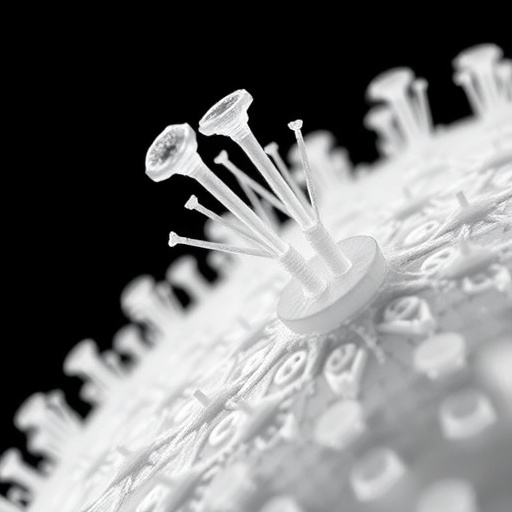
Traditional use of PDMS involves cross-linking the polymer chains to create a solid silicone rubber. Instead, the researchers developed a “brush-like” surface composed of long, flexible PDMS chains that extend from the substrate. These mobile bristles mimic a liquid-like interface, differing fundamentally from rigid solid surfaces in their interaction with proteins.
This dynamic, brush-coated surface physically impedes bacteria’s proteins from acquiring a foothold. The PDMS chains’ mobility prevents proteins from establishing stable contact, causing them to detach easily. When bovine serum albumen (BSA)—a proxy for bacterial proteins—was tested, protein residues failed to form the typical “coffee ring” pattern seen on conventional coatings. Instead, the residue shrank as the droplet evaporated and finally flaked off effortlessly when disturbed.
What sets this innovative coating apart is its remarkable resistance to protein adhesion, surpassing even well-known substances like polyfluoroalkyl substances (PFAS), including Teflon. Importantly, whereas PFAS have garnered concern due to links to various health risks including carcinogenicity, PDMS presents a far safer profile for both healthcare environments and broader consumer applications.
The implications of this technology extend beyond hospital surfaces. By enabling easier cleaning with just water and eliminating the need for harsh chemical disinfectants, this PDMS brush coating offers a sustainable and non-toxic solution to one of healthcare’s most persistent challenges: infection control. Its scalable coating process positions it well for integration into medical devices, high-touch surfaces, and potentially single-use products.
Looking ahead, the University of Toronto team plans collaborations with microbiologists to verify the coating’s efficacy against real pathogenic bacteria, moving beyond protein proxies. Concurrently, industry partnerships are exploring commercialization opportunities, aiming to bring this protective technology into widespread use where it can make the greatest impact in safeguarding patients and healthcare workers.
Dr. Nektaria Markoglou of Meltech Innovation Canada, a key collaborator and funder, underscores the importance of such partnerships for innovation in infection prevention. She highlights how the research leverages expert surface engineering to develop more sophisticated and resilient antimicrobial products, reinforcing a commitment to science-driven solutions that protect public health.
Despite the enthusiasm, Golovin candidly notes that deploying the coating commercially will require optimizing manufacturing processes for cost efficiency and scalable application. Nonetheless, the prospect of significantly reducing hospital-acquired infections with a non-toxic, protein-repelling surface heralds a new era of safer healthcare environments and infection control strategies.
This advancement at the intersection of polymer engineering and biomedical applications exemplifies how targeted surface chemistry can transform everyday materials into advanced functional surfaces with critical, life-saving properties. The research marks a pivotal step towards safer, cleaner, and more sustainable health infrastructures worldwide.
Subject of Research: Development of non-toxic, protein-repelling surface coatings using polydimethylsiloxane (PDMS) brush-like polymers for infection prevention.
Article Title: University of Toronto Engineers Develop Innovative PDMS Brush Coating to Prevent Protein Adhesion and Combat Hospital-Acquired Infections
News Publication Date: Not specified in the content.
Web References:
– DREAM Laboratory: https://golovin.mie.utoronto.ca/
– Chemical Engineering Journal Paper: https://www.sciencedirect.com/science/article/pii/S1385894726008764
– DOI Link: http://dx.doi.org/10.1016/j.cej.2026.173417
Image Credits: Image by Mehdi Sadeghi / University of Toronto Engineering
Keywords
PDMS, protein adhesion, antimicrobial coatings, infection prevention, polymer engineering, hospital-acquired infections, non-toxic surface coatings, biomedical polymers, surface chemistry, microbial resistance, protein repulsion, material science
Tags: antimicrobial coatings without harsh chemicalsantimicrobial surface technologydurable repellent engineered materialsengineered polymer bristleshospital-acquired infection preventioninfection control in healthcareinnovative surface disinfection methodsnon-toxic protein repellent coatingprotein adhesion inhibitionprotein and germ repellent surfacesreducing microbial contaminationsafer medical surface coatings