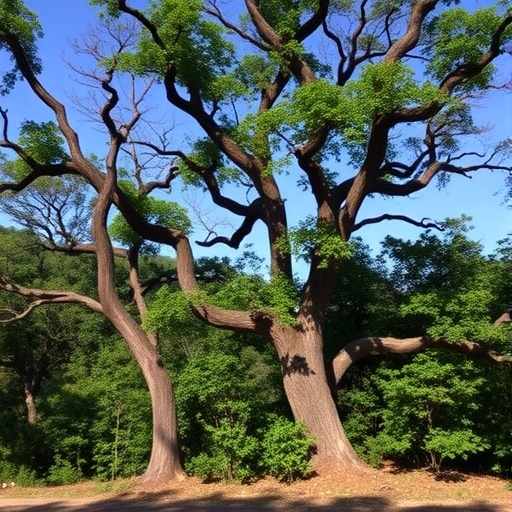
In a groundbreaking study published in the prestigious Proceedings of the National Academy of Sciences (PNAS), researchers have uncovered pivotal insights into the extraordinary biodiversity of oak trees in the mountainous regions of Mexico and Central America. This extensive investigation, led by University of Chicago Ph.D. candidate Kieran Althaus in collaboration with The Morton Arboretum and several American and Mexican institutions, reveals the evolutionary mechanisms that fueled the rapid diversification of oaks in this unique biogeographic hotspot. Their findings shed light on the complex interplay between geographical topography, climatic adaptability, and evolutionary biology, providing a comprehensive framework to understand how mountain ecosystems serve as crucibles for biological innovation on a global scale.
Oaks (genus Quercus) represent a foundational group of tree species and play a vital ecological role in forest ecosystems worldwide. The current study leverages an unprecedented dataset encompassing genetic, morphological, and ecological characteristics from 322 of the approximately 450 known oak species worldwide. Through detailed phylogenetic analyses and fossil-calibrated molecular clock models, the researchers reconstructed the evolutionary timeline of oak diversification with remarkable precision. Their data pinpoint the colonization of the rugged terrains of Mexico and Central America by two primary oak lineages — the red oaks and the white oaks — approximately 25 million years ago during the Oligocene epoch.
This dual invasion into high-elevation habitats marks a critical evolutionary juncture. Upon encountering the complex and varied montane topography, these oak groups independently but concurrently diversified along parallel evolutionary pathways. This convergence resulted in an explosion of speciation events, enhancing species richness to levels unparalleled in any other region globally. Today, Mexico and Central America host around 160 distinct oak species, accounting for nearly 40 percent of the total global diversity of the genus. Such expansive speciation illustrates how environmental heterogeneity, including factors like altitude gradients, microclimates, and soil heterogeneity, can drive accelerated diversification rates through ecological niche differentiation and adaptive radiation.
A key revelation of this study is the extraordinary evolutionary flexibility exhibited by oaks in adapting to diverse climatic regimes associated with mountainous regions. Oaks demonstrated rapid phenotypic and genetic shifts that enabled their survival and proliferation in novel and often harsh ecological environments. This behavioral plasticity, coupled with the complex terrain’s role in fostering isolation and genetic divergence through physical barriers, facilitated a dynamic evolutionary landscape. The study’s integrative approach underscores the importance of geospatial and climatic variables as principal engines of biodiversity generation, reinforcing mountain ecosystems’ status as biodiversity hotspots with significant conservation importance.
However, despite their ecological prominence, the study highlights a sobering conservation reality: more than 30 percent of the world’s oak species are currently threatened with extinction. Given their critical ecological roles in supporting diverse fungal, insect, avian, and mammalian communities, the decline of these keystone species could precipitate cascading effects throughout forest ecosystems. Moreover, oaks possess profound cultural significance for numerous indigenous groups throughout the region, underscoring the intertwined nature of biodiversity and human heritage. The loss of oak species thus represents not only a biological crisis but also a cultural and ecological dilemma.
The findings of this research carry profound implications for future forest management and conservation strategies. Dr. Socorro Gonzalez, a co-author and researcher at Centro Interdisciplinario de Investigación para el Desarrollo Integral Regional (CIIDIR), Instituto Politécnico Nacional, emphasizes that understanding the evolutionary mechanisms underpinning oak diversity enables more informed predictions about plant community responses to ongoing environmental changes. As climate change alters temperature regimes and precipitation patterns, the preservation of montane habitats that facilitate oak diversification becomes crucial for maintaining genetic resilience and ecosystem stability.
The research was facilitated by over fifteen years of meticulous fieldwork, botanical expeditions, and inter-institutional data sharing between American and Mexican scientists. This multinational collaboration highlights the indispensable role of cross-border scientific partnerships and mentorship programs in advancing biological research and fostering the next generation of conservation leaders. The study’s senior author, Dr. Andrew Hipp, Director of the Herbarium and Lead Scientist in Plant Systematics at The Morton Arboretum, remarks on the project’s significance in demonstrating the power of collaborative science to generate impactful evolutionary insights.
In addition to Kieran Althaus and Dr. Hipp, The Morton Arboretum team included Director of the Global Tree Conservation Program Dr. Silvia Alvarez-Clare and Plant Systematics Research Program Manager Marlene Hahn. Collaborators extended to researchers from world-renowned institutions such as Harvard University and Duke University, as well as key Mexican research centers including La Universidad Nacional Autónoma de México (UNAM) and Benemérita Universidad Autónoma de Puebla (BUAP). This multidisciplinary consortium provided comprehensive expertise in systematics, biogeography, and conservation biology, allowing a holistic and integrative approach to oak evolutionary studies.
A particularly compelling aspect of the study is its contribution to evolutionary theory by offering a clear example of parallel adaptive radiations in two distinct but related phylogenetic lineages within the same geographical context. This insight advances understanding of how similar environmental pressures can independently shape biodiversity within coexisting taxa. By disentangling these dynamics, the study not only enriches scientific knowledge of oak evolution but also informs broader discussions about speciation processes in variable and fragmented landscapes.
The comprehensive methodology employed integrates molecular phylogenetics, paleobotanical data, and advanced geospatial modeling. By cross-validating molecular clocks with fossil records, the research offers rigorous temporal frameworks that contextualize the timing of diversification events relative to geological and climatic shifts in the region. Such precision allows for linking speciation patterns to specific environmental changes, including mountain uplift and climate oscillations, breaking new ground in evolutionary ecology and biogeography.
Given the pressing threats posed by habitat loss, climate change, and human encroachment, the study reinforces the urgent need to implement targeted conservation measures aimed at protecting montane oak ecosystems. These efforts should prioritize safeguarding habitat heterogeneity and maintaining connectivity between oak populations to preserve the evolutionary processes critical to biodiversity maintenance. Furthermore, incorporating indigenous knowledge and community engagement in conservation frameworks will be essential for achieving sustainable stewardship of these irreplaceable natural resources.
Ultimately, the landmark findings presented by Althaus and colleagues underscore the significance of mountainous regions in shaping biodiversity patterns and evolutionary trajectories. Their work exemplifies how the integration of cutting-edge molecular techniques with extensive field data can unravel the complex history of life on Earth. As global biodiversity faces unprecedented threats, such research not only illuminates past evolutionary successes but also guides future efforts to conserve the intricate web of life sustained by species such as oaks in Mexico and Central America.
Subject of Research: Evolutionary origins and diversification of oak species in Mexico and Central America
Article Title: Timing and origins of Mexican and Central American oak diversity
News Publication Date: 4-May-2026
Web References:
10.1073/pnas.2537040123
Image Credits: The Morton Arboretum
Keywords: Evolution, Biodiversity, Trees, Endangered species, Native species, Geographic regions, Forest ecosystems, Habitat diversity, Species diversity, Species richness, Plants, Ecosystems
Tags: biogeographic hotspots for treesclimatic adaptability of oak treesecological role of oak forestsevolutionary biology of oaksfossil-calibrated plant evolutionmolecular clock in plant evolutionmountain forest ecosystemsoak species diversificationoak tree biodiversity in Mexicooak tree species in Central Americaphylogenetic studies of oaksQuercus genetic analysis