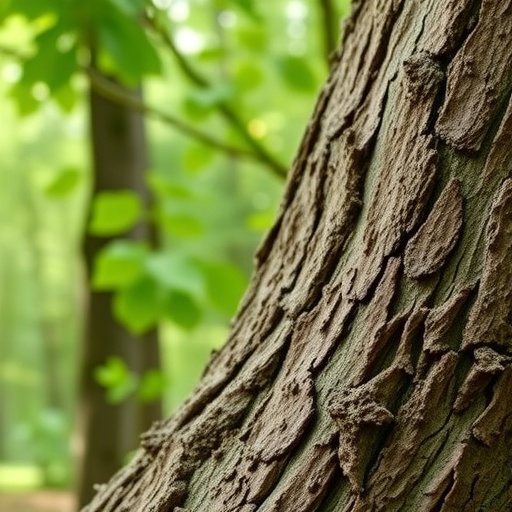
In a groundbreaking development that could revolutionize environmental remediation, researchers at RMIT University have unveiled a novel method to transform eucalyptus bark — a traditionally discarded forestry by-product — into an advanced microporous carbon material with exceptional pollutant-capturing capabilities. This transformation unlocks new potential for sustainable, cost-effective filtration technologies addressing polluted water, contaminated air, and atmospheric carbon dioxide.
Typically regarded as waste, eucalyptus bark is abundant yet underutilized. However, RMIT’s research team discovered that applying a straightforward, one-step chemical activation process surprisingly yields a highly porous carbon structure optimized for adsorptive performance. This process contrasts with conventional multi-stage approaches common to porous carbon synthesis, which often entail high energy consumption and complex manufacturing setups. By simplifying the production pathway, the team’s technique significantly lowers barriers to scaling this eco-friendly material for real-world applications.
What makes porous carbons indispensable in environmental technology is their intricate micro- and mesoporous architecture. The labyrinth of pores acts like a molecular sieve, entrapping impurities suspended in fluids or gases. This feature has long been exploited in water purification and air filtration systems worldwide. Yet, the choice of precursor biomass remains critical in balancing cost, sustainability, and filter efficiency. Eucalyptus bark now emerges as a promising candidate due to its natural abundance and compatibility with streamlined processing.
PhD researcher Pallavi Saini, leading much of the experimental work, emphasized the unexpected efficacy of eucalyptus bark-derived carbons. Despite the feedstock’s low perceived value in forestry cycles, the processed material demonstrated remarkable adsorption capabilities comparable to, if not exceeding, more conventionally sourced carbons. The research highlights profound opportunities to repurpose overlooked biomass residue into cutting-edge environmental materials.
The simplicity of the activation method deployed involves a single-step chemical treatment that opens up the carbon’s pore spaces extensively without necessitating subsequent complex steps such as templating or multi-stage carbonization. This approach enhances economic viability and aligns with circular economy ideals by converting waste into high-value filtration media. Such efficiencies are particularly pertinent in regions where infrastructure and energy resources constrain conventional industrial-scale production.
Eucalyptus bark’s suitability goes beyond logistical factors. Australia, home to over 900 species of eucalypts, offers researchers a diverse botanical library to explore species-specific chemical compositions and structural nuances that may optimize carbon porosity further. Collaborative plans with Indigenous communities aim to harness traditional ecological knowledge, guiding the selection of species that naturally exhibit desirable traits for carbon activation, enhancing performance while preserving cultural respect and sustainability.
The engineered porous carbon materials exhibit high surface area and microporosity critical for adsorption of small molecules like carbon dioxide. This quality positions them not only as powerful water and air filter components but also as candidates for carbon capture technologies — systems designed to mitigate greenhouse gas emissions from industrial sources. The regenerative potential of these carbons through repeated cycles of adsorption and desorption further adds to their attractiveness as sustainable materials.
Practical deployment scenarios extend from point-of-use filtration in remote communities with limited access to centralized water treatment, to large-scale industrial gas scrubbing and purification. The team underscores that while initial laboratory results are promising, comprehensive assessments of long-term durability, regeneration efficiency, and scalability remain essential before widespread commercialization. Nonetheless, the research direction signals a paradigm shift in tackling environmental pollution via agro-industrial waste valorization.
Distinguished Professor Suresh Bhargava AM highlights the work as emblematic of innovative circular economy solutions that simultaneously reduce waste and address pressing environmental challenges. This synergy between material science innovation and ecological stewardship fosters inspiring pathways toward cleaner water, cleaner air, and carbon neutrality goals. At the Centre for Advanced Materials Innovation and Circularity (CAMIC), the approach also serves as a training ground for emerging researchers, ensuring the continuity of purpose-driven scientific inquiry.
The publication of these findings in the international journal Biomass and Bioenergy consolidates their contribution to the field of sustainable materials science. Future endeavors aim to integrate in-depth physicochemical characterizations with ecological insights, refining the carbon activation process, and unlocking the full spectrum of eucalyptus bark’s potential as a versatile environmental asset. This cross-disciplinary initiative exemplifies the fusion of traditional knowledge with modern research methodologies.
In conclusion, RMIT’s transformative eucalyptus bark porous carbon not only exemplifies innovative reuse of natural waste streams but also offers practical, scalable solutions for managing environmental contaminants. It bridges fundamental research and application, presenting a replicable template for converting other biomass residues worldwide into effective pollutant filtration resources. As regulatory and social pressures mount to improve environmental quality and reduce carbon footprints, such bio-based porous carbons may very well become integral components in global sustainability strategies.
Subject of Research: Not applicable
Article Title: Sustainable valorisation of eucalyptus bark waste into microporous carbon materials for efficient CO2 capture
News Publication Date: 10-Mar-2026
Web References: http://dx.doi.org/10.1016/j.biombioe.2026.109242
References: Sustainable valorisation of eucalyptus bark waste into microporous carbon materials for efficient CO2 capture, Biomass and Bioenergy, DOI: 10.1016/j.biombioe.2026.109242
Image Credits: Will Wright, RMIT University
Keywords
Eucalyptus bark, porous carbon, adsorption, water purification, air filtration, carbon capture, biomass valorization, sustainable materials, circular economy, environmental technology, activation process, pollutant removal
Tags: air pollution control technologybiomass-derived porous carboncarbon capture from airchemical activation of biomasseco-friendly filtration mediaenvironmental remediation innovationseucalyptus bark water purificationforestry waste valorizationlow-cost water purification filtersmicroporous carbon filtrationporous carbon for pollutant removalsustainable water treatment materials