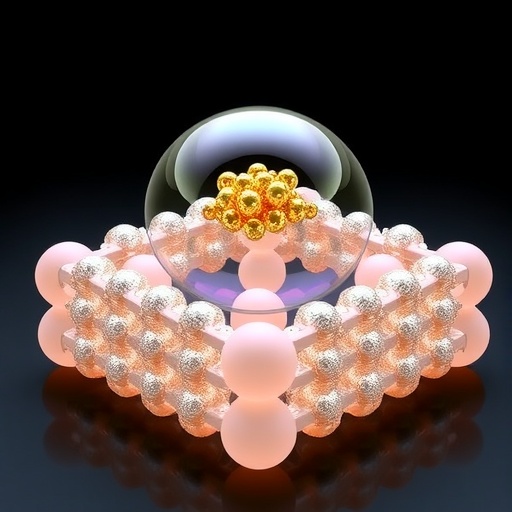
In a groundbreaking study emerging from the laboratories of Tohoku University, researchers have unveiled a counterintuitive principle governing the efficiency of nanoscale chemical reactions. Published in the Chemical Engineering Journal on April 6, 2026, this research challenges the long-held assumption that maximizing reactant access to catalytic sites unequivocally leads to the fastest reaction rates. Instead, the team demonstrated that a slight restriction in reactant transport to hollow nanoreactors can significantly boost their catalytic performance by harmonizing mass transport with intrinsic reaction kinetics.
Nanoreactors are ingeniously engineered structures that encapsulate catalytic nanoparticles within hollow, porous shells. These nanoscale reactors provide a confined environment that mimics, on a drastically reduced scale, the conditions of large industrial reactors but with precise control over reaction parameters. The porous shell modulates the diffusion and transport of reactants into the inner cavity, where catalytically active nanoparticles reside and chemical transformations occur. This unique configuration offers opportunities to tailor reactions that are otherwise challenging or inefficient in bulk systems.
Conventional wisdom suggests that allowing reactant molecules to flood the catalytic interior as rapidly as possible would maximize reaction rates. However, the Tohoku University research team has flipped this notion on its head by showing that when reactant inflow is finely tuned—not maximized—the nanoreactor’s overall efficiency improves. This balanced approach ensures the reaction does not become bottlenecked by either limited reactant availability or overwhelmed catalytic sites.
Tom Welling, the lead scientist on the project, elaborates on the nuanced interplay uncovered: “Chemical reactions are often simplified to a supply-and-demand model where more reactants mean more product, faster. Our findings reveal a more subtle dynamic in nanoscale reactors. When the supply of molecules aligns with the processing capacity of catalyst nanoparticles, the system operates at optimal efficiency.” This principle mirrors traffic flow dynamics, where excessive vehicles on roads can lead to congestion, slowing overall movement.
Indeed, Kanako Watanabe, a co-author of the study, draws a compelling analogy between nanoreactor function and urban transportation: “Think of reactant molecules as cars and catalytic active sites as traffic lights. Without regulation, vehicles crowd the intersection, causing gridlock. But if vehicle flow is moderated, the lights cycle smoothly, allowing continuous flow.” By managing transport restrictions, catalytic sites avoid saturation and downtime, maintaining a steady pace of chemical turnover.
The heart of the discovery lies in matching two traditionally competing processes: mass transport through the porous shell, and reaction kinetics at the nanoparticle surfaces. Optimizing either in isolation risks inefficiency—too rapid transport can cause site saturation, while insufficient transport leads to underused catalytic capacity. By designing shells with precise permeability that balances these rates, researchers unlock enhanced reaction control and catalytic productivity.
This insight extends far beyond the specific nanoreactor model utilized in the study. It offers a fresh design blueprint for the next generation of catalytic materials and chemical reactors. Tailoring porous shell structures to fine-tune molecular traffic promises reduced consumption of precious metals while elevating catalytic turnover. This synergy is critical in industrial applications seeking to balance cost, performance, and sustainability.
From an engineering perspective, the fabrication of hollow-structured nanoreactors demands meticulous control over morphology and pore architecture. Advances in nanoscale material synthesis, such as templating methods and controlled shell deposition, enable creation of shells with tunable porosity and thickness. Integrating these controlled transport properties with active catalytic cores is key to realizing the performance gains observed.
Fundamentally, this study emphasizes the necessity of viewing catalytic reaction environments as integrated systems where transport phenomena and chemical kinetics coalesce. The often-overlooked role of constrained molecular access can actually serve as an enabling factor rather than a handicap. Embracing this paradigm sets a precedent for exploiting confinement effects and spatial organization at the nanoscale.
The practical implications are far-reaching. Chemical industries reliant on catalysts for synthesis, energy conversion, and environmental remediation could adopt these principles to engineer more efficient reactors. The approach heralds a move away from brute-force maximization strategies toward smarter, system-level optimization. This not only streamlines resource use but may unlock chemical pathways previously inaccessible due to kinetic or transport limitations.
Moreover, the nanoreactor concept itself raises exciting possibilities for integrating multifunctionality. By carefully designing shells that selectively permit reactants or intermediates, it might be feasible to orchestrate multistep reactions within single nanoscale units. This ‘reaction choreography’ could revolutionize processes like pharmaceutical synthesis, where precision and yield are paramount.
Beyond catalysis, insights from this study resonate with broader disciplines concerned with transport and reaction coupling, including membrane science, sensor technology, and biochemical engineering. The principle that controlled restriction can enhance performance challenges entrenched norms and invites renewed inquiry into spatial and temporal reaction regulation.
This work by Tohoku University researchers elucidates a fundamental yet subtle aspect of nanoscale chemical engineering. By proving that “more” is not always synonymous with “better” in catalyst-reactant interactions, it inspires a shift towards elegance—where measured moderation unlocks superior efficiency. As the field advances, embracing such counterintuitive insights will be vital for the development of next-generation materials and technologies that balance complexity with control.
Subject of Research: Nanoreactor design and catalytic efficiency through balancing mass transport and reaction kinetics.
Article Title: Designing hollow-structured nanoreactors for effective use of catalytic nanoparticles by balancing mass transport and reaction kinetics.
News Publication Date: April 6, 2026.
Web References: http://dx.doi.org/10.1016/j.cej.2026.175913
Image Credits: Hana Aizawa et al.
Keywords
Catalysis, Catalytic efficiency, Chemical reactors, Mass transport, Kinetics, Chemistry
Tags: catalytic nanoparticle encapsulationconfined nanoscale reactor environmentenhanced chemical reaction efficiencyharmonizing transport and reaction ratesinnovative catalytic reactor engineeringmass transport in nanoreactorsnanoreactor designnanoscale catalysis optimizationnanoscale chemical transformation controlporous shell diffusion modulationreaction kinetics controlTohoku University catalysis research