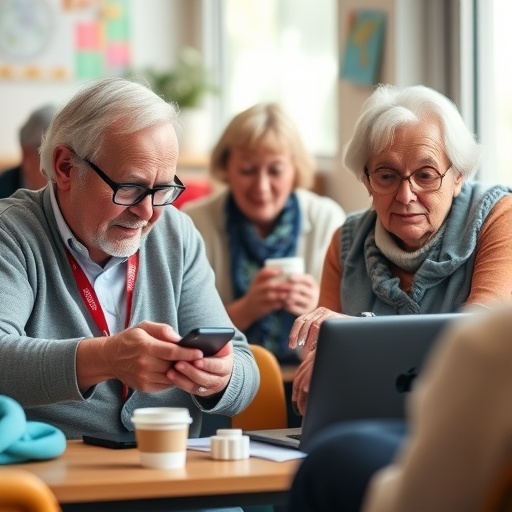
In an era where digital technology shapes every aspect of modern life, empowering older adults to harness these innovations for health management is a growing priority. The groundbreaking study by Liu, Luo, Pang, and colleagues, published in BMC Geriatrics in 2026, dives deeply into this challenge by exploring the education of older adults in technology use within social contexts. This research not only sheds light on the barriers and facilitators faced by senior citizens but also highlights the critical role played by community workers who aid in this educational process.
As societies worldwide grapple with aging populations, the effective use of digital health technologies presents both opportunities and complexities. Older adults often find themselves at a technological crossroads, where the potential benefits of wearable health monitors, telemedicine, health apps, and online medical records confront a steep learning curve and entrenched digital divides. The study by Liu et al. tackles this issue head-on, centering on a comprehensive approach that includes the social dynamics impacting technology adoption.
The researchers adopted qualitative methodologies involving interviews and focus groups, gathering firsthand narratives from older adults together with community workers engaged in educational programs. This dual-perspective approach uncovers nuanced insights, revealing that technology education cannot be decoupled from social interaction. Older adults express a desire to learn that is not only about mastering devices but also about feeling supported in communal settings to overcome anxiety, frustration, and skepticism toward new tools.
Importantly, the study identifies social settings as critical arenas for educational interventions. These spaces—community centers, senior clubs, and local health workshops—are not merely venues but act as facilitators of peer support and collaborative learning. The presence of community workers, who provide empathetic guidance and bridge generational gaps, is pinpointed as a cornerstone of successful technology adoption. Their role extends beyond instruction to include emotional encouragement and fostering a sense of communal achievement.
From a technical standpoint, the study emphasizes the need for technology platforms to be designed following principles of accessibility and user-centeredness for older adults. Features like simplified interfaces, clear visual cues, voice-assisted commands, and interoperability between devices can dramatically lower the threshold of entry for this demographic. The researchers advocate a paradigm shift in designing digital health tools, intertwining technological sophistication with human factors engineering specifically tailored for an aging population.
This research also probes the psychological dimensions underpinning technology adoption. Fear of incompetence, concerns about privacy, and lack of trust in digital systems are potent inhibitors. The community workers’ insights reveal strategies to mitigate these challenges, such as creating low-pressure learning environments, ensuring transparent privacy policies, and offering continuous post-training support. The iterative process of learning is portrayed not as a one-off event but a sustained engagement requiring patience and adaptability.
Crucially, the study underscores the value of culturally sensitive educational content. Since older adults hail from diverse background demographics with varying degrees of prior technology exposure, community-based programs must be flexible and attuned to these differences. Incorporating familiar contexts, vernacular language, and relatable examples enhances comprehension and motivation. Moreover, intergenerational learning approaches, where younger volunteers assist older learners, are heralded as innovative solutions for bridging technology gaps.
The implications of these findings are far-reaching. At a health systems level, adopting community-driven educational models can reduce hospital visits and improve chronic disease management by empowering older adults to monitor vital signs, adhere to medication schedules, and engage in teleconsultations effectively. This proactive engagement can reduce healthcare costs and improve quality of life, illustrating a blend of social innovation and technological progress.
The study’s authors call for policymakers to recognize the indispensable role of community workers and allocate resources that reinforce grassroots educational frameworks. Funding technical training for these facilitators, developing standardized curricula, and fostering partnerships between healthcare providers and community organizations are among the prioritized recommendations. Such systemic support is crucial to scaling up interventions proven effective through the research.
In light of the rapid digital transformation accelerated by global events, particularly the COVID-19 pandemic that highlighted disparities in digital health access, research like this is especially timely. It serves as a clarion call to pivot from viewing older adults as passive recipients of technology to active learners capable of mastering complex systems when adequately supported.
Technical innovation alone cannot achieve widespread adoption without equally robust educational infrastructures. Liu and colleagues’ work illustrates that the future of digital health lies in integrating social sciences with technology design, ensuring devices meet real human needs informed by empathy and social connectivity.
This study sets a new agenda for interdisciplinary collaboration among gerontologists, engineers, social workers, and policymakers. By weaving together perspectives from technology, education, and social support, it charts a comprehensive strategy to confront the digital divide in healthcare, advocating a future in which older adults confidently engage with digital tools to enhance their autonomy and well-being.
As we advance towards increasingly sophisticated health management systems reliant on artificial intelligence, remote monitoring, and big data analytics, the fundamental principle remains clear: inclusivity must be foundational. This research reinforces that inclusivity demands not only technical accessibility but also meaningful human support frameworks that empower older adults to thrive in a connected world.
These findings invite continued exploration into scalable models that combine technological innovation with community engagement, ensuring no demographic is left behind in the digital revolution of healthcare. Building on this foundation, future studies can explore longitudinal impacts, cost-effectiveness analyses, and integration of emerging technologies in enhancing educational interventions for older populations.
Ultimately, the research conducted by Liu, Luo, Pang, and their team serves as a beacon illuminating the path to an equitable, inclusive digital health ecosystem. Their work highlights that empowering older adults through education in social settings is not merely about technology transfer—it is about fostering dignity, independence, and communal support at the intersection of aging and innovation.
Subject of Research:
Educating older adults in technology usage for health management within social contexts.
Article Title:
Educating older adults to use technologies for health management in social settings: perspectives of older adults and community workers.
Article References:
Liu, T., Luo, Y., Pang, P. et al. Educating older adults to use technologies for health management in social settings: perspectives of older adults and community workers. BMC Geriatr (2026). https://doi.org/10.1186/s12877-026-07495-7
Image Credits: AI Generated
Tags: community-based tech educationdigital divide among older populationsdigital health literacy for seniorshealth app training for elderlyimproving health outcomes with technologyqualitative research on senior tech userole of community workers in tech educationsocial dynamics of technology adoption in agingteaching technology to older adultstechnology adoption barriers in elderlytelemedicine use in older adultswearable health monitors for seniors