In the year 2000, the United States celebrated a monumental public health victory: the official elimination of measles within its borders. This milestone was not only a testament to the power of vaccination programs but also a beacon of hope for infectious disease control worldwide. To preserve this accomplishment, the Centers for Disease Control and Prevention (CDC) established a stringent set of seven indicators designed to maintain the country’s measles elimination status. These indicators served as a scientific framework ensuring that measles cases remained sporadic, linked chiefly to travel-related importations, and prevented sustained community transmission.
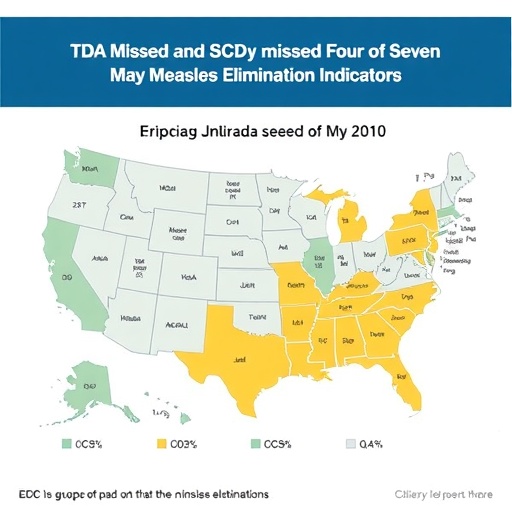
However, recent research spearheaded by a team at Boston Children’s Hospital reveals a deeply troubling development. Using the CDC’s own criteria, the team conducted a thorough analysis of measles trends from January 2025 to early 2026 and found the United States falling short on four of the seven indicators, while the remaining three indicators teeter precariously on the edge of compromise. Their groundbreaking findings, now published in the prestigious journal The Lancet, sound an alarm about the resurgence of a disease long thought vanquished.
The research, led by Dr. Maimuna Majumder, PhD, an expert in computational health informatics, alongside pediatrician and national science fellow Dr. Anne Bischops, examined the latest epidemiological data encompassing the number of reported measles cases, outbreak sizes, transmission dynamics, and viral lineage diversification. Analyses of these parameters indicate a stark divergence from elimination criteria, suggesting that measles has shifted from an imported threat to a domestically sustained contagion, spreading continuously across the country for over a year.
Beginning with an outbreak in Texas in January 2025, measles cases have since peppered 45 states, manifesting an alarming amplification in both geographical reach and case counts. The US had previously secured full certification of elimination in 2011, reflecting an epidemiological landscape where transmission chains were brief, case numbers minimal, and the majority of infections traceable to importation events. The current situation, however, reveals a degradation of these benchmarks, indicating an epidemiological regression with profound public health implications.
Quantitatively, the US has surpassed the threshold of measles occurrence, recording approximately 93 cases per 10 million people by early 2026—far exceeding the CDC’s criterion of less than one case per 10 million. This figure underscores the widespread nature of the outbreaks relative to population size and sharply contrasts with the low-level incidence expected in an elimination context. Furthermore, only a small minority of cases—about 6 to 7 percent—trace back to international sources, evidencing that internal transmission dynamics now principally fuel the resurgence.
Outbreak magnitude adds another layer of concern. The CDC’s elimination indicators call for no more than four outbreaks annually, each limited to roughly six cases. Yet, the US experienced 48 outbreaks last year culminating in over 2,000 cases, and by early 2026 had already seen 19 outbreaks resulting in more than 1,600 cases. Such widespread cluster formations reflect an unchecked transmission milieu wherein the virus no longer fizzles out quickly but propagates via continuous chains of infection.
A critical epidemiological parameter—the effective reproductive number (R)—has also breached safe thresholds. This value represents the average number of secondary infections generated by a single infectious person. To maintain elimination, the R value should remain below one, signifying that measles transmission is in decline. Distressingly, data indicate that this critical value has risen above one more than 75 percent of the time since the resurgence began, allowing sustained and expanding transmission networks.
Scientifically, these quantitative violations of elimination benchmarks illuminate broader underlying issues, most notably declining vaccination coverage. Herd immunity for measles demands that approximately 95 percent of the population receive two doses of the measles-containing vaccine, commonly administered as part of the MMR regimen. Recent surveys suggest this gold-standard immunity threshold is unmet nationally, with kindergarten vaccination rates averaging 92 percent in the 2024-2025 school year. Variability among states exacerbates the problem; Texas records notably lower coverage rates, ranging from 79 to 90 percent, creating pockets of vulnerability ripe for viral spread.
The genetic epidemiology of circulating measles strains further corroborates the loss of elimination status. Instead of multiple unrelated viral strains indicating isolated importations, genetic sequencing reveals that most cases share a common viral lineage. This homogeneity signals ongoing transmission within interconnected chains rather than sporadic introductions, emphasizing the virus’s insidious persistence in the US population.
Beyond the statistical bounds, the clinical and societal implications are profound and multifaceted. Measles, once considered a standard childhood infection, is now recognized as having pernicious long-term effects, including immune system suppression that can last months to years post-infection. Vulnerable populations, especially infants under one year of age who cannot be vaccinated, face heightened risk of severe complications such as pneumonia, encephalitis, and death. The unfolding outbreaks represent a dire threat to these groups, with full health consequences likely to unfold years into the future.
The timing of this reemergence is particularly inauspicious as it precedes a critical Pan American Health Organization (PAHO) expert panel meeting scheduled for November 2026. This panel will reevaluate the United States’ official measles elimination status, and the new evidence detailed by Boston Children’s researchers provides a crucial early warning. Should the US lose its status, it may face renewed scrutiny, increased public health interventions, and a need for comprehensive vaccination campaigns to regain ground.
Collectively, these findings underscore an urgent call to action for public health authorities, healthcare providers, and communities nationwide. They highlight that decades of progress can be rapidly undermined in the absence of sustained immunization efforts and vigilance. As Dr. Bischops warns, declining vaccination rates already signaled potential resurgence, but losing elimination status will be a concrete marker of a public health failure with far-reaching consequences.
From a research perspective, this situation provides a valuable case study in epidemiological surveillance, vaccination policy impact, and viral transmission dynamics in high-income settings. It also emphasizes the critical role of data-driven public health strategies underpinned by computational analytics, genetic sequencing, and frontline clinical reporting. The integration of these tools offers the best defense against the reestablishment of endemic measles transmission.
In conclusion, the resurgence of measles in the United States represents a stark reminder of the tenuous nature of infectious disease control. Despite prior triumphs, measles remains a persistent foe capable of exploiting gaps in vaccination coverage and public health infrastructure. Sustained commitment to high vaccination rates, robust outbreak response, and continuous surveillance will be pivotal to safeguarding the gains of the past quarter-century and protecting future generations from this potentially devastating disease.
Subject of Research: Measles incidence and elimination status in the United States
Article Title: Will the USA lose its measles elimination status?
News Publication Date: 30-Apr-2026
Web References: https://www.thelancet.com/journals/lancet/article/PIIS0140-6736(26)00466-6/fulltext
Keywords: Measles, Viral infections, Vaccination, Public health, Disease outbreaks, Infectious diseases
Tags: Boston Children’s Hospital measles studyCDC measles surveillancecomputational health informatics in epidemiologyinfectious disease control in the USmeasles elimination indicatorsmeasles importation casesmeasles outbreak prevention strategiesmeasles vaccination programs effectivenesspublic health milestone measlessustained community transmission measlesThe Lancet infectious disease researchUS measles resurgence 2025